Roath Lock - facts and figures
The iconic BBC Roath Lock Studios in Cardiff Bay celebrates its fifth birthday this month.
Published: 20 March 2017
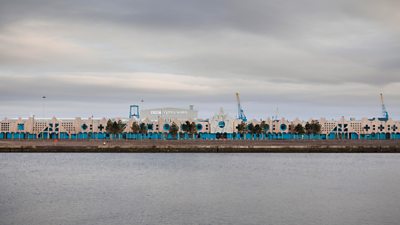
- Roath Lock was built in record time, work began in June 2010 and 14 months later, in August 2011, Casualty became the first inhabitants of Roath Lock.
- Roath Lock is a purpose built 175,000 square foot facility.
- Roath Lock is equivalent in size to three football pitches.
- There are nine studios in Roath Lock.
- When all three productions (Pobol y Cwm, Casualty and Doctor Who) are filming, there are approximately 500 people working in Roath Lock.
- There are approximately 15,500 prop items in Roath Lock.
- The building was made to have as little environmental impact as possible so all lavatories are flushed using rainwater. In 2012 Roath Lock was announced as the first ever UK building to achieve BREEAM Outstanding certification for an industrial building post-construction, and the largest building in Wales to achieve BREEAM Outstanding.
- Roath Lock is and has been home to flagship dramas.
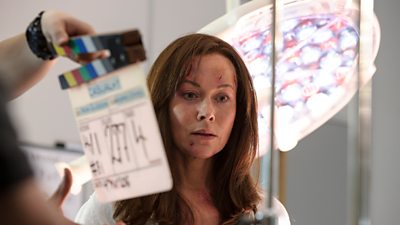
Programmes filmed in Roath Lock (part or all)
- Casualty
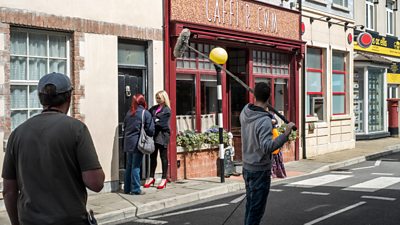
- Pobol y Cwm
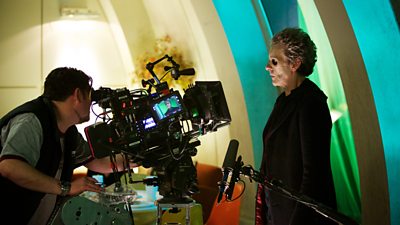
- Doctor Who
- Class
- A Midsummer Night’s Dream
- Wizards Vs Aliens
- Under Milk Wood
- An Adventure In Space And Time
- Upstairs, Downstairs
Productions produced by BBC Wales in Roath Lock
- To Walk Invisible
- Sherlock
- The Green Hollow
- The Living And The Dead
- War And Peace
- The Game
- Atlantis
- Passing Bells
- A Poet In New York
- Being Human
- Merlin
Doctor Who
- Doctor Who will celebrate its 53rd anniversary on November 16 2017.
- Doctor Who has filmed 46 episodes in Roath Lock.
- One episode of Doctor Who takes an average of three weeks to film.
- Doctor Who’s studio in Roath Lock is 11,500 square foot. It has housed the UK’s biggest green screen.
- Doctor Who production moved to Roath Lock in early 2012, but nine of the 13 official Doctors have filmed at the production centre: Tom Baker, Peter Davison, Colin Baker, Sylvester McCoy, Paul McGann, David Tennant, Matt Smith, John Hurt and Peter Capaldi.
- A corridor connecting several Doctor Who studios at Roath Lock has been affectionately named Russell’s Alley, after Russell T Davies who brought Doctor Who back in 2005.
Casualty
- One episode of Casualty takes two weeks to film. Episodes are filmed concurrently.
- By the end of Series 31, approximately 251 episodes of Casualty will have been filmed in Roath Lock.
- Medical experts read all Casualty scripts to ensure they are as correct and true to life as possible.
- There are medical advisors on set who advise and instruct Casualty cast members how to accurately use medical equipment.
- Many Casualty cast members shadow real doctors and nurses in A&E to prepare for their roles.
- Casualty uses between 15 to 20 types of fake blood, from various suppliers. All blood has been camera tested so that they are the right colour red, from arterial, scab, venous, clotted, dried etc... Most are edible as they’re made from sugar.
- The amount of fake blood used for each episode of Casualty varies from a small amount to a few pints.
- The only red which is seen and used on Casualty is the blood and the red emergency phone in reception.
Pobol y Cwm
Since opening its doors, Roath Lock – which has nine studios, three external filming lots, post-production facilities and office space - has not just had an impact on TV screens. Since 2012, it has initiated 52 apprentices at the site – in roles such as production, costume, editing, post production and rigging –with 75% now working in the creative industries.
Ben Davenport, 21 is one of those apprentices. Originally from Rhosllanerchrugog near Wrexham, Ben was studying at his local college when his teacher shared an email about BBC apprenticeships. He jumped at the chance and within five days of receiving confirmation that his application had been successful, he’d packed his bags and moved to Cardiff.
Ben says: “I was a script and production apprentice with Pobol y Cwm and the experience of working with the Production and Script Coordinators was fantastic. It really gave me an insight into working in television as well as a foot in the door. I didn’t want to follow my friends to University. I wanted to work and this scheme gave me that opportunity. I’d strongly encourage other young people who want to work in the creative industries to do the same.”
In July 2016, shortly before his apprenticeship came to an end, Ben successfully applied for a job as a runner on Pobol y Cwm. “I know it sounds like a cliché, but I genuinely love coming to work. The people I work with are great; professional and they’re happy to let me learn from them. That’s got to be a good thing.”
Reflecting on the past five years, Rhodri Talfan Davies, Director of BBC Cymru Wales says: "The teams at Roath Lock have been inspirational. They have storytelling in their souls - and they have made their mark locally and globally.
“Roath Lock is also playing such an important role developing a new generation of creative talents for the future. The BBC's award-winning apprenticeship scheme at Roath Lock is helping to develop the craft and production skills that will be essential to secure the long-term future of the sector in Wales.
"Over five years, Roath Lock has established itself as one of the most exciting production centres anywhere in the UK. But this is no time to be resting on our laurels. Roath Lock was only created because we dared to think big. That spirit of bold creativity and invention is essential if we're to continue to build on the centre's many successes over the coming years."
Mark Linsey, Director, BBC Studios says: “Roath Lock has been a success story for the BBC and BBC Studios. We make some of our most important drama from here, including the multi-award-winning Doctor Who and Casualty. We are always impressed by the facilities, which have helped rejuvenate the market, which is good for BBC Studios and the wider industry.”
Oliver Kent, the BBC’s Head of Continuing Drama is a former Series Producer for Casualty. He said: “The move to Roath Lock has been transformational for Casualty. The production space means we can film the 360 degree angles we always dreamt of which gives the audience a whole new experience. There’s also a really great collaborative spirit here; we share resources and that benefits us all, but most of all our loyal audience who tune in every Saturday evening.”
Casualty - a cornerstone of BBC One’s Saturday evening schedule - has recently celebrated its 30th birthday. It also topped the Best Drama category at this year’s National Television Awards.
NTW
- Pobol y Cwm films six weeks ahead of transmission.
- From discussions on the initial storylines to writing the final scripts ready for filming, the writing process takes between seven to nine months.
- 250 episodes of Pobol y Cwm are filmed every year (as opposed to 30 episodes in the 1970s and 1980s).
- Pobol y Cwm films approximately 16-18 scenes per day in studio, which is about 20 minutes of action and equivalent to approximately 80 pages of script per day, much higher than any other UK soap.
- Pobol y Cwm has two studios in Roath Lock; one studio has eight sets and the other has seven sets.
- More than half the lighting used on Pobol y Cwm is energy efficient, with more than 350 lights used in the studios.
Porth y Rhath - ffeithiau a ffigyrau
- Adeiladwyd Porth y Rhath mewn amser byr; dechreuodd y gwaith ym mis Mehefin 2010, ac 14 mis yn ddiweddarach, yn Awst 2011, symudodd Casualty i mewn.
- Mae Porth y Rhath yn gyfleuster pwrpasol sy’n 175,000 metr sgwâr.
- Mae Porth y Rhath yr un faint â thri chae pêl-droed.
- Mae 9 stiwdio ym Mhorth y Rhath.
- Pan mae’r tri cynhyrchiad (Pobol y Cwm, Casualty a Doctor Who) yn ffilmio, mae tua 500 o bobl yn gweithio ym Mhorth y Rhath.
- Mae tua 15,500 o eitemau propiau ym Mhorth y Rhath.
- Mae’r adeilad wedi cael ei greu i gael cyn lleied â phosib o effaith ar yr amgylchedd felly mae pob tŷ bach yn defnyddio dŵr glaw. Yn 2012 fe gyhoeddwyd mai Porth y Rhath oedd yr adeilad cyntaf yn DU i gael tystysgrif rhagorol BREEAM am adeilad diwydiannol yn dilyn adeiladu, a’r adeilad mwyaf yng Nghymru i gael BREEAM rhagorol.
- Mae Porth y Rhath yn gartref, ac wedi bod yn gartref, i ddramâu blaenllaw.
Rhaglenni sy'n cael eu ffilmio ym Mhorth y Rhath (yn llwyr neu’n rhannol)
Casualty
Pobol y Cwm
Doctor Who
Class
A Midsummer Night’s Dream
Wizards Vs Aliens
Under Milk Wood
An Adventure In Space And Time
Upstairs, Downstairs
Cynyrchiadau wedi eu cynhyrchu gan BBC Cymru ym Mhorth y Rhath
To Walk Invisible
Sherlock
The Green Hollow
The Living And The Dead
War And Peace
The Game
Atlantis
Passing Bells
A Poet In New York
Being Human
Merlin
Doctor Who (yn Gymraeg)
- Bydd Doctor Who yn dathlu ei 53fed pen-blwydd ar Dachwedd 16, 2017.
- Mae Doctor Who wedi ffilmio 46 o benodau ym Mhorth y Rhath.
- Mae’n cymryd 3 wythnos ar gyfartaledd i ffilmio un bennod o Doctor Who.
- Mae stiwdio Doctor Who ym Mhorth y Rhath yn 11,500 troedfedd sgwâr.
- Symudodd gwaith cynhyrchu Doctor Who i Borth y Rhath yn gynnar yn 2012, ond mae 9 o’r 13 Doctor swyddogol wedi ffilmio yn y ganolfan gynhyrchu: Tom Baker, Peter Davison, Colin Baker, Sylvester McCoy, Paul McGann, David Tennant, Matt Smith, John Hurt a Peter Capaldi.
- Mae coridor sy'n cysylltu nifer o stiwdios Doctor Who ym Mhorth y Rhath wedi cael ei alw’n Russell’s Alley, ar ôl Russell T Davies a ddaeth â Doctor Who yn ôl yn 2005.
Casualty (yn Gymraeg)
- Mae un bennod o Casualty yn cymryd pythefnos i'w ffilmio. Caiff y penodau eu ffilmio yr un pryd â’i gilydd.
- Erbyn diwedd Cyfres 31, bydd tua 251 o benodau o Casualty wedi cael eu ffilmio ym Mhorth y Rhath.
- Mae arbenigwyr meddygol yn darllen holl sgriptiau Casualty er mwyn gwneud yn siŵr eu bod yn gywir ac mor realistig â phosib.
- Mae yna gynghorwyr meddygol ar y set i gynghori a chyfarwyddo aelodau o gast Casualty sut i ddefnyddio cyfarpar meddygol yn gywir.
- Mae llawer o aelodau o gast Casualty yn treulio rhyw ddiwrnod neu ddau yn cysgodi meddygon a nyrsys go iawn mewn adrannau argyfwng.
- Mae Casualty yn defnyddio rhwng 15 ac 20 math o waed ffug, gan wahanol gyflenwyr. Mae’r holl waed yn addas ar gyfer y camera felly mae’r lliw coch cywir, megis lliw gwaed prif wythïen, crachen, wedi ceulo, wedi sychu ac ati ... Mae’r rhan fwyaf ohono’n fwytadwy gan mai o siwgr y caiff ei wneud.
- Mae faint o waed ffug a ddefnyddir ar gyfer pob pennod o Casualty yn amrywio o fymryn bach i rai peintiau.
- Gwaed a'r ffôn argyfwng coch yn y dderbynfa yw’r unig bethau coch a welir ac a ddefnyddir ar Casualty.
Pobol y Cwm (yn Gwmraeg)
- Mae Pobol y Cwm yn cael ei ffilmio chwe wythnos cyn ei darlledu.
- O’r trafodaethau ar fraslun y stori i ysgrifennu'r sgriptiau terfynol yn barod i'w ffilmio, mae’r broses ysgrifennu’n cymryd rhwng saith a naw mis.
- Mae 250 o benodau o Pobol y Cwm yn cael eu ffilmio bob blwyddyn (o gymharu â 30 pennod yn yr 1970au a’r 1980au).
- Mae Pobol y Cwm yn ffilmio tua 16-18 o olygfeydd yn y stiwdio bob dydd, sef tua 20 munud o ddigwydd sy'n cyfateb i ryw 80 tudalen o sgript bob dydd, sy’n llawer mwy nag unrhyw opera sebon arall ym Mhrydain.
- Mae gan Pobol y Cwm ddwy stiwdio ym Mhorth y Rhath; mae 8 set yn un stiwdio, a 7 set yn y llall.
- Mae mwy na hanner y goleuadau a ddefnyddir ar Pobol y Cwm yn rhai sy’n arbed ynni, a defnyddir mwy na 350 o oleuadau yn y stiwdios.