Interview with Sam Miller
Interview with Sam Miller, executive producer / director of Rellik
Published: 5 September 2017
I have been amazed by the effect of the rewind and the backwards storytelling and how you perceive that.
Sam Miller is the executive producer / director of Rellik
Can you tell us the general premise of Rellik?
The interesting thing about Rellik is that the storytelling goes from effect to cause, so you are constantly being taken back in a case, and trying to piece together what the relevant pieces are and how they are going to impact when it comes to the denouement. You have a structure where the first five hours are told literally in reverse order so you will go back three or four time jumps per hour. You’ll meet a character, see something happen to them and then you’ll go back in time and start to understand why that may have happened.
That has an immediate interest on a crime thriller level. It is very interesting because you start reading the clues in a reverse order, but it also has a bigger emotional sweep within the story because the lead character, played by Richard Dormer, has been badly damaged by an acid attack, and so what you come to realise is that you are also heading back to the moment that that happened to him.
It has a heavy psychological impact to every level of the storytelling, and the trick in editing is to keep the audience balanced between getting satisfied in terms of the trail of breadcrumbs they are following in a backwards direction, while also understanding this man and finding out more about his past and what he did to deserve this - or did he deserve it, and what happened. And then the final episode shuffles right back to the present and tells you what happens because of that.
Could you give us an insight into the genesis of the story and how this came about?
The Williams brothers, who wrote The Missing, are fascinated with the way time works and the impact of time. They came up with the story of Rellik thinking how cool it would be to tell a story in backwards fashion. It is very much hashed from the darkest recesses of their amazing imagination. It was an incredible feat to write it because it really defies a lot of the normal conventional storytelling; other things start to jump out and become more relevant.
Making the six episodes was a real journey into what that [reverse chronology] does. From the audience's point of view I think there's still a desire to read it forwards, even when they know it's going backwards. That has been a very interesting editing process: you have an audience who is quite wrong-footed at times and they get invested.
It has the potential to be quite a deep rewarding experience watching it, where things challenge you and wrestle you a bit and aren’t as you expected. It is a very exciting watch.
What were the most challenging aspects of filming?
The main challenge was how went about filming the piece. We felt it would be a dangerous exercise to reverse the order of filming and switch it around during the post production. It felt like cheating. We also felt we needed to be in control of how it was working in a backwards fashion.
Other challenges included the part of London we were portraying. The way that we showed the city was very particular. We somehow settled on a couple of streets out by Silvertown east of Canary Wharf as being the heart of the piece. There is something quite interesting and juxtaposed about that community, some of the new parts of the community do not match up with the old and big roads going through the centre.
Was there a conscious decision to ration information?
There is an argument for giving some of the story upfront to an audience to go, "ok this is the story so don’t worry about that just worry about how you experience it". Also there were certain things that in normal conventional storytelling that you would hold back and try to make it cooler. With this, we would be very loud about it and focus on the how rather than the what. It was about finding a way of holding the audience’s hand throughout, but at the same time scared them a little bit, challenge them and make them see it differently without pushing them off.
How do you decide which scene you reveal in reverse?
Jack and Harry had quite strong places where the story jumped, so we stuck to them as they felt right for us. It is important how you tell the audience that the time has stopped now, and we are going to take you back 11 hours or take you back six hours. We found a very strong visual motif for that which relates to what is around it.
Can you describe the relationship between Gabriel and Elaine?
Their relationship is at the centre of the story - how they work, what’s going on, who she is and who he is. Due to the structure of the piece they start off at the end of the affair and as you continue watching more is revealed how it came about and what is at stake. The nature of their relationship and how particularly poised that relationship is, right at the heart of the storytelling. You’ll have to watch it.
During the making of Rellik what has stood out or surprised you the most about the series?
I have been amazed by the effect of the rewind and the backwards storytelling and how you perceive that. It is not straightforward and it can effect you at different times, depending on how you approach the story. It feels to me it has opened up storytelling to reveal other things to the audience and make them more aware of other aspects as it is constantly challenging their understanding. So it can penetrate at times a little bit harder. That has to have been the main storytelling investigation which I have never done before.
In terms of the making of the piece I am always really excited to shoot London and I love how London appears in it. As a city it seems to get better and stronger and weirder and stranger. There was something extra in it for me due to the involvement, development and ongoing work I have on Luther. And this version of London feels like a more twisted, distorted, digitally weird world, a little bit further out than the Luther world. It has been interesting to just explore and push the city a little bit harder and go into another zone.
Is there any footage you shot that has since surprised you in a good way now in post edit?
You are constantly evaluating and your feelings about the way shots work and how things develop is ongoing in the edit. It is an ongoing process. We are finding some interesting ways to use music with this piece that in a more normal reality you wouldn’t do. We have this electronic artist called Clark who is scoring for us. It feels like a much larger playing area than normal, so we are really looking at a score that sits within the picture, that comments on the picture and has a dialogue with you rather than just an emotive engagement. It has surprised me how well that is working. It feels it is getting a very strong soundscape attached to it.
Were there any moments off camera that you will cherish?
I think you are always surprised and amazed by how versatile and committed the crew can be. Especially when you are doing long gruelling days, the weather is bad, people are working through the night and yet there is still a great sense of humour and people are still creating and coming up with solutions to problems. The camaraderie over a long period of time is intense. You are indebted to each other.
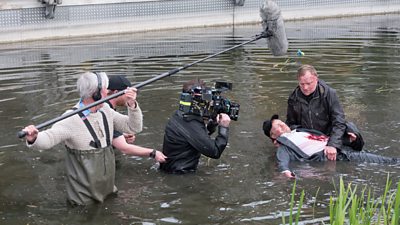
Pictured: Steven Mills (Michael Shaeffer), Gabriel (Richard Dormer) - behind the scenes
Character Biographies
DCI Gabriel Markham (Richard Dormer)
Confident, attractive and intelligent, Gabriel is a traditional alpha-male, until the moment his world comes crashing down in the aftermath of a brutal attack. A brave and highly commended police officer, Gabriel has a self-destructive streak that has led to years of drinking, drugs and womanising. Husband to Lisa and father to Hannah, he struggles to balance his family relationships with his work, as he resorts to more and more desperate measures in his obsessive hunt to track down a serial killer.
DI Elaine Shepard (Jodi Balfour)
Elaine’s natural intelligence, combined with her warmth and determined intensity, make her a skilled detective. Newly transferred to Gabriel’s team, the two of them have an undeniable connection, and as he starts to unravel over the course of the serial killer investigation, Elaine continues to support him, protecting him from the worst of himself. As the two of them struggle to balance their personal and professional relationships, it becomes increasingly apparent that she would do anything for Gabriel.
Lisa Markham (Lark Winther)
Lisa is warm, clever, and engaging. She fell in love with Gabriel the moment she met him and never had eyes for anyone else. She has huge inner reserves of strength and loyalty and knows that Gabriel has his demons, but is prepared to put her happiness to one side to hold onto him and keep him from sinking into self-destruction. However, Lisa holds close a secret that she’s been keeping from Gabriel for years, that when it emerges threatens to sink their marriage.
Hannah Markham (Shannon Tarbet)
Sixteen year-old Hannah is intelligent, observant and sensitive. She has a loving family and a happy home life and is particularly close to her father - almost in awe of him. Hannah is very caring, with a good heart and a sensible head on her shoulders. However, when her image of her perfect family is shattered, she’s left heart-broken and her desire to act out leads her into dangerous territory.
Christine Levison (Rosalind Eleazar)
Christine is an arch-manipulator with a disturbing skill for drilling straight to the heart of people’s weaknesses and using them to her advantage. After a damaged and abusive childhood, Christine became a coldly egotistical adult, desperate for attention and with a penchant for power games. Precociously intelligent, she bores easily and has problems with figures of authority. As a result, Christine is isolated from other people because she doesn’t consider anyone worthy of her intelligence. She relishes her therapy sessions with Isaac because she likes to think she’s too clever for any psychiatrist to understand, and as the case progresses and Gabriel becomes fixated on her as his prime suspect, she begins to enjoy tormenting him as well.
Isaac Taylor (Paterson Joseph)
A professional psychiatrist, Isaac uses his warm, calm, and collected demeanour to win the trust of his patients. He’s intelligent and extremely observant, but suffers from extreme OCD. Isaac has a lofty impression of his chosen profession that borders on a saviour complex - and believes that by delving into people’s dark pasts, he’s fixing them and making the world a better place. Through the series, Isaac is profoundly affected by the loss of his closest friend and partner in his practice, Jonas Borner, and as the serial killer case unravels, it is slowly revealed that this outwardly intelligent and sensitive man may be hiding darker depths to his own psyche by subsuming himself in the darkness of his patients.
Detective Superintendent Edward Benton (Ray Stevenson)
Bullish, domineering and arrogant, Benton is the chief of the police station. Originally close friends and partners with Gabriel, Benton started to drift away from him, as Gabriel descended further into self-destruction while Benton focused on climbing the ranks. Now Gabriel’s boss, the two of them often butt heads, but manage a working relationship of begrudging respect, while managing to fix the system where they can for their own gain. However, as secrets from each of their pasts begin to surface, their professional relationship, and their long-standing friendship comes under serious fire.
DI Martin Brook (Michael Wildman)
Quietly imposing, Martin is a reassuring presence in the station, particularly for Gabriel, who trusts him more than any of his other colleagues. He works hard and methodically, and he does things by the book, meaning that he finds some of Gabriel’s more unorthodox methods of policing uncomfortable to witness. Martin’s an ordinary guy - warm, caring and sensible - and finds some of the more gruesome parts of his job too much to deal with at points.
DI Mike Sutherland (Kieran Bew)
A straightforward, popular bloke, Mike is uncommunicative, unobservant and not keen on talking emotions, but he has a good heart nonetheless, and is trusted and respected by his colleagues and superiors. Mike is a natural leader, slightly domineering at times, and he doesn’t always have a lot of time for Gabriel and his preening masculinity. When a new and surprisingly romantic relationship within the station blossoms, it brings Mike a huge amount of joy, but he remains reluctant to make it public.
DS Jenny Roberts (Faye Castelow)
Chatty, perceptive and sharp, with a dry sense of humour, Jenny is hyper-organized with a lot of emotional intelligence. She is in a relationship with the station receptionist, Alex, and considers herself very much in love. As the series progresses, she throws herself into the search for the serial killer but is side-swiped by a surprising piece of news that will change her life forever.
DC Sam Myers (Joseph Macnab)
Young, cocky, and popular, Sam loves the team atmosphere of the station and enjoys playing the class clown, but sometimes his barbs hit too close to home. Despite most of the station enjoying his company, he can push the joke too far at times, which begins to alienate some of his colleagues. Inexperienced and naïve, Sam has a lot to learn about the world.
DC Andrea Reed (Mimi Ndiweni)
Andrea is intelligent, funny, and fun to be around. She works hard and loves her job, but ends up finding Sam difficult to deal with at times. Ultimately she’s a peacemaker and a pragmatist, who defuses situations and just wants to get on with the case in hand.
DC Asim Fry (Reece Ritchie)
Asim is a loyal and affectionate friend, emotionally tuned into the people around him. He is gay but doesn’t see his sexuality as something that should exclusively define him. Stubborn, and prone to moods, he doesn’t take any crap from colleagues, friends, or suspects.
Patrick Barker (Paul Rhys)
Outwardly smooth and charming, Patrick uses these qualities to mask a cold lack of empathy. A rich and successful management consultant by trade, he is an expert at assessing situations and acting to protect his own self-interest, as well as a master of rationalising even his most immoral acts. A consummate actor, his true character hard to pin down, but he is defined by a controlling attitude to all his relationships, especially within his family.
Sally (Tanya Reynolds)
An impressionable young woman, Sally is weak, spoiled and immature. She’s easily manipulated by the people around her, and her romantic delusions lead her to more and more desperate acts.
Steven Mills (Michael Shaeffer)
A seemingly unremarkable, middle-aged man, Steven Mills has spent his life struggling with schizophrenia, and treating it with medication. Despite the consequent paranoia and delusions that accompany his condition, he is a kind man who cares deeply for his wife and daughter. When he finds himself at the centre of the serial killer case, his life begins to unravel.
Beth Mills (Georgina Rich)
A warm, kind and loving mother, and a loyal wife to Steven, Beth is a strong and stable woman. However, she is understandably worried for the mental health of her husband as he appears to be deteriorating, as well as for the safety of their daughter.
Cassie Hughes (Charlie Blake)
Hannah Markham’s best friend, Cassie has an unhappy family life and is left to fend for herself most of the time. Growing up like this has made her spikey, rebellious and distrustful of authority, so Gabriel naturally worries that she’s a bad influence on his daughter. However, Cassie isn’t as street-smart as she pretends to be, and as things spiral out of hand she finds herself desperately out of her depth.