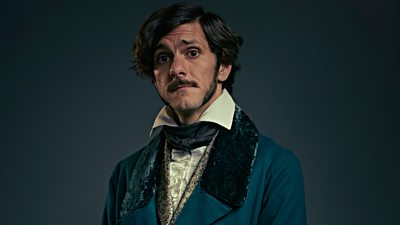
Mathew Baynton plays William Agar
Mathew Baynton plays William Agar in Quacks.
Published: 8 August 2017
Was it hard to get the balance between the authenticity and the comedy? No.The researched fact very often turns out to be madder than anything than you could think of anyway
You've been in talks about this role for a long time, haven’t you?
Yes. I was sent the script to audition for it before it was commissioned, maybe three or four years ago, and I absolutely loved it.
And it's a great cast...
It’s amazing. Another compliment you can pay the scripts is the people we’ve had coming in to play for a day or two. You don't often get people as brilliant as Andrew Scott, Miles Jupp - the list goes on, I can’t sit here and name them all - Jamie Demetriou as well, absolutely amazing people. I think that's because they read the scripts and they go, 'Yes, I’d do that, that sounds fun'.
And what did you love about the script?
I don’t know if I would say this directly to James, because I don’t want to inflate his ego too much, but I haven’t read a better script since. And you’re sent so much stuff, 90 percent of it has nothing new or different or challenging about it, or the quality of the writing is not great. But this had everything going for it.
He just writes dialogue so well. One of the things I love about it is the characters are always in the position where they are lying or covering their true feelings, so there’s always a lot of subtext. There’s the thing they’re saying, but also, quite heavily present, is the thing they’re not saying.
With my character, it's often that he's with his best friend’s wife - who he is falling in love with - and he can’t contend with his feelings; you know that they’re there, but they’re not being said.
These three pioneers are actually trying to do things that society is not yet up to speed with. William is possibly the most tragic of them because in attempting to treat mental illness, he has this drive, this idea that people can be treated humanely and gently, and that they shouldn’t be chained up, they shouldn’t be beaten, that they should be spoken to, which seems very obvious but is incredibly pioneering at that moment.
He is very progressive as well.
Without giving too much away, we discover why it’s mental health that he is interested in, we discover that he has a really personal connection to it.
It wasn’t an area of medicine that he would have chosen to go into, because it was derided and frowned upon as the lowest thing really. So for a person like him, he would have to have a really big personal reason to face that sort of derision. And so we discover that there is a very personal connection to it, but it means that he fears madness, or he is trying really hard as an individual to be as conventional and as proper a person as he can.
When he falls in love with someone else’s wife, not only does he know that that’s complicated from the point of view of her marriage, but it throws his own identity into disarray, because it’s a mad thing to do, a wild, uncontrollable thing to do. It’s a passion that he is not consciously choosing, so it troubles him, this attraction that he can’t control and that he can’t justify from any civilised sort of perspective.
We have to try and make sure that it’s clear that what Caroline represents is wildly unconventional, and that anyone of that time - women included - would be shocked by what she suggests and what she does. I mean, people genuinely thought that reading too much was dangerous for women’s health, that they would become mad just by reading. Apparently particularly French novels. Even Queen Victoria said it’s a danger to society.
But it’s really important to have that character, because otherwise it's far too masculine, isn't it?
Hugely, yes. And I think there’s a nice sort of trick to it in that I think in that it’s really about four medical pioneers, but you don’t realise that she is one of them until the series goes on.
Then you start to realise that in many ways she is the greatest pioneer of them all, because she is the one who is going to open the door to half the population to be able to be a part of that profession. A big moment for me was the discovery that women had to pretend to be men to get into medical societies.
Hopefully, if we get to do more series, that journey for Caroline will be fascinating. The idea of her as one of the first female GPs for example, the abuse that they got just for wanting to treat people… it would be great. I hope we get to do it.
Was it difficult, when you were writing your episode, to get the balance between the authenticity and the comedy?
No. The researched fact very often turns out to be madder than anything than you could think of anyway. For me at least, it was far easier than trying to dredge something up out of my subconscious. You read this stuff and it just presents itself.
I found this amazing book, written in the late 19th century, by this guy who had put together a dictionary of street slang, which is brilliant. There's a bit where John comes in, having put someone to sleep, and I wanted to say, "have you killed him?" but that's not all that funny. So I just searched this book for a slang word for 'murder' and I found 'to burke someone'. So we got, '"have you burked him?", which is hilarious.
It's doubly brilliant, because in the medical context, Burke and Hare were killing people to sell for medical research.
It’s such a rich period, isn’t it?
Yes, in terms of behaviour as well, this period gives us a rich vein of comedy, because these people have got funny prejudices, you know? They’re not PC, for want of a better word. Not that I’m saying that’s something to celebrate, but it’s funny to see that in these people, that they can make bold statements about women being easier to mesmerise than men because they’re not as clever.
If you put that in a modern sitcom, it tells you that that character is a misogynist, whereas in a Victorian context you can laugh at the misogyny of that world as something outdated and old-fashioned, and therefore stupid. Some people actually thought men had bigger brains.
In the pilot William tries phrenology, which is absolute rubbish, the idea that you can tell what’s wrong with someone from feeling their head. I mean, there’s still some of that quackery around, to be fair.
Even in surgery, where there’s such a wealth in advancements, at the heart of it, it's basically carpentry. There’s still sawing.
Do you have any physical scenes like that?
William needs a surgical procedure in one episode. I've got a bladder stone, and Robert tells me how he can smash the bladder stone, and shows me the instruments that will be inserted into my penis. It’s terrifying! I still shudder, thinking about it. And we had the props. You just think, how did anyone go through these things?
You must have had some horrific dreams that night.
Yes. Thank God for anaesthesia, and people like John who pioneered it. In fact, Rory and I were talking about how we can both say with some certainty that had we been born in this period, we wouldn’t have made it through our early childhood.
We certainly have modern medicine to thank for being here, and how many of us could say that of ourselves or our parents? My dad had TB before I was ever born, so he wouldn’t have even got to the point where he could have had kids if it wasn't for these guys.
Like he did with Rev, I think James likes to find a world that people know a little bit about, then shine a light on it and show the full experience of these people.