A Poet In New York
Tom Hollander (Rev, Any Human Heart) plays the lead role in Andrew Davies’ (South Riding, Little Dorrit) brand-new single drama, A Poet In New York, for BBC Two and BBC One Wales.
Published: 14 April 2014
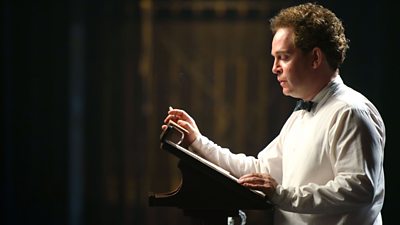
Made by Modern Television for the BBC to mark the centenary of Dylan Thomas’s birth, the drama explores how Dylan Thomas, the creator of some of the most memorable lines in the English language, died in a smog-ridden New York on a November day in 1953, aged 39.
Set in New York and Laugharne, A Poet In New York begins when Dylan (Tom Hollander) arrives in the city on his fourth and fatal visit to rehearse, write and party. One of the most famous poets in the world by the early 1950s, Dylan's popular and electrifying tours had also made him a much-loved celebrity in America.
He was on his way to Hollywood to write an opera with Stravinsky. But, before he headed west, he had to earn enough to fund the trip by fulfilling a commitment to take part in a production of the recently completed Under Milk Wood at the prestigious Poetry Centre in Manhattan. What might have been a triumphant new departure in his career and life turned instead into a requiem for a man whose life had spiralled out of control.
A Poet In New York, directed by Aisling Walsh (Room At The Top, Loving Miss Hatto), explores how Dylan's past made his present virtually untenable, and the part that he played in his own demise.
Tom Hollander says: “Thomas was a great poet, whose blazing life and premature death left both a considerable poetic legacy and an enduring reputation for bad behaviour. He was also quite fat. Playing him was both a wonderful acting challenge and a great opportunity to eat things that I would normally have to avoid.”
A Poet In New York also stars Essie Davis (The Slap, Miss Fisher’s Murder Mysteries), as Dylan’s wife Caitlin, Ewen Bremner (Trainspotting, Page Eight), and Phoebe Fox (Switch, New Tricks).
Essie Davis says: “I was very excited to be part of this production and working with this terrific team on A Poet In New York. I played Polly Garter in Under Milk Wood in high school and have loved Dylan Thomas since that first meeting. Caitlin has an interesting story to tell and it is thrilling to be part of a project celebrating the centenary of his birth.”
A Poet In New York was co-commissioned by Janice Hadlow, then Controller BBC Two, Ben Stephenson, Controller BBC Drama and Commissioning, and Adrian Davies, Head of English Language Programmes and Services, BBC Cymru Wales. It is made by Modern Television for BBC Cymru Wales.
Writer Andrew Davies says: "Tom is a wonderful actor, with a striking resemblance to the poet. He's captured the wonderful voice, and he has, more than any other actor I can think of, that outrageous charm that drew so many people to Dylan."
Griff Rhys Jones, Executive Producer, Modern Television, says: “Andrew Davies has written a moving, exciting and sensitive script about the tragic end of a huge figure. It does full justice to Dylan and his legacy.”
Faith Penhale, Head of Drama for BBC Cymru Wales, adds: "Andrew has written a heart-breaking script that captures those last few days of Dylan's life beautifully. The memory of Dylan's childhood and his yearning for home life with Caitlin back in Wales is woven in seamlessly and I can think of no better team of acting talent to bring this script and this real-life story to screen."
A Poet In New York is produced by Ruth Caleb. The executive producers are Griff Rhys Jones for Modern Television and Faith Penhale and Bethan Jones for BBC Cymru Wales and BBC Two. Filming took place in Cardiff and Laugharne.
CM
Transcripts of online short films
DYLAN THOMAS: FROM LIGHT TO DARK
(with writer Andrew Davies, executive producer Griff Rhys Jones and director Aisling Walsh)
GRJ: Well when we read out this screenplay, the room was full of laughter, and at the end it was full of tears, and you couldn’t hope for any better combination really.
AD: I remember when I was doing the first draft, I was very anxious about getting it right – more anxious than I normally am. I’m adapting War and Peace at the moment and it’s just a breeze, I’m not anxious at all. Often, you look at writers’ lives, and what do they do? They sit down and write. The actual act of writing, to be absolutely brutally honest, is not necessarily very dramatic, but there was something in this story and the context of it, that was fascinating and became something that was worth making into a film.
AW: It’s the story of a lot of people isn’t it? I kind of understand because I’m Irish. How does one leave the world of Laugharne and travel to New York and become a huge celebrity?
AD: The difficulty in a way is to keep an element of joy and wonder in the script, which is what you want people to get from the poetry, when you’re also getting a lot about a guy who is ill, panicky, broke, disillusioned, his marriage is falling apart and he’s killing himself with drink - arguably.
AW: He’s very real, he’s funny, he’s very dark, he’s sometimes not that pleasant, sometimes he drinks too much, and there’s a reality in the film that I think we’re all quite proud of.
AD: The childhood flashbacks that I’ve put in are absolutely crucial. You had to see him as this sweet little boy with a kind of vision of how wonderful the world is. You see him madly in love with his wife, and she was the great love of his life. We’re celebrating his life and his work as much as we’re showing a very sad story of a man practically killing himself. I was so pleased we got Tom Hollander to play Dylan, because he’s somebody – besides being a terrific actor – who’s got that charm and sweetness about him that Dylan had. And to see somebody who you’re going to love on screen, plummeting downhill, is going to be very moving I think.
AW: His performance in this film was extraordinary. Without that performance there isn’t a film. He’s at the centre of it, and he just so inhabits that role, and so took it on, and so took up that challenge. He put weight on, he transformed himself utterly, and actually transformed himself twice - because of course he plays our Dylan at 38/39 and our Dylan seven years prior to that, where he’s much more hopeful and younger, and youthful and happier. I think it’s quite an extraordinary performance, but I hope people don’t just look at the flawed character. Like everybody, he was flawed, but had an incredible talent.
DYLAN THOMAS: CREATING UNDER MILK WOOD
(with Dylan’s granddaughter Hannah Ellis and director Aisling Walsh)
HE: The key thing I get from Under Milk Wood is certainly perhaps in the first voice, even right at the beginning is all the language and the alliteration, and the similes the metaphors and all that rich language.
AW: He had a wonderful feeling for nature, and people in the landscape. It’s there in Under Milk Wood actually in a different way. That’s what’s so fascinating about that work is - that is Laugharne. That village, those people, you know where those buildings are and who probably those people are.
HE: When he was talking to the actors, when he asked them to perform Under Milk Wood for the first time, he only gave them one stage direction which was ‘Love the words. Love the words.’ Under Milk Wood has so many different layers to it, and so many different levels. Yes absolutely there’s the jolly-rogered double meanings within there, and there’s definitely lots of sexual innuendos, but it’s all about villages. It’s about people; he says ‘We’re not wholly bad or good.’ It’s about the characters, it’s about the place. It’s about bringing it all alive and showing something we can all relate to, and showing everyone that nobody’s perfect.
