Mountains
In this episode we climb high into the world’s great mountain ranges. Only a few pioneering animals have what it takes to survive up here, they are amongst the most elusive and mysterious animals on the planet. Witness the first time ever four snow leopards filmed together, as a mother and cub become trapped in a desperate fight between two rival males. Grizzly bears comically scratch on pine trees like wild pole dancers, and a bobcat struggles to hunt for ducks without getting its feet wet.
Published: 29 October 2016
In this episode we climb high into the world’s great mountain ranges. Only a few pioneering animals have what it takes to survive up here, they are amongst the most elusive and mysterious animals on the planet. Witness the first time ever four snow leopards filmed together, as a mother and cub become trapped in a desperate fight between two rival males. Grizzly bears comically scratch on pine trees like wild pole dancers, and a bobcat struggles to hunt for ducks without getting its feet wet.
Big facts
- Mountains cover one fifth of the planet’s surface.
- With every 1000m of ascent, the temperature falls 6.5 degrees C and there is a 10 percent increase in dangerous ultra violet radiation.
- The coldest temperature ever recorded was -89.2 degrees C at an altitude of 3488m at Vostok Station, Antarctica.
- The world’s tallest mountain is Everest, at 8848m; and the greatest mountain range is The Himalaya, the third largest deposit of ice and snow (after the two Poles).
Key characters and stories
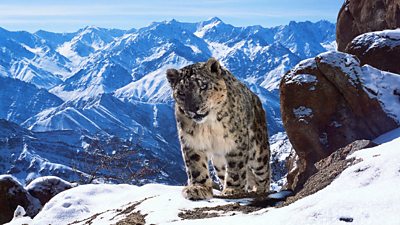
Snow Leopards; Himalayas, Ladakh, India
- The Planet Earth II sequence is the first time that four snow leopards have ever been filmed together. With as few as 3,500 snow leopards remaining in the wild, they are incredibly elusive and hard to film.
- The camera traps used were reengineered to give better operating quality and to survive in the toughest field conditions; the highest camera trap was operating close to 5000 metres.
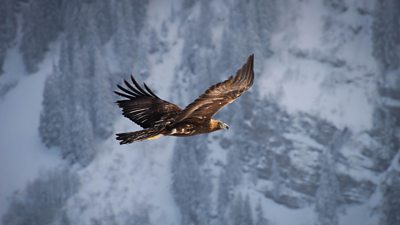
Golden Eagle; French Alps
In order to bring viewers a first-hand experience of what it is like to dive hunt like a Golden Eagle soaring and diving through the Alps, the crew had to innovate – a miniature 4K camera was placed on the back of a bird, to get the Eagle’s perspective. They also worked with a world speed-rider champion who was rigged with cameras and flew down the mountain using a special parachute which is how we got these immersive, in motion shots.
- A Golden Eagle’s wingspan can reach up to seven feet and they have a huge hallux or ‘killing claw’ which averages over 6cm long.
- They have the ability to spot prey as small as hares and marmots from three kilometres. They can steep dive at up to 300kmh (only a peregrine falcon is faster).
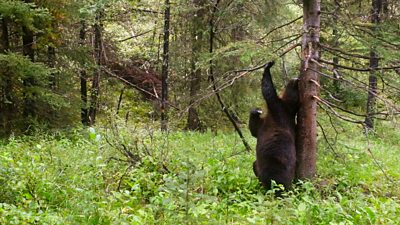
Grizzly Bears; Alberta, Canada
The team used remote camera traps concealed in rubbing trees to reveal the secret world of grizzly bears and their use of the trees like crazy pole dancers!
- Grizzly bears and brown bears (alongside polar bears) are the largest land carnivores; measuring 1.5 – 2.5 metres tall, weighing up to 360kg, and can run nearly 50km per hour.
- Females dig dens high in the mountains under the snow and give birth to their (often twin) cubs there.
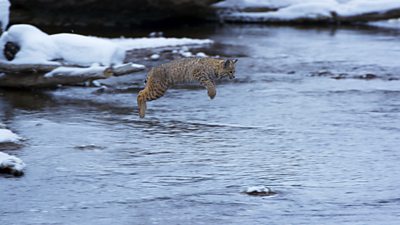
Bobcats; Yellowstone National Park, USA
Bobcats are seldom spotted by humans, but the team captured the most intimate footage of a wild bobcat ever recorded.
- Bobcats are America’s most numerous wild cat with a population of around a million.
- They are highly adaptable and, compared to other predators, they feed on a wider range of prey, including wildfowl; rabbits; rodents; birds; small deer and fish. While they are often nocturnal their activity changes to suit their prey.
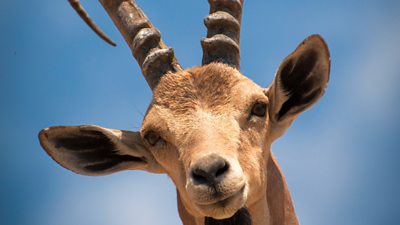
Nubian Ibex; Israel
- They live in the desert mountains of the Arabian Peninsula up to altitudes of 8500 feet.
- There are thought to be fewer than 2000 Nubian Ibex in existence.
- Their coats have a shiny quality that is thought to help reflect the desert sun to keep them cooler. And the male Ibex have long curving horns that can be up to a metre in length.
Komodo Dragon; Komodo and Rinca Islands, Indonesia
Working from a boat, the team worked across Rinca and Komodo Islands to capture this sequence. It’s a dangerous job for a cameraman - if the dragons got too close, they relied on the six rangers armed with only sticks as a deterrent!
- The Komodo dragon is the largest lizard on the planet growing up to three metres long and weighing in at over 70kg.
- The Komodo Island population is around 2,000 individuals. They can be deadly, there are reported cases of people being stalked and killed by dragons.
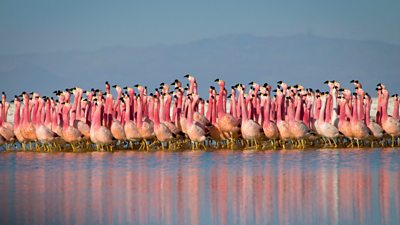
Andean Flamingo; San Pedro de Atacama, Chile
- The Andes is the only place in the world where you can see three species of flamingo together; The Andean, Chilean and James (being the rarest flamingo species in the world).
- Their lakes are so high that the water often freezes trapping the flamingos in the ice, so in some lakes the birds aggregate near volcanic hot springs to keep warm.
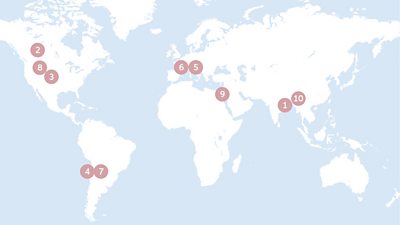
Filming locations
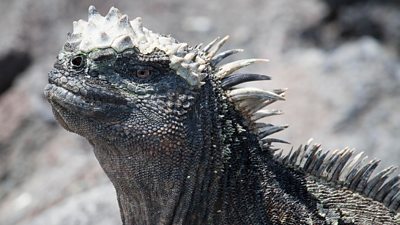
Marine Iguanas; Fernandina, Galapagos
Working from a small yacht to access this uninhabited, remote island location the team arrived on Fernandina and witnessed a hatchling sprint across the beach followed by what seemed a ‘medusas head’ of snakes pour from the rock.
- Racer snakes are known to also hunt fish at this location but the yearly emergence of hatchling marine iguanas is a bonanza for them.
1. Snow leopards - Himalayas, Ladakh, India
2. Grizzly bears rubbing - Alberta, Canada
3. Summer bears - Rocky Mountains, USA
4. Flamingoes - San Pedro de Atacama, Chile
5. Mont Blanc aerials - Chamonix, France
6. Golden eagles - French Alps
7. Viscacha - San Pedro de Atacama, Chile
8. Bobcats - Yellowstone NP, USA
9. Ibex - Arabian Peninsula, Israel
10. Mount Everest - Nepal
Stories from location
Mountains by their nature are some of the most physical habitats to film in, because the animals often live at high altitudes and in difficult conditions. In addition, mountain animals tend to be thin on the ground. Because mountain habitats aren’t as productive as jungles or grasslands, your snow leopards and bears tend to be pretty sparsely spread throughout the terrain. Just finding the animals is the first challenge. I’m much fitter now than when I started this!
The remote cameras have been a big part of our success. We had a traditional crew on site who worked very hard to film the fight behaviour and the mating of the snow leopards. But remote camera traps allowed us to film the animals much more intimately in their landscapes. Historically, mountain films tend to involve shooting something on the other side of a valley with a long lens, which leaves you with quite a flat image. You don’t see the ridges they walk on, or the peaks they live in. Getting up amongst the pathways that the animals use has allowed us to bring their whole world to life. A lot of hard effort went into getting those shots.
The biggest struggle I had was the sheer physicality of it. When we were on the second snow leopard shoot, and trying to get more cameras higher than ever before – up to 5000 metres in places – we were struggling. I managed to get acute mountain sickness and had to come down and spend a couple of days sitting in a hotel with an oxygen cylinder. Film crews carry so much stuff and everywhere we went we had to find ways to get in. There were some very physical days where you’d end up feeling sick from the exertion of it.
We wouldn’t have achieved anything without our incredible local team, whose knowledge of the snow leopards was second to none. They knew where they walked, they knew which rocks they sprayed on. We would walk for kilometres up into the mountains and they would find their paths and show us where the cats marked their territory by scraping their feet on the ground. This knowledge was invaluable to us.
We got to know the porters really well. We did three shoots in Ladakh and for each shoot we had a small team of about six guys who helped us out. Because we went out there three times, we really got to know the people working for us, and their backgrounds and stories. There was lots of laughter, and they were so proud to be part of the project. They’d come and look at footage with us in the evening. They were especially excited as the snow leopard is their emblem and in their hearts. They’d never seen them in the way we’d shot them, and they were blown away with what we were getting. It made everyone work harder. If we were tired, they were always the first guys up. Our growing relationship with those people was really special.
We wanted to film golden eagles swooping in the mountains at 200mph. We got the footage, but to get the perspective of the bird, we employed a world champion paraglider, fitted him out with cameras and crossed over into the world of extreme sport. New territory for us and a real learning experience for everyone. We needed a shot of him buzzing down the side of a mountain, and we got it in the end by getting him to fly tandem with a cameraman who had never flown before. He made a very high pitched scream on the way down!
Justin Anderson, Mountains Episode Producer