Islands
For some, remote islands offer sanctuary away from the mainland: the tiny pygmy three-toed sloth only survives because of the peace and safety offered by its Caribbean island home, while seabirds like albatross thrive in predator-free isolation. But island life isn’t always easy. The volcanic islands of Galapagos are so barren that marine iguanas are forced to find food in the ocean, but their ingenuity allows all sorts of other animals to survive on the land - including deadly racer snakes. And at the end of the earth, a smouldering wave-battered volcano appears a strange vision of paradise to more than 1.5 million penguins that live there.
Published: 29 October 2016
For some, remote islands offer sanctuary away from the mainland: the tiny pygmy three-toed sloth only survives because of the peace and safety offered by its Caribbean island home, while seabirds like albatross thrive in predator-free isolation. But island life isn’t always easy. The volcanic islands of Galapagos are so barren that marine iguanas are forced to find food in the ocean, but their ingenuity allows all sorts of other animals to survive on the land - including deadly racer snakes. And at the end of the earth, a smouldering wave-battered volcano appears a strange vision of paradise to more than 1.5 million penguins that live there.
Big facts
- Islands account for one sixth of the earth’s land area, yet around 20% of its species.
- The small populations and therefore small gene pools, allows evolution to happen very rapidly on islands.
- Island animals are among the most threatened - of the species that have gone extinct in the last 500 years, around 80% have been islanders.
Key characters and stories
Pygmy Three-Toed Sloth; Escudo Island, Panama
- The Pygmy sloth was only confirmed as a unique species in 2001. The team worked with scientists studying the remarkable but small population of a few hundred individuals, that live on a single island the size of New York’s Central Park.
- Pygmy sloths ancestors were trapped on the island of Escudo de Veraguas when the sea level rose around them, 9,000 years ago. Isolated from mainland Panama, they evolved into a new species, 40% smaller than their mainland cousins.
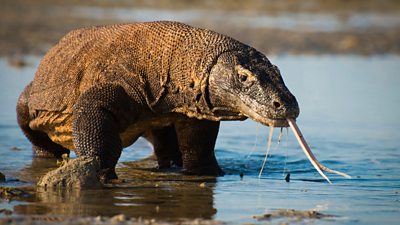
Komodo Dragon; Komodo and Rinca Islands, Indonesia
Working from a boat, the team worked across Rinca and Komodo Islands to capture this sequence. It’s a dangerous job for a cameraman - if the dragons got too close, they relied on the six rangers armed with only sticks as a deterrent!
- The Komodo dragon is the largest lizard on the planet growing up to three metres long and weighing in at over 70kg.
- The Komodo Island population is around 2,000 individuals. They can be deadly, there are reported cases of people being stalked and killed by dragons.
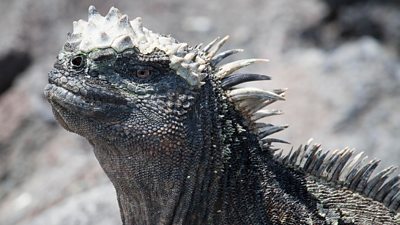
Marine Iguanas; Fernandina, Galapagos
Working from a small yacht to access this uninhabited, remote island location the team arrived on Fernandina and witnessed a hatchling sprint across the beach followed by what seemed a ‘medusas head’ of snakes pour from the rock.
- Racer snakes are known to also hunt fish at this location but the yearly emergence of hatchling marine iguanas is a bonanza for them.
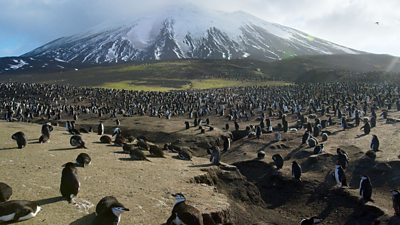
Chinstrap Penguins; Zavodovski Island
- Zavodovski Island is one of the most remote and challenging locations a film crew could choose to work. After a year of planning, the team undertook a six-week expedition to film there, camping amongst the smoke and sulphurous air alongside the world’s biggest colony of penguins, around 1.5 million chinstrap penguins.
Lemurs; Madagascar
- There are around 100 species and sub-species of lemur on Madagascar, all descended from a few early primate ancestors that ‘rafted’ to the island by accident.
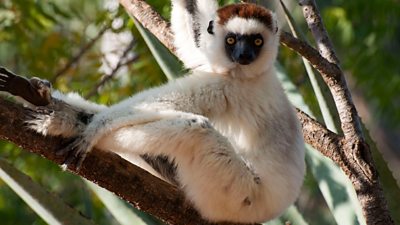
- The Verreaux’s sifaka lives in the most hostile and arid corner of Madagascar as one of the only primates to live in a desert environment.
- They rarely drink but gain all their food and water from tiny leaves, nibbled from between giant spines.
Volcanic Islands; Kilauea, Hawaii
- Many oceanic islands are formed from active volcanoes that emerge from the sea, forming new islands for animals to colonise.
- Accessing the active area of lava meant dropping the team by helicopter onto the volcano, wearing toughened soled shoes. There they used time lapse to capture the movement of lava, building on the volcano.
Albatross; New Zealand Sub-Antarctic Islands
The team worked from a yacht to visit these islands, crossing through stormy seas for 24 hours to reach this predator free land which is the perfect sanctuary for sea birds.
- Southern Buller’s albatrosses mate for life, or as long as both partners survive. Leg bands mean we know the couple in this sequence have been together for several years, though this is a second mate for the older, female, bird.
Crabs and Crazy Ants; Christmas Island, Australia
- For millions of years, Christmas Island has been ruled by crabs, it was once thought to be as many as 80 million red crabs. But in recent years, yellow crazy ants have invaded with brutal consequences.
- Weather dictates when the red crabs migrate, and the team had an unpredictable time thanks to El Nino and variable weather patterns.
- Australian scientists are working hard to battle this invader, though it is unlikely they will ever be eradicated, they hope to control their numbers and reduce crab mortality.
Filming locations
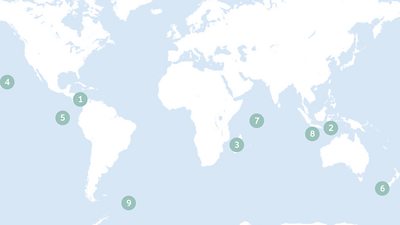
1. Pygmy sloth - Escudo de Veraguas, Panama
2. Komodo dragon - Komodo & Rinca, Indonesia
3. Lemurs - S & E Madagascar
4. Volcano erupting - Kilauea, Hawaii, USA
5. Marine iguanas - Fernandina Island, Galapagos
6. Bullers albatross - Snares Islands, New Zealand
7. Bird-catcher tree - Cousin & Cousine Islands, Seychelles
8. Red crabs & crazy ants - Christmas Island, Australia
9. Chinstrap penguins - Zavodovski Island, South Sandwich Islands, Antarctica
Stories from location
Animals living on remote islands are often quite naïve, because they are not used to encountering humans. This was a benefit in filming Planet Earth II – the island animals were often quite relaxed around humans. Some, like the penguins, would waddle up to the camera and have a little nose!
While filming Frozen Planet I worked with Antarctic yacht skipper, Jerome Poncet, who has over 40 years of experience visiting remote parts of Antarctica. When quizzing him about amazing places, he mentioned the island of Zavodovski – an active volcano that’s home to the world’s largest penguin colony. He said it was incredible but people I spoke to who had visited the island said that it’s a difficult place to access. The island is surrounded by rough ocean, and 30 foot cliffs.
The whole trip took more than a year of planning. We had to be entirely self-sufficient as there’s nobody down there to rescue you if it all goes wrong. It was the shoot I was most excited by, and absolutely the most terrified by. Six months in advance I’d wake up in the night thinking ‘what do we do if somebody slips and breaks a leg?’
It was a rough seven-day crossing to get there. On the final morning, we saw an ominous volcanic plume on the landscape and I remember so clearly, I had a deep knot in my stomach. There was an awful lot of uncertainty - we knew that the sea around the island would be rough and there was no guarantee that we’d be able to land - but we were so fortunate. We arrived on a calm day and within 24 hours we were ashore, with all our kit. Literally, the next day a storm came in and the boat had to retreat to the other side of the island. It was a week before the tender could come in for a resupply.
The only thing that really went wrong happened three days in. A huge wave came in over the cliff, and doused one of our cameras with water. We were seven days from the Falklands, there was no chance of us getting another camera so we were trying to dry the camera with heat packs and the cameraman was sleeping with it in his sleeping bag trying to warm it up. Eventually the seas calmed down and we were able to get the camera across to the boat and dry it out above the stove. Remarkably, it sprang to life and we were able to finish filming the sequence!
Throughout the trip there was a worry about getting off the island. We gave ourselves a window of three days, but the swell was too big. On the final afternoon – just as another storm was coming in – we managed to get ourselves and all the camping and filming equipment back down the cliff and on to the boat. It was incredible.
There’s a story in the Galapagos that I can’t wait for people to see. It’s the tale of hatchling marine iguanas that emerge from their eggs buried in the sand and have to cross the beach to reach the colony down by the sea. As they make their journey they are hunted by Galapagos racer snakes, which emerge from the rocks like a medusas head – all slithering and racing to capture the hatchling. They catch it, wrap around it and swallow it whole. I’ve never seen anything like it… it’s like something from a horror film! I don’t have a phobia of snakes, but I spent half the shoot with my hands in front of my eyes willing the poor hatchlings to escape! Thankfully, some did make it to the sea.
Elizabeth White, Islands Episode Producer