Grasslands
Grasslands cover one quarter of all land and support the greatest gatherings of wildlife on earth. The extraordinary creatures that live here must survive the most hostile seasons on the planet. From bizarre looking Saiga antelope in Asia, rarely seen by humans, to the giant ant-eaters of Brazil, grassland animals show extraordinary survival techniques. In the flooded Okavango, lions take on formidable buffalo in epic battles, stunning bee-eaters ride on the back of ostriches like miniature jockeys, while caribou embark on great migrations, where they must cross paths with their nemesis, Arctic wolves.
Published: 29 October 2016
Grasslands cover one quarter of all land and support the greatest gatherings of wildlife on earth. The extraordinary creatures that live here must survive the most hostile seasons on the planet. From bizarre looking Saiga antelope in Asia, rarely seen by humans, to the giant ant-eaters of Brazil, grassland animals show extraordinary survival techniques. In the flooded Okavango, lions take on formidable buffalo in epic battles, stunning bee-eaters ride on the back of ostriches like miniature jockeys, while caribou embark on great migrations, where they must cross paths with their nemesis, Arctic wolves.
Big facts
- Grasslands cover one quarter of all land on Earth.
- There are over 10,000 species of grass, found on all seven continents.
- From the baking equator to the arctic circle, grasslands are able to survive the most extreme seasons on Earth.
- Unlike other plants, grasses grow from their base and not their tip, so they are almost indestructible, capable of surviving fire, flooding, freezing and drought.
- Grasslands support and sustain more large animals than any other habitat and are home to the greatest gatherings of wildlife on earth.
Key characters and stories
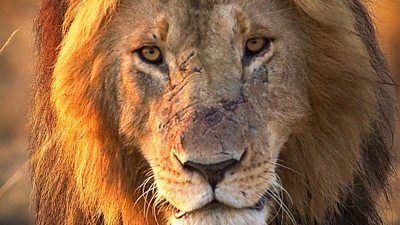
Swamp Lions; Okavango Delta, Botswana
The crew spent five months, spread over two years, in the remotest parts of the Okavango Delta to capture the remarkable sequence of lions taking on their deadliest opponent, Cape buffalo in flooded grasslands.
- They camped the entire time in the wild, under the stars, surrounded by hyena, crocodiles and hippos, their only safety and refuge - a small boat and their filming vehicle.
- Only a few prides of lions in the world have learnt how to hunt in the swamps.
- Buffalo are extremely dangerous - they kill more lions than any other animal.
- An adult bull buffalo weighs almost a tonne, more than the weight of six lionesses combined.
Key characters and stories
Serval Cat; Karoo, South Africa
The crew had a remarkable opportunity to follow a serval cat being re-released into the wild. It meant they could, for the first time ever, use a Steadicam to get up close and film a wild serval cat hunting and get intimate footage as she rediscovered her hunting skills.
- Servals have, relative to body size, the longest legs and largest ears of any cat in the world. They can leap over three metres through the air.
Saiga Antelope; Kazakhstan
- The team drove three days and three nights to the remotest corner of Kazakhstan. They then headed out on foot at 3am to find new-born calves, dug a one metre deep hole to submerge and camouflage themselves, hiding a few metres away, then waited 12 hours for mum’s return.
- This is the first time in 20 years a BBC crew were able to access the calving grounds as the Saiga antelope comes back from the brink of extinction.
- The Eurasian steppe is the largest on earth, stretching one third of the way around the planet.
- Saiga are a critically endangered relic from the ice-age, once grazing alongside woolly mammoths and saber-toothed cats.
Harvest Mouse; Norfolk, UK
- Using a specially developed macro crane-arm the team were able to make the camera go where a cameraman couldn’t. Following a tiny harvest mouse as she climbed through the grass canopy and revealing the intimacy of never-before-seen, new-born babies inside a tiny hidden ‘tree house’ nest a metre above the ground.
- Harvest mice are the smallest rodents in Europe. An adult weighs less than a 2 pence piece. They are the only rodent in Europe with a prehensile tail that they can wrap around branches and hang from.
Bee Eaters; Savute, Botswana
- Carmine bee-eaters ride on the backs of bustards and ostrich to secure an easy snack, then bob and weave around a bull elephant’s legs in a shark-like feeding frenzy.
Grass Cutter Ants; Reserva al Baugal, Argentina
- A miniature city of 5 million ants harvest grass on an epic scale. But they can’t digest a bit of it. So why bother? These ingenious farmers feed it to underground fungus which in turn feeds the ants.
- Macro sliders and cranes allowed the camera to track along with an army of ants following their every move. Even venturing underground into their secret fungal farms.
- Ants and termites harvest more grass than all other herbivores on earth combined. One third of every grass blade that grows on earth will be harvested by an insect.
Compass Termites; Northern Territories, Australia
- The spectacular architecture completely changes the landscape, and hand-held stabilising rigs like the MoVi allowed the team to get smooth moving shots around, up and over towering termite mounds. Aerial filming drones took it one step further flying close to the mounds but then rising to reveal the full spectacle.
- The spectacular mounds are over one million times the size of their creators.
Anteaters; Cerrado, Brazil
- The team captured rare Steadicam footage of anteaters in the wild.
- Ant-eaters have a two foot long tongue covered in microscopic hooks and saliva as strong as glue.
- They also have claws longer than those of a velociraptor, weapons that allow them to hoover up over 20,000 ants or termites in a day.
Filming locations
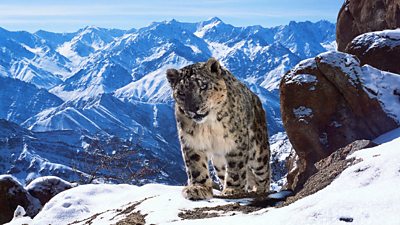
Snow Leopards; Himalayas, Ladakh, India
- The Planet Earth II sequence is the first time that four snow leopards have ever been filmed together. With as few as 3,500 snow leopards remaining in the wild, they are incredibly elusive and hard to film.
- The camera traps used were reengineered to give better operating quality and to survive in the toughest field conditions; the highest camera trap was operating close to 5000 metres.
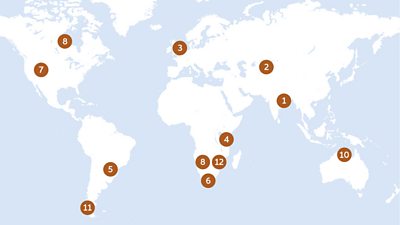
1. Elephants - Kaziranga, India
2. Saiga antelope - Eurasian steppe, Kazakhstan
3. Harvest mice - Norfolk, UK
4. Widowbirds - Maasai mara, Kenya
5. Anteaters - Cerrado, Brazil
6. Serval cat - Karoo, South Africa
7. Bison and fox - Yellowstone NP, USA
8. Swamp cats - Okavango Delta, Botswana
9. Caribou - Barrenlands, Canada
10. Termite mounds - Northern Territories, Australia
11. Grass-cutter ants - Reserva al Baugal, Argentina
12. Bee-eaters - Savute, Botswana
Stories from location
Grasslands are really strange and unfamiliar places. In north east India you get elephant grass, the tallest grass in the world. It grows to four metres tall, at a rate of two feet a day, and it’s impenetrable. Elephants will push their way through and create temporary tunnels. You end up with this network of beautiful carved grass tunnels, like Alice in Wonderland.
This elephant grass in India contains the greatest number of large animals in all of Asia. But because the grass is so tall, you can’t actually see them. So what you do for safety is go in on elephant back.
We also worked in the Okavango Delta in Botswana to film flooded grassland. I went down in a little boat with a local cowboy cameraman in this tiny metal dinghy.
Hours in, we got bogged in these thick reeds, surrounded by hippopotamus. They’re really aggressive, they kill more people in Africa than any other large animal. As it got close to sunset, we had to start getting out of the boat because it kept getting wedged into this thick mat of swampy reeds. The local cowboy told me to take my shoes off, because we wanted to be able to react as quickly as possible if we stepped on a crocodile. We’re pushing a boat through the Okavango, surrounded by deadly crocodiles and hippos, at night, barefoot, trying to feel for crocodiles and at that stage I thought ‘I’m an idiot, I should have known better, what have I done?’. Our legs got slashed to ribbons by swordgrass, and our faces were getting eaten alive by mosquitos. From head to toe we were decimated, and our legs were just bleeding with thousands of cuts. Every single step you’re taking in this water you can’t see, you’re feeling for the texture of a crocodile back and getting ready to jump. That was the most hair-raising it got.
But if there’s an animal and a place that I’m most excited about bringing to people, it’s the Saiga antelope. It’s this wonderfully bizarre-looking creature that used to roam across the tundra in tens of millions, but got decimated very quickly by poaching and hunting so the last few herds are left in the middle of nowhere. We went deep into the middle of Kazakstan, driving for days with nothing around, to find the calving herds of this amazing animal. To go somewhere so remote to see an animal that looks like it’s from another planet was just incredible.
There’s a slight twist to the story. When we were out there in the calving grounds, with hundreds of thousands of females all giving birth at the same time, a very virulent disease swept through the population and killed around 150,000 of them in a matter of three days. At the time we thought we were watching the greatest natural catastrophe that I’d ever heard of. We watched 150,000 of these magnificent animals die in front of us. At the time we didn’t know if it was the final extinction of the species, which was devastating, emotionally, for the crew. But we’ve since heard that the last few mothers and babies we filmed for Planet Earth II have survived. It was a potent reminder of how fragile yet resilient nature can be.
Chadden Hunter, Grasslands Episode Producer