Deserts
In this episode we visit the world’s deserts, a land of extremes that pushes life to the limit. Animals here have developed ingenious ways of dealing with the hostile conditions – giving rise to the most incredible survival stories on Earth. A pride of desert lions are so hungry they risk hunting a giraffe several times their size, whilst male sand grouse fly nearly 200 kilometres each day from their nests to the nearest waterhole, simply to collect water for their chicks – all the while avoiding the predators that wait to ambush them. And, never filmed before, a tiny bat takes on one of the world’s deadliest scorpions just to get a meal.
Published: 29 October 2016
In this episode we visit the world’s deserts, a land of extremes that pushes life to the limit. Animals here have developed ingenious ways of dealing with the hostile conditions – giving rise to the most incredible survival stories on Earth. A pride of desert lions are so hungry they risk hunting a giraffe several times their size, whilst male sand grouse fly nearly 200 kilometres each day from their nests to the nearest waterhole, simply to collect water for their chicks – all the while avoiding the predators that wait to ambush them. And, never filmed before, a tiny bat takes on one of the world’s deadliest scorpions just to get a meal.
Big facts
- Desert temperatures can reach a scorching 120 degrees C, and all over the world many are getting hotter and larger, rising more than the global average.
- Every year a further 80,000 square kilometres of grass and farmland in already dry areas, are turned to desert.
Key characters and stories
Key characters and stories
Locust Swarm; South West Madagascar
- Though locusts are normally solitary, the team filmed a swarm of several billion. A swarm of this size may only be seen once a decade and is one of the largest swarms ever caught on film.
- This swarm stretched over 300 square kilometres. It could travel up to 100 kilometres and consume 40,000 tonnes of vegetation per day!
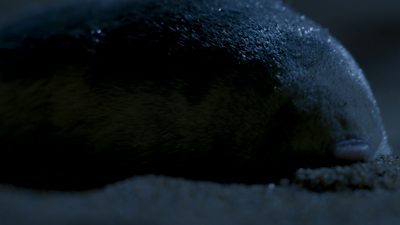
Golden Mole; Namib Desert, Namibia
- Golden moles are rarely seen - they spend most of their time under the sand, and what’s more they are tiny, only the size of a ping pong ball!
- A Golden mole’s eyes are covered in fur, meaning it’s totally blind - but well suited for life underground. To compensate, it has very acute hearing - its entire head acts as an amplifier picking up vibrations in the sand.
- Though only small, it can travel up to 1 km per night in search of food.
Bats vs Scorpion; Negev Desert, Israel
- For the first time the crew filmed the long-eared bat (Otonycteris hemprichii to be specific) hunt its surprising prey, the death stalker scorpion, on the ground. This scorpions venom is capable of killing a human.
Zebra; Makgadikgadi Salt Pans, Botswana
- Zebra have the longest migration of any mammal in Africa, in the search of elusive water.

Sand Grouse; Namib Rand, Namibia
- Sand grouse nest far away from water for the safety this provides from predators. However this means the father must do a 200 kilometre round trip each day to provide for his chicks.
- They have special unique feathers that soak up water, and one bird can carry up to a quarter of its body weight at a time.
Filming locations
Snow Leopards; Himalayas, Ladakh, India
- The Planet Earth II sequence is the first time that four snow leopards have ever been filmed together. With as few as 3,500 snow leopards remaining in the wild, they are incredibly elusive and hard to film.
- The camera traps used were reengineered to give better operating quality and to survive in the toughest field conditions; the highest camera trap was operating close to 5000 metres.
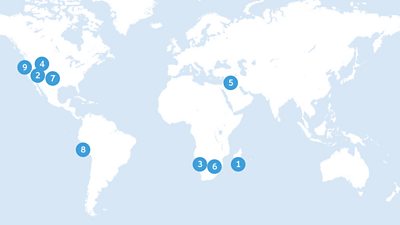
1. Locust swarms - South West Madagascar
2. Harris Hawks - Sonoran desert, USA
3. Sand grouse - Namib Rand, Namibia
4. Mustang - Nevada, USA
5. Bats v scorpions - Negev Desert, Israel
6. Zebra - Makgadikgadi Salt Pans, Botswana
7. Shrike larders - New Mexico, USA
8. Desert greening - Lomas de lachay, Peru
9. Desert canyons - Arizona, USA (Zion National Park, Arches National Park, Antelope Canyon)
Stories from location
When I first got to the desert, I realised how unaccustomed to this environment I was. I’m more used to filming in cold temperate climates like Alaska and the Falklands, so the heat of the desert took quite a lot of getting used to. It’s so hot and can be incredibly overbearing if you’re not used to it, so you end up sweating buckets. But it’s interesting how quickly you acclimatise.
Filming in Madagascar was an eventful trip on all fronts. You wouldn’t think it would be difficult to find a billion locusts, but you’d be surprised. We went to some very remote rural communities looking for them, and one by one we all got sick because of the local street food.
The locust sequence captures one of the largest swarms that has ever been recorded on film. It’s absolutely epic and we filmed it in a way that you might not have seen before. We’ve got a fantastic lion sequence shot by two very talented people. They managed to get access to this pride in Namibia, true desert lions who live right in the sand dunes. The sequence they shot shows the lions trying to take down a giraffe, which was epic. We’ve also filmed a species of bat that hunts scorpions, a species only recently described by science and we were able to film a big battle between this predator and its prey.
That all sounds big and epic and violent but we’ve also got a lovely sweet character. It’s called a golden mole and it’s about the size of a ping pong ball. It spends pretty much all of its life under the sand, and it only comes up to feed at night. But one got so accustomed to us that it would happily forage on the surface of the sand in the evening as the sun was setting, running around our feet as it did so. It meant that we were able to film this lovely mole in a way that not many people will have seen before, that’s very endearing. Even showing the footage to editors and sound mixers who’ve been doing this for years, they all pick up on the golden mole as their new favourite character.
Ed Charles, Deserts Episode Producer