Interview with Rhod Gilbert
Interview with Rhod Gilbert
Published: 16 May 2016
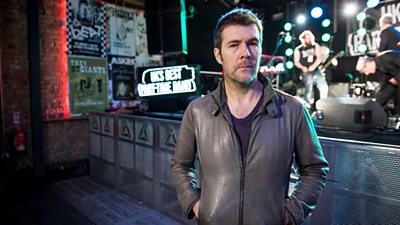
I headed out on a road trip with legends of the music industry to see what we could find. What we found was thousands of incredibly talented people doing music in their spare time - just for the love of it.
What can viewers expect?
Essentially, it’s a documentary exploring the amazing passion, hard work and diversity of part-time bands across the UK. I headed out on a road trip with legends of the music industry to see what we could find. And what we found was thousands of incredibly talented people doing music in their spare time - just for the love of it. Some of them might be kids who got together in school and rehearse on the weekend, and others might be family bands that have been going for 50-odd years and may have flirted with success and fame, music labels and charts, and are still going after all this time. It’s a competition, but actually the competition element isn’t the main driver of the series.
I’ve watched the rough edits and the show feels very real. These are people who write their own music, they’re out there gigging. It’s not a karaoke show trying to find something that fits some pre-conceived idea, someone that will slot into a pre-arranged commercial plan. There’s no prize, no recording contract, no Christmas number one, nothing.
What has your reaction to the level of talent in the series been?
I didn’t know what to expect at first. But wow, the level of talent is absolutely fantastic. I go to my fair share of festivals and gigs and I know that there are great musical talents out there. But what was nice for me was being on the road with Midge, Jazzie and Peter and seeing how inspired they were and how amazed they were by the standard. They were really excited, really moved and really passionate about the whole thing, and to see that was nice for me.
Were there any stand-out moments for you?
I was the only person who did the whole thing. I had a brilliant time with the three legends. Initially you’re a bit wary because you’re not sure how you’re going to get on with someone, and we were spending a lot of time together. But we all had the best time, just brilliant fun.
In terms of the bands, it was one of the most exciting projects I’ve ever been involved with. Wandering in on bands rehearsing in the bedrooms, garages and studio spaces felt like a real privilege. We went to one place where this one band were rehearsing in the kitchen. There was this five-piece band crammed into this little kitchen, but acoustics in there were unreal - I’d describe it as like being in a warm bath. There I was sitting in somebody’s kitchen with them right in my face playing this amazing music. Acoustically it was fantastic - the close harmonies they were doing. It just blows you away. Those were the experiences that made it really special and we had a lot of those moments.
Seeing a full dub-reggae band perform in a ten foot by ten foot lounge was amazing. They must have the most understanding neighbours in the land because there was reggae piling out of there at 10 o’clock at night. They live and breathe reggae, they’ve been doing it for 18 years in this guy’s lounge. Having the chance to see where these people get together to perfect their talent isn’t something I’ve had the chance to do previously. And I’ve got to admit that sometimes it was exceptionally moving and exciting.
There was a band of Welsh guys in their 70s who had such a fascinating history, supporting The Who in 1966, and getting back together after a 45-year break. And the lovely thing is I am still in touch with many of the bands, I’m collaborating with some of them through charity shows that I put on in Wales, or getting them on my BBC Radio Wales Saturday show for acoustic sets.
Are you glad you didn’t have to make the decision about which bands went through?
So glad! Even though we tried to play down the competitive element, it was a competition. And that did give it a bit of an edge. The bands clearly were excited by that idea and did get a bit competitive. It was heart-breaking to see some of them go out. I got a bit too emotionally invested in them to be honest.
Have you ever been in a band?
I did once. I did one gig in a French youth club. I was in front of the mic - it was quite weird. There were only about nine people in the audience – nine French youths staring at me and this other guy who was with me. I don’t think they quite knew what we were trying to do. So I’ve not really explored that avenue.
Has this experience inspired you to join a band?
I don’t think I’m musical enough. Midge Ure had a great time at my expense when I confused a ukulele and a mandolin; oh what laughs! I can kind of play the piano and I’ve got a drum kit which I’ve been meaning to learn. And I am going to teach myself when I get time.
But my dad was a jazz pianist and plays by ear, and all my family are musical. And that bizarrely, is quite off-putting when you’re a kid because I used to plinkety plonk and try and work out a tune and then my dad would sit down and play this amazing jazz version of what I was trying to. He was trying to inspire me, but when you’ve got someone that talented in front of you and you’re not that great it put me off a little bit. So I shied away from music. I was always funnier than him so that’s OK!