Interview with Oliver Jackson-Cohen (Michael)
Interview with Oliver Jackson-Cohen, who plays Michael
Published: 20 July 2017
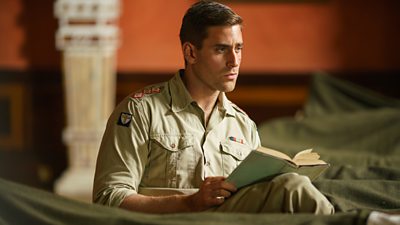
No one told me the story about Patrick’s father until half way through filming - I then felt a huge responsibility to tell the story as honestly as I possibly could
How did Man In An Orange Shirt come about?
I got a phone call from my agents about it, saying they had been tracking the script for a while and they sent it through. It's very rare to read scripts that have something to say and I really felt it did. It was something that needed to be heard. It was an immediate connection. It has a story that is incredibly honest and that deals with love and love that is forbidden. There is something inherently potent about that and the way it spoke to me.
Tell us about your character, Michael
You meet Michael Berryman in episode one. He is a captain in the army and a middle class Englishman. We first meet him at the end of the Second World War, where he finds a badly injured old school friend and romance blossoms between the two of them. He’s mathematical in his thinking and chooses to conform in life, so he gets married, has a child. But as a result he is then forever conflicted because the man he loves - Thomas - keeps coming back into his life over the course of ten years. It creates chaos for Michael and his family. He chooses to continue on this life that’s a lie and the ripple effects are dramatic.
Do you think he loves Flora?
I think he does love Flora, I think... but it’s a different kind of love. I actually spoke to Michael Samuels, our director, a lot about this. I think that he has an awful lot of respect for Flora, but in a sad way he is sort of using her. He is using her to keep this sort of fantasy alive, this fictitious life that he has built with her. But I do actually think that it hurts, I think that is why there is the conflict. I think that if he didn’t love Flora then he wouldn’t care; I think it is because he cares so deeply about Flora, that he doesn’t want to hurt her at all, but he also doesn’t want to hurt Thomas. But of course in turn he is hurting both of them.
If he knew Adam’s story, what would he think?
I don’t know if Michael would be jealous of Adam, because I actually think that by the end of episode one there is sort of an acceptance that comes with the life that he has chosen. I think that Michael would actually feel horrified - because the choices that he makes in his life have such massive knock-on effects through the years, that are all apparent in episode two. I think overall he would be very proud to see Adam, and would want him to flourish.
How do you feel about Patrick’s writing?
He has a personal attachment to the story, so the writing is going to be a lot more honest, and he spent a lot of time on set which was very rare. No one told me the story about Patrick’s father until half way through filming - I then felt a huge responsibility to tell the story as honestly as I possibly could. He showed me a picture of his father and the equivalent of Thomas on a boat in Venice and they looked really happy. It was very moving because all of the other pictures he had shown me were his father looking very stoic, and manly with his wife. It was the first thing Patrick showed me where his father genuinely looked blissful, and it was so moving.
An introduction, by Patrick Gale
My commission to write this show couldn’t have been more fortuitous: Commissioning Editor Lucy Richer let it be known she was after a script reflecting gay male experience in the 20th century, which ideally would have the flavour of a Patrick Gale novel.
Happily she said this to Kudos’s Sue Swift, who just happened to be an old friend from my days of bridge addiction. With such a vast subject, I had to find an involving, intimate story within it and, as with so many of my novels, this was a fragment of narrative from my own life.
When my mother was pregnant with me and preparing for us to move - from Camp Hill Prison on the Isle of Wight to Wandsworth, where my father was to become governor - she found a stash of personal letters hidden in his desk. At first she was amused, assuming they were from an old girlfriend he’d never mentioned, then horrified, as she realised they were from an old school and university friend who had been his best man.
In real life she destroyed the letters, terrified he’d be arrested for what was then an imprisonable offence but also disgusted because, in her ignorance, she assumed this meant he was a paedophile. In true buttoned-up English fashion, she never let him know what she had discovered.
What I’ve done in Man In An Orange Shirt is to take that scene of discovery and wind backwards, imagining the two men’s impossible love for each other being shipwrecked on the demands of respectability and the law. And then I’ve wound forwards from it, imagining what would have happened if my mother had instead confronted my father with the discovery. Readers of my novels will know I’m a psychotherapist manqué, fascinated by the effects of secrets and lies within a family.
Man In An Orange Shirt takes those secrets and lies and imagines the long-range damage they might do if the understandably embittered wife of episode one went on, in episode two, to find that her grandson was yearning for the fulfilment her late husband had never known.
Although it’s brilliant that transmission will coincide with the BBC’s celebration of the partial decriminalisation of homosexuality in 1967, I hope this is much more than just a drama about gay men and their difficulties.
I hope that its two love stories will touch people simply as love stories, and that the torments and frustrations in the family I portray will set viewers wondering about their own ancestors, grandparents and parents - and what secrets and lies they might be concealing.
GK