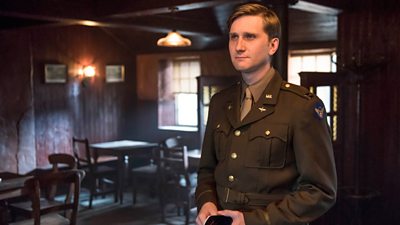
Aaron Staton plays Captain Dreyfuss
Set in Northern Ireland during World War Two, My Mother and Other Strangers follows the fortunes of the Coyne family and their neighbours as they struggle to maintain a normal life after a huge United States Army Air Force (USAAF) airfield, with 4,000 service men and women, lands in the middle of their rural parish.
Published: 2 November 2016
My grandfather fought in World War Two, I think a lot of Americans have a relative who fought. They are called the greatest generation.
Who is Captain Dreyfuss?
Captain Ronald Dreyfuss is a liaison officer for the U.S air force. He’s inbetween these two worlds, trying to keep the peace and maintain a bridge after this air base has been plonked down. He takes it seriously and he falls in love with the place.
What draws him to Rose?
Rose and Captain Dreyfuss meet in this very idealistic, magical setting. It launches in to this ‘will they, won’t they?’ story and I think they wonder the same thing. They have a connection which in some ways is literary, in some ways it’s a sense of humour and in some ways maybe it’s just a place in life where they both feel they are somewhere they don’t belong but yet, at the same time, in the perfect place. There is this mutual, often at times unspoken, connection and it will be interesting to see how that plays out.
Do we see a change in Captain Dreyfuss across the series?
Captain Dreyfuss has a journey over these five episodes and he changes. It’s very incremental in a way and there’s something that effects that change that is a secret. We come to find out about his personal life, something that has a big hand in shaping the overall journey, and it has an effect on his relationship with Rose Coyne ultimately.
What appealed to you about the project?
The thing that drew me to this project initially was the writing. I think it’s so authentic and vivid but also it’s really patient. Barry really allows the stories to develop. It’s very real and I thought the people sounded real. I think what is going to make this special and make the characters so authentic, is our individual experience; Hattie’s English, I’m American and most of the characters are from Northern Ireland. Most people are bringing their own experience to the roles.
However, before I read the script, the initial appeal was that it was going to be produced by the BBC. I just love the content of the BBC and consider it to be of very high quality and without reading page one I knew it was going to be good. Then you open the script and my expectations were met and exceeded.
What do you think will appeal to the audience?
What makes this story universal is that it is a story about people. I worked on a show that took place in the 1960s and what was fascinating about that was how much things have changed while staying the same. This is a different period of time in a very different place but again, what makes people tick, what drives them, is the same whether it’s love, fear, whatever. These things are the same. This is a story with so many people in it, so many strangers, but you feel like you have known them.
Do you have any personal connections to the story?
My grandfather fought in World War Two, I think a lot of Americans have a relative who fought. They are called the greatest generation. To be honest I take privilege in representing a time in history that everyone’s pretty clear on but it’s also fascinating and interesting. It’s also enlightening because in a very real way everything has consequences, and obviously this had a very mixed impact for this particular town and for people who lost their homes. I’m not sure they would remember it the same way that I was brought up to think about it.
How did you find filming in Ireland?
I love it here, I really do. It’s just incredible. The people are wonderful and I think truly the beauty of the place is matched by the beauty of the people here. There is a sense of community that is very special and nice to be around. At first I felt self-conscious of speaking because obviously I have an American accent and people recognise it immediately. You go somewhere and people say, “what are you saying?” because that’s not necessarily the way you would say something or pronounce it but people are just so kind.
How did you find working with Adrian Shergold?
It’s a very interesting story and I think Adrian Shergold has an incredible hand in steering this. A friend said to me once there are three ways an actor reads his lines: the way you do it in the car on the way to set, the way you do it on set and the way you do it in the car on the way home. Adrian has a way where it helps to drop that last part because you trust him if he’s happy. He also does a lot of things in one shot, which as an audience I love. You really get a sense of the story and it has this unconscious way of drawing you in. A lot of old movies used to be like that, and obviously theatre. I think it’s going to be something unique about this.
Cast
- Rose Coyne - Hattie Morahan
- Michael Coyne - Owen McDonnell
- Captain Ron Dreyfuss - Aaron Staton
- Emma Coyne - Eileen O’Higgins
- Francis Coyne - Michael Nevin
- Voice of older Francis Coyne - Ciaran Hinds
- Ned Hanlon - Des McAleer
- Davey Hanlon - Seamus O’Hara
- Mickey Joe Hanlon - Ryan McParland
- Failey - Kerr Logan
- Barney Quinn - Gavin Drea
- Sally Quinn - Fiona O’Shaugnessy
- Ellen Quinn - Maggie Cronin
- Kettie Brady - Antonia Campbell-Hughes
- Seamie Brady - Isaac Heslip
- Doctor Black - Charles Lawson
- Andrew Black - Ruairi O’Connor
- Jemmy Fox - Frank McCafferty
- Nellie Fox - Christina Nelson
- Tillie Ziegler - Kate Phillips