Interview with Peter McDonald
Interview with Peter McDonald, who plays Leo in BBC Two drama Murder.
Published: 23 February 2016
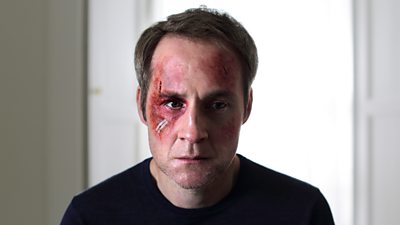
The challenge as an actor is to give up completely to the process
What attracted you to the role?
Ninety percent of the script is very original in terms of the format, and I loved the script, the story and the form. Then I saw the pilot episode and I thought that it worked so well, I really wanted to be a part of it. I thought it was brilliant.
Who is Leo?
Leo is one half of a middle-class couple who live in a small town in the Borderlands, not too far from Edinburgh and the River Tweed. Three years previous to when we meet him, Leo and his wife lost their only daughter Sonia to meningitis, but she died when they were abroad and Sonia was in the care of his brother-in-law, Rafe. Leo is struggling with his grief and finding it impossible to grieve naturally for her. He is fixated on blaming his brother-in-law for his daughter’s death because he didn’t take care of her properly in Leo’s eyes and bring her to the doctor quickly enough to have the meningitis treated.
How is his relationship with his brother-in-law?
Leo is an undemonstrative man. He’s quite a shy, contained character and was probably someone who struggled with life, maybe even depression before he had a child, but becoming a father really changed his life. It was a big turning point for him and a huge focus in his life. He’s quite a delicate character but quite mysterious in how he’s grieving and how he deals with his feelings of blame towards his brother-in-law. He’s become obsessional. He feels emasculated by his brother-in-law, who is a much bigger man and more of an alpha male, and someone whom his wife saw as a paragon of manhood.
Once this happens he feels that Rafe’s dominant masculine personality, and his sense of knowing what’s best, was at fault in relation to the death of his child. He’s always felt challenged by Rafe but now he becomes fixated with it.
How did you find the format of filming directly to camera?
The brilliance of the script to me was that when you hear the pitch that everyone is talking directly to camera you think, is it going to be very exhibitional? And then you read it and realise it’s quite the opposite. The characters are in a very unresolved place and who they’re talking to, or what they’re saying to you, is something that is always ambiguous. It has to be weighed up by the viewer in terms of its veracity and also how much the character is lying to themselves, even though in the form they’re at complete liberty to be truthful.
To me, that was inherently dramatic as there was such a tension between the form and actually what you’re being told. It’s therefore very dramatic as it’s moving forward with that tension and also the characters are realising themselves as they speak to you. The challenge as an actor is just to give up completely to the process. I never asked the question, who I am talking to? I just took it completely at face value. While I did a lot of backstory for myself - what my relationship with my wife was, the world around me and myself - actually performing it, you discover who and what the character is.
There’s nobody reacting to what you’re saying on screen. I just treated the camera as someone who is sitting in the room with me and hearing my innermost thoughts.
How did you find working with Birger?
I loved working with Birger. He is 100 percent committed to what he’s making. He’s got a great energy and runs a great set. He would talk to you about the acting like, do this faster, leave a longer pause, maybe don’t leave a pause, and be totally in that space with you but he wouldn’t have long conversations about who the character was. That had to come from you which is great in relation to this process. You had to come up with that and he would help you shape it for the performance. I really felt that I could trust him because he was looking out for the best way to shape what I was giving him.