Miriam’s Dead Good Adventure
This new series fronted by Miriam Margolyes will look at one of the world's last taboos: our own mortality.
Published: 16 April 2019
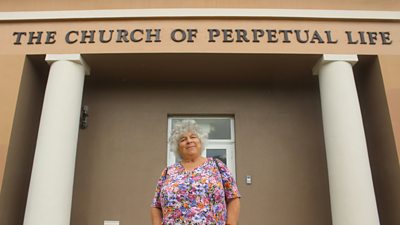
For so long death has been a subject that people couldn’t talk about. It makes people embarrassed or nervous and that doesn’t help anyone.
In this immersive, thought-provoking and entertaining series, 77 year-old Miriam will ponder her own mortality - alongside ours. Miriam spends time with communities in the US and in Europe to learn from those who are resisting the end and others who are facing the inevitable.
Miriam's Dead Good Adventure (2x60') is a Wild Pictures production for BBC Two. It was commissioned by Patrick Holland, Controller BBC Two and Clare Sillery, Head of Commissioning, Documentaries. The BBC Commissioning Editor is Emily Smith. The Series Producer and Director is Simon Draper, the Executive Producers are Alicia Kerr and Paul Hamann, and the Editor is Gwyn Jones.
DG2
Q&A with Miriam
Why is it important that we talk more openly about death?
For so long death has been a subject that people couldn’t talk about. It makes people embarrassed or nervous and that doesn’t help anyone. I think that we should all talk about it and that’s why I have made this programme. You can’t generalise about death which is odd when it is the most universal experience. Everyone deals with it differently but it’s the only thing that absolutely everyone will go through.
Has filming this series changed the way that you feel about death?
Yes, the film has definitely changed the way that I feel about death. I’m less frightened by it now. I feel really in awe of the people I met who have faced death so beautifully and so gracefully. I’ll never forget the experience and I’ll never forget them.
You meet people facing death and see how it has drawn them closer to their loved ones. Do you think it’s better to know when death is going to happen or is ignorance a blessing?
I never think ignorance a blessing. Knowledge is always preferable to ignorance. For me, what was so remarkable was how everyone I met was dealing with death in very different ways. There is no one way to cope with death but I think it is always best to know what’s coming and to try to deal with it. I believe in handling the things that are difficult.
If you had the choice to live forever, would you want to?
I would love to live forever if all my friends could live forever. I don’t think I could handle it if I was the only person left. You’ve got to have someone to talk to!
Is worrying about death a privilege that is only reserved for the wealthy and healthy?
We should all take the time to think about death but I do think that death is easier for the rich. I resent that fiercely. It’s wrong but that’s the truth.
What was the most striking thing that you experienced on this journey?
The most striking thing from my journey would be meeting Tracy, a wonderful woman living with terminal cancer. I was very nervous to meet a stranger to talk about something as personal as preparing for death but I felt an incredible connection with her. We opened up to each other straight away. Tracy’s life was full of passion for living and love for her daughters. She made life rich. She was extraordinary and she had such strength. She was very special to me. We remained in daily contact until she died.