Director Camilla Arnold explains the process of interpreting poetry into British Sign Language
Interpreting modern and classic poetry into British Sign Language may at first glance seem like a simple concept. It has, in fact, been a huge challenge. What do you do when you come across words in poems for which there is no official sign? And how do you then take the BSL interpretation and turn it into visually stunning - and groundbreaking - television that is accessible for everyone? Director/writer Camilla Arnold explains.
...it was a challenge, but an enjoyable and fascinating one and one, that I have to say, I wouldn’t have missed out on for the world."
The process of making Magic Hands has been about creating a marriage between British Sign Language (BSL), English text and dubbing. We had to give particular attention to creating a translation which is both visually beautiful, true to the poet’s vision and, just as importantly, accessible. When you add the complexity of graphical representation you come to realise that you are actually working on a pioneering project.
BSL consists of an entirely different structure to that of spoken English. In English we say ‘I went to the shop’ but in BSL the structure is shifted to ‘shop I went’.
Here you should spot an obvious problem: the translation process from BSL to English and vice versa is not straightforward. It is not a ‘word for word’ translation so, as with any foreign language, plenty of mediation and thought has to go into the translation process.
Similarly, there are some words that have no BSL equivalent. For instance, when we were translating Christina Rossetti’s What Is Pink, we realised that there is no official sign for the colour 'violet'. After much discussion with the presenter (a native BSL user) and our two qualified BSL monitors/translators, we came up with a sign that combines the signs for blue and purple - which is a near enough description for violet.
Rhyming words such as 'late' and 'eight' does not rhyme in BSL, whereas the sign for 'tree' and 'wave' rhymes because they are visually similar, but those words do not rhyme in English. Through discussion and mediation, we worked hard to find a middle way to respect both languages and to achieve an accurate translation.
We had to ensure that we made the programme accessible for everyone, both hearing and non-hearing, by ensuring that the voice-over and the signing are in sync. This was difficult because of the speed of delivery, the repetitive nature of a poem - including the beat and the rhythm - (such as in Kenn Nesbitt's I’m Building a Rocket) and of course the big reveal of punchlines!
We had a BSL Script Supervisor who united the BSL with the voice-over. This was a massive challenge though because the use of BSL multichannel signs often means that a whole sentence can be condensed into one sign, which then affects the dubbing. And the same is true in reverse - one word in English could need five signs to deliver the concept. So how did we make the signing match the voice over and visa versa?
Myself as the director, along with the producer and our BSL creative translator, Jean St Clair, worked very closely together to capture something which was fitting against both languages - especially context and what a poet means rather than the individual words they use.
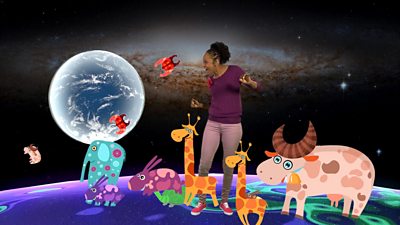
Jean is an expert in sign performance and very experienced at translating texts into BSL for the stage. At the start of the process, we discussed each text to ensure we had a shared understanding of the content, and that Jean knew what, as the director, I was hoping for visually. Jean then worked out a BSL version of the text that would make the meaning of the verse clear to children, less than 6 years-old, and that would interact neatly with the graphics. The presenters then had to perform in front of a green screen, just imagining the graphics that were around them as they performed. It took an average of 10 takes to achieve the desired unity between the voice and signs!
So yes, it was a challenge, but an enjoyable and fascinating one and one, that I have to say, I wouldn’t have missed out on for the world.
