Legacy: Interview with Charlie Cox
Interview with Charlie Cox who plays Charles Thoroughgood in new BBC Two drama, Legacy.
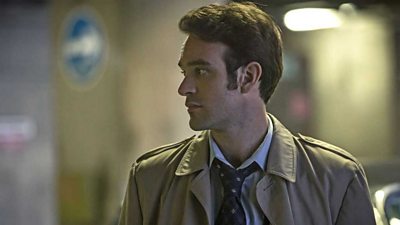
What attracted you to Legacy and the role of Charles?
What attracted me to the project above anything else was Pete Travis, the director. I’m a big fan of Omagh and Endgame and his style of directing. I’ve always thought that his films are so unique, they cut a fine line between drama and documentary, and they feel very real and very moody in tone. I thought the role of Charles was an interesting one, he finds himself in an interesting dilemma. He joins MI6 and is still in training when he’s brought in to recruit a friend of his who they expect is working for the Russians. This bombshell is dropped on him within the first 20 pages of the scripts, so seeing how he deals with that and how he does his job was really interesting and compelling.
How would you describe him as a person?
He’s quite arrogant. He’s very good at his job and has a huge amount of potential. He’s probably excelled in everything he’s ever done. Prior to MI6 he worked as a bomb disposal expert and was stationed in Belfast, so he’s seen a lot of action and with that comes a certain sort of swagger. He’s raring to get involved and be on the front line of the excitement and importance of what is happening in London at this time.
How does Viktor come back in to Charles’ life and what are the implications of that for Charles?
Viktor was a friend of his at Oxford, where they studied together. Whilst Charles is on the training course at MI6 he’s called in to head office because Viktor has come on to their radar and they recognise that they have someone who could potentially make contact without ringing any alarm bells. So he’s brought in to do that and see what he can find out about him. They want to see if he can use that friendship to gain some knowledge of the Russians and their activities.
The nature of their relationship is that Viktor and Charles are constantly crossing and double crossing one another. What was that like to play?
It’s really fun because you have to find different ways to be duplicitous. Early on we’re pretending that we’re just friends and it’s nice to catch up, but as the relationship and the events unfold in front of us it gets to a point where, even though we’re still pretending, we both know we’re pretending. It’s almost like a double bluff. Eventually everything is revealed and there are no more games to be played. What’s sweet about their relationship is that once that happens you realise that they do care about each other quite a lot. Neither one of them wants the other to be hurt or ruined in anyway. It was quite difficult to act as someone who is putting on an act, because of the different levels. You have to ask yourself, ‘how good of an actor is my character’?’
Are Charles’ motivations personal or political?
The line gets blurred. Initially they are political. Charles is at an age and stage in his life where he finds it difficult not to take things personally. He’s not quite where Hookey, the character played by Simon Russell Beale, is, where he could detach himself from events in order to be able to do his job properly. As the story develops you realise that his family is implicated and involved, so it can’t not be personal. That’s the journey that Charles goes through, by the end of it he’s begun to be numbed by everything that takes place and their consequences so he’ll probably go on to be a much better agent.
Did you do any research in to the Cold War for the role? Was there anything about the period or being a spy in that period that particularly stood out?
Yes I did. I watched quite a few documentaries and looked through a number of books. There was the feeling that at any moment, any day now, the world could end.
What stood out about being a spy in the Cold War is the idea that, especially in Charles’ world, you could be being watched at any minute, every phone call you have is potentially being listened to. Anyone you meet or person you bump in to who you haven’t seen for a long time, you have to question whether that was orchestrated or really was a coincidence.
Did you read the novel before you started filming?
Yes I did. I really enjoyed the book and found it a very interesting read. Certain details have been changed and we changed the character of Charles a little bit, in terms of what kind of person he is and what motivates him.
Is the genre one that you enjoy watching yourself?
It is actually. I watched a lot of things that I hadn’t seen before and really enjoyed them. I watched the original Tinker Tailor Soldier Spy series with Alec Guinness and Richard Burton in The Spy That Came In From The Cold. I also watched a lot of American Cold War films.
Why do you think audiences enjoy espionage thrillers so much?
The nature of espionage, spying and double-crossing and being duplicitous, lends itself very well to drama. There’s an immediate tension. What Pete’s done at the beginning of Legacy is, from the opening credits, I’m being followed. It’s just really good drama.
Was there a scene you particularly enjoyed playing?
I happen to think that Andrew Scott is one of the greatest actors of our generation. I’ve admired his work for so long and when I found out he was going to be in Legacy I was over the moon. So I just loved every scene I had with him. I also loved the scenes with Simon Russell Beale and particularly enjoyed the scene with Tessa Peake Jones, who plays my mum.
What can audiences expect from Legacy?
For those who were around it’s a great reminder of what it was like to live through that, and be in London or any other major European city of that time. The thrill and the drive, will hopefully captivate audiences.
