Interview with Damon Thomas
Damon Thomas is Lead Director and an Executive Producer on Killing Eve.
Published: 29 May 2019
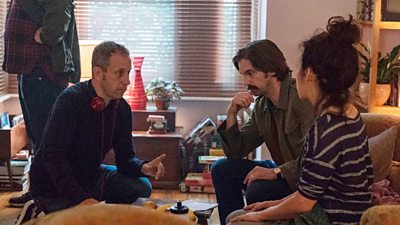
There is an attitude in the way we shoot it. We don’t shoot like standard drama, we try and push it a little bit.
You directed the finale of season 1 and the beginning of season 2, how was that?
It was a thrill to close out the first season’s final three episodes and especially with the dramatic scene in Villanelle’s apartment. It was then great to be able to pick up exactly where we left off and do the first two episodes. The scripts do an exact pick-up moments later which is exciting. It was also a challenge because we’d ended on such a fever pitch with the confrontation between the two character. How do you go forward from that high point?
What was interesting about filming the opening sequence of season two?
Emerald Fennell did something quite bold in that she picked up immediately from where we’d ended, so we had to go back to Paris. I suggested that we do something a bit exciting and have one long shot that tells both Villanelle and Eve’s stories and links them together. Emerald thought it was a great idea so we start the second season with one long shot that lasts about two minutes. It was great in theory but in practice you just have to keep rehearsing because there are no cuts. We did that over and over which involved a lot of people running up and down the steps of the apartment, especially the Steadicam operator. We got it after about seven takes which was one whole day’s worth of filming, but I think it kicks the season off with a bang.
Can you talk about the importance of tone in this show?
It is so important to maintain the unique tone of this show. The closest thing to compare it with would be the Coen brothers’ movies. You need to keep the dramatic story of the two characters as well as the comic twist. Those two things characterise the Coen brothers’ films and Killing Eve. It’s not just a standard espionage thriller where everyone is very serious throughout, they are very human - they go to the toilet and have dandruff!
That’s interspersed with high drama and exceptional violence. Part of my job is to keep that tone and the unique mixture that Phoebe Waller-Bridge created in the first season. I have to keep the attitude and sensibilities as we go forward into season two. Part of that is fundamentally in the writing, but I have to keep the visual language of the show quite strong. There is an attitude in the way we shoot it. We don’t shoot like standard drama but we try and push it a little bit. A vital part of that is continuing to work with Director of Photography, Julian Court.
You have to have a comedic sensibility on this show and be able to appreciate what is funny and what isn’t. That can even change while you are shooting or in the edit, it's all part of the process. But the tone is there, always undercutting and subverting things and helping us to avoid the genre route. Sometimes you have to be dramatic though, so there is always a push and pull between the two things. The TV series Fargo does that too. It treads a darkly comic line.
Do you have to work closely with the actors?
You do have to build up a trusting relationship and learn their process. Having trust as the basis of the relationship means you can explore things successfully. It also means you have shortcuts and don’t have to feel your way as if it was the first time working together. You get to know each other as people and can have a lot of fun together. We have a lot of fun on Killing Eve.
Killing Eve takes place in cities like Paris, Amsterdam, Rome and London, do these different cities add a unique flavor to the backdrop of the show?
It’s always good to go somewhere foreign and we wanted to continue the trend of season one, being on location. Part of what a director does is discussing locations and trying to do something that supports the drama or takes it a stage further. Some of the locations give the show a big feel, but you can’t just do it for no reason. It has to follow on from the drama and the writing.
What was it like working with Emerald this season?
Emerald had a very difficult job, which was to follow on from Phoebe, and she has done that fantastically. She was very willing to go for it, embrace the tone and be collaborative. She took on board ideas and incorporated them in the script. She kept the elusive, dramatic, sometimes violent, darkly comic, humorous tone too. The audience go on a very heightened unusual journey with these characters. It’s an enjoyable journey because of the wit and humanity that it’s told with.
What is the process for you from script to screen?
When I first get a script I just read it and enjoy it. Then I go back with a critical eye and think how I will direct each scene. I write loads of notes and look at what makes practical sense. Then, as a team with the Producers and Executive Producers, we start the re-drafting process.
After that I work with the 1st Assistant Director who tells me if we have enough time to film it. That has a big impact on filming. If we don’t have enough time we have to go back to the writer and see if they can tell the story with cutting scenes. My job is the overview of the realisation and to try to do things that are exciting, whilst keeping the show’s tone. The job of a director is all encompassing and that is time consuming. You do need a team that you can collaborate with, rely on and delegate to. Ultimately the job is one of taste: you have to trust your own instincts and ask everyone to go along with you!