Jin
Jin Ha was born in South Korea and moved to London with his family when he was five.
Published: 18 October 2017
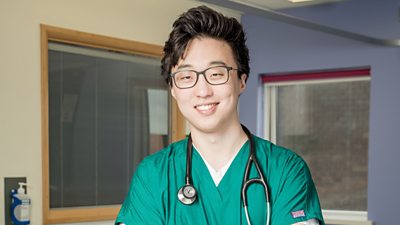
He is the son of a Reverend at a Korean Community Church in London. He decided he wanted to be a doctor when he was 16 and is the first member of his family to go into medicine. He studied at Liverpool University and then King’s College.
Jin Ha’s been playing the drums since he was 14 and still fantasises about being a famous musician. He’s obsessed with rock music and his favourite band is Muse. He says playing the drums is a great way to de-stress after work and is a way to maintain his sanity. When he’s not at work or playing the drums, Jin Ha loves drawing comics and watching Korean movies. He admits he’s a perfectionist - he likes to keep his room spotless and puts everything in alphabetical order!
Jin Ha has a very busy schedule. He travels to London every Sunday if he can to play drums in his dad’s church band. He also translates the church service for non-Korean people and mentors at the church youth group. He usually gets back to Wolverhampton at midnight.
He has a small group of doctor friends and enjoys going out for dinner. He’s currently single and says being a doctor has its pros and cons with the ladies. It’s great telling girls you’re a doctor - it creates an immediate sense of attraction, but the work/life balance and the stress that comes with the job can be off-putting for potential partners. He admits he likes to keep himself active socially and busy with hobbies so he doesn’t get depressed and feel lonely.
Jin Ha’s father suggested going into medicine because of his love of sciences as a child and because he’s always liked helping other people. His family are very proud and supportive of his career. Since qualifying, he’s developed a coping mechanism for dealing with difficult cases. He believes his sarcastic sense of humour brings a sense of relief on the wards. However, he finds breaking bad news to patients and family members incredibly difficult - he is not a natural at consoling people.

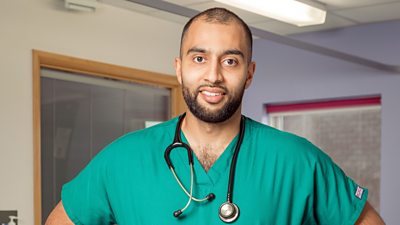
Q&A with Jin
What was it about being a doctor that attracted you to the role? Is it something you’ve always wanted to?
I was quite late in deciding to become a doctor. I fully made up my mind when I was around 16/17-years-old. It was at the beginning of A-Levels. Before that I wanted to do a variety of things but I think at the bottom of my heart I wanted to help people. I think compassion, hard work and academic achievement and with a focus on helping others - that was always at the bottom of everything I wanted to do. I think initially my father suggested it. I thought about it and grew to like the profession and for me it’s been a slow and steady rise to becoming a doctor. So when I first started I was unsure. As the years went by, and now in my second year, I feel that my aptitude and my willingness and motivation, and my purpose as a doctor is getting greater.
What are the most rewarding parts about being a doctor?
Definitely the rewards of patient management; when I look after a patient and they are grateful. And when a patient gets better. When what I decide works and you see the smile on their face - that is definitely the most rewarding aspect of the job. Another rewarding aspect is when I learn on the curve and when I apply what I’ve learnt and actually get it right. That feeling when you see what you know, when you put it in to practice - that learning process is definitely a rewarding process.
And the most frustrating part about being a doctor?
I think you can divide it into two sides - the personal and then the current climate with the NHS - the work stress and workload. When I get things wrong, we all get things wrong; we’re junior doctors - that’s how we learn. Especially when your senior colleagues point out mistakes and criticise, I’m the kind of person who finds that a painful psychological learning experience. It’s not wholly negative because conversely, and ironically, those are the moments I learn and improve. And another aspect of the job that we all have to do as doctors, is breaking bad news. When things don’t go your way with patients and you build a rapport with them and you want them to get better but end up going the other way. Those things can be a little bit emotionally taxing - especially when you’re on more difficult specialities like A&E and Oncology. And on a general scale, the NHS is a little bit busy and it is very pressurised - especially working in A&E; you do see that on a daily basis. But that doesn’t deter me from being a doctor.
How has it been having the cameras follow you?
I would say ‘interesting’ is the word to define it. I think overall it’s been interesting in a very different way. It has had its ups and downs. But overall in terms of my personal development it’s been a lot take away from. At times when there have been pressures, especially in the context of an A&E environment, I find I’m using double energy, double efforts. It’s a very fast paced and acute area and I don’t want to fall behind with the patients. So I have to work fast, come up with the accurate management of the symptoms and I’m also aware that the cameras are with me. So it has been difficult at times - especially when you’re going through a bit of a personal stress. But overall, in terms of being on camera, it’s been a very different experience - something that I probably won’t ever do again. It’s a once in a lifetime experience.
Why did you want to get involved?
I’ve always enjoyed acting and like being on camera. Secondly, I thought it would an emotional uplift in that we have this fun and it creates an exciting buzz. And thirdly, I thought it would be a good platform to put junior doctors in a good light, especially in the midst of what has happened with junior doctor contracts. I don’t want there to be too much negativity around junior doctors. I truly wanted to show that we do a good job, we are still out there and we do work hard. And for this to have a positive light to show us in. And to educate younger students to become junior doctors and provide that positive inspiration and motivation.
What do you think viewers will take away from having watched the show?
What I really hope is two things – one, for us to be portrayed in a way that is good and in a way that is very supportive of junior doctors - our commitments, efforts and trying our best and learning. Secondly, I want the audience to see how hard junior doctors work, how we are really at the fore and quite selfless because junior doctors often go beyond to help patients. I want the optimism and positivity to shine through.

