Emeka
Emeka grew up in Kent, he’s 6’6 and the son of Nigerian parents.
Published: 18 October 2017
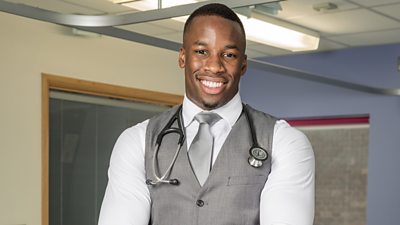
He was very competitive as a child and naturally leaned towards the sciences. He comes from a family of medics and from a very young age knew he wanted to be a doctor. He studied medicine at the University of East Anglia.
Emeka is third in line to the throne in his province in Nigeria, where his paternal grandfather was King. He prides himself on looking dapper at work and has a vast collection of tailor-made shirts and ties. He likes to think of himself as ‘a new medical fashion icon’.
In his spare time, Emeka is sports mad - when he’s not at the gym or out on a run, he can be found shooting hoops on the basketball court. A budding entrepreneur, long-term he sees himself at the heart of a multi-national medical company.
Emeka prefers a night out at the ballet or the opera, than a night down the pub. He has a big group of medic friends and tries to keep his social life ‘interesting’.
Emeka’s following in the footsteps of his grandfather, who was a doctor, and his father, an obstetrics and gynaecology consultant. His younger brother and sister are also medical students.
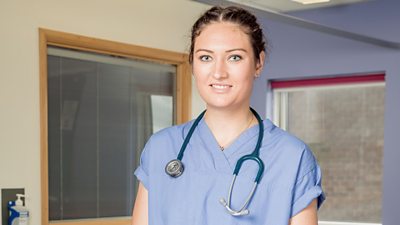
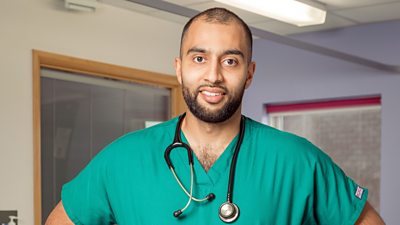
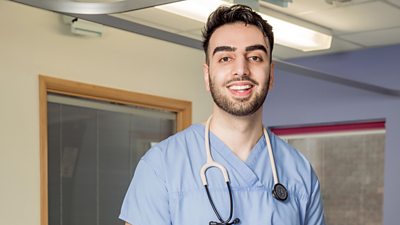
Q&A with Emeka
What was it about being a doctor that attracted you to the role? Is it something you’ve always wanted to?
A lot things went in to my decision to become a doctor: The subjects I was good at in school and I liked (I liked the sciences). I was very good at science and was very competitive in sports. So it was a competitive field and I was quite interested in the competition of it. My dad is a surgeon and I’ve seen how the career goes and so I was very familiar with it. It was a combination of what I liked, what I was good at and what I was familiar with. So it all kind of fell in to place for me.
What are the most rewarding parts about being a doctor?
It’s a really rewarding job for me. When I discharge patients and they go home, and the families come up to you and thank you, and the patient thanks you, it makes it all worth it. It makes it all worth it - all the stresses, the hard work. Because the patient obviously came in because they needed you, not because they wanted to be there. Whether it’s minor or major they get to go home happy with a smile on their face.
And the most frustrating part about being a doctor?
The hours can be quite long. And a lot of the time you’ll be working hours you’re not paid for. Not because you want to, but because you have to - because of safety. It’s not a job you can clock out at five. With medicine, because of safety, you can’t always leave. This can make the hours unpredictable - you miss plans etc and that’s something I’m just getting used to. And because it’s my first year in the job. I’m used to being at school where everything is timetabled. It all depends on the day.
How has it been having the cameras follow you?
I really enjoyed it. I thought it was a great experience and I’m going to miss the cameras. If I could, I’d have them follow me for the whole year.
Why did you want to get involved?
I thought it would be a really good opportunity. I was discussing with my friend Osama (also in the series) about how crazy our lives can be and no-one really knows what we do. And people often ask ‘what do you actually do on a day-to-day basis?’ and it’s hard to say because our jobs entail so much from one day to the next. So when I saw the email about the show I thought ‘let’s do it - this would be awesome.’
What do you think viewers will take away from having watched the show?
I hope the viewers will take away that the life of a junior doctor, the life of a first year medic, isn’t what everyone presumes. It does encompass a lot, a lot of different skills. Communication skills, practical skills, organisational skills - there are so many skills that you’re required to have. I think a lot of people miss that. It’s hard to describe your job top to toe because you’re not doing the same job every day. It would be great for the country to have insight into what we do and how it affects us. It is a taxing job - to jump from school into that level of responsibility; responsibility over people’s lives. It’s one of the greatest responsibilities you can have - it’s quite tough.

