Jamaica Inn: interview with Philippa Lowthorpe
An interview with the director of BBC One's new adaptation of Jamaica Inn, Philippa Lowthorpe.
What drew you to get involved with Jamaica Inn?
Jamaica Inn is a passionate and dark, gothic romance set in a wild and haunting landscape, and Emma’s scripts captured this brilliantly. I thought it would be exciting to direct a drama which has a wonderful love story but also a thrilling adventure story. I also love the fact that Jamaica Inn has a female heroine. As a child I loved stories like Treasure Island, but a man or a boy always tended to be the hero, so it has been wonderful to be able to tell this adventure story with a young woman at its heart.
What was it like working on a production that has a strong female lead?
The films I am drawn to often have a strong female lead, and Jamaica Inn is no exception. I like stories where there's a woman at the centre, instead of a woman as a passive bystander, or indeed someone who wants to be rescued. Mary is such an active character. She is brave, headstrong, passionate, stubborn and she also gets things wrong too. Her journey is fascinating to watch.
How was it working with Jessica Brown Findlay? What do you think she brings to the character of Mary?
I adored working with Jessica and was very impressed by her. She is in almost every scene, so it was extremely hard work for her, physically and mentally. She had to climb mountains, march across moors, wade through mud, be thrown around in the sea, but she never complained once. She is strong, clever and beautiful, and has a mesmerising quality on screen. You can’t take your eyes off her. Jessica is also a very instinctive actor, and brings out all the layers in Mary’s character - her strength and opinionated nature, her naïvety, hot-headed passion, vulnerability.
It’s really a rite of passage story. Mary starts off as an innocent who enters into a world of darkness and lawlessness. She doesn’t know whether people are good or bad, she doesn't know who she can trust and she has to grow up fast. It was gripping to watch Jessica breathe life into this brave, young woman going through all the danger and difficulties, and coming out the other end.
The dynamic between Jem and Mary is really interesting. How did you go about dramatising that?
I was lucky to be able to do a week of rehearsals before the shoot, sitting round a table with all the actors and the writer, going through the scripts, discussing the psychology of their characters and making sure we understood everything about them. Matthew McNulty and Jessica knew their characters inside out before we went off filming. Matthew had very good ideas about Jem’s prickly, dangerous character and his yearning for Mary, and Jessica had great insight into Mary’s desire not to fall for any man, let alone one like Jem whom she perceives as dangerous and bad.
It’s quite unusual to have a rehearsal period. Did you think this was important?
Really important. I always try to do it. It’s not about standing around acting, more about talking. It gives the cast an opportunity to air any worries they have or bring ideas. I love working with actors – they are so thoughtful and clever about their characters, very often their ideas feed into the way that I direct it. The actors teach me stuff! It’s so helpful to have really thrashed out the subtext of everybody’s character, before you go filming; understanding all their faults and foibles, and what they would be doing, what they are really thinking but not saying. It adds so much to it.
Filming is often a mad rush, with no time to talk in depth, so it’s very important for me that we all understand what we are trying to do in the scenes beforehand. Sean Harris (Joss), Jo Whalley (Patience), Ben Daniels (Reverend Davey) and Shirley Henderson (Hannah) all brought so much imagination and insight to their characters. I was privileged to work with such a fine cast.
In fact Sean Harris went through the novel and found tiny little details, like the fact that Joss had been to America, so that meant he’d been on sailing ships and that meant he would have had tattoos - then he worked with the make-up artist to find real tattoos from the 1800s. A man like Joss lived a very tough life, so during rehearsals Sean and the makeup designer worked together to achieve a worn and weathered look which was not only true to the character of Joss, but also to a real person of that time living in those conditions.
Cornwall is a character in both the novel and on screen. Was it important for you to film in Cornwall?
It was very important for me to film in Cornwall because we wanted to try to do justice to the powerful way Du Maurier wrote about the landscape - which Emma captures so evocatively in her adaptation. The landscape of Bodmin Moor is iconic, and has a strange, haunting beauty, and the beaches are magnificent and dramatic. The vast, wildness of the landscape inspired all of us, cast and crew alike, and it has become a vital visual element in the drama.
What were the challenges you faced while filming?
I think the biggest challenge was filming in all the elements! In the book, Du Maurier is always talking about the drizzle and the mizzle, and the mud and the mist, and all of that is absolutely wonderful on paper but then when you go and film and you want all that – you want the drizzle, and the mist, and the wind and rain – but actually working in it is really hard!
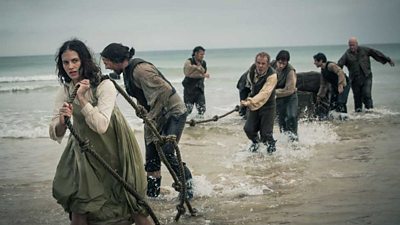
I wanted to film the wrecking sequence in the sea, and not in a tank in a studio. I wanted it to feel very raw and real. Going in the sea with all the crew and the actors was absolutely exhilarating, but completely gruelling as well. I’m not a very brave person so I had grit my teeth. We had to wear dry suits, and have our ankles weighted so we didn’t get flipped off our feet by the waves. We each had a lifeguard in the water to fish us out when we fell over! The crew kept me going, but unlike me, they’re all really brave and loved it!
Do you think your past documentary work has influenced your drama work?
I haven’t made a documentary for about 15 years, but since then I’ve made a lot of dramas based on real life, like Call The Midwife and Five Daughters. I think if you start off in documentary you always have a feeling that things have to be authentic, no matter whether it’s a fictional drama or a drama based on real life. For me it’s important that the characters feel believable, and that I can relate to them and that I get totally drawn into their life, and I want to know what happens to them. I think that’s what is so important with a character like Mary. You want to be drawn into her world, and go through what she’s going through with her. I can only do that if the characters and the world we are creating feel real to me .
What did you particularly love about Emma’s script?
Emma is a great story teller and I love the fact the scripts are so visual and atmospheric. I also love the tangled web of the relationships between the characters. A lot of the time it’s not about what the characters are saying, it’s about what they are not saying! It’s about the undercurrents between them, and that’s so exciting to dramatise – who is really in love with who, who is jealous of who, who really has the power. The dialogue in Emma’s script is spare, which makes it really cinematic, and gives room for the complexity of the relationships to come out between the characters in a more visceral and visual way.
What would you like audiences to get from this adaptation of Jamaica Inn?
I would really like audiences to enjoy the fantastic cast and the epic Cornish landscape, bringing Du Maurier’s gripping gothic romance to life on screen, and get swept along with Mary as she navigates the dangers she faces both physically and emotionally – will she survive, will she fall in love...
