Q&A with Reece Shearsmith and Steve Pemberton
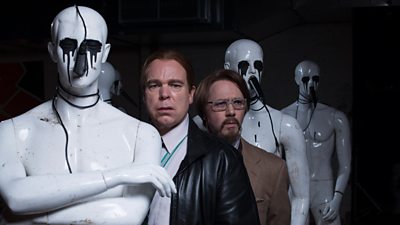
It’s like a big box of chocolates that you’ve got to rummage around in - and you may love them all, but you might be aware that one of them has a drawing pin in…
What can we expect from series three of Inside No. 9?
Reece: There are five more rooms to explore, with comedy, great horror and psychological thrills. A mixture of the things that you would expect us to do, but in new and surprising ways, with a great new cast and with Steve and I as the driving force behind those stories. It’s a mixed bag as anthology shows should be: we go into a lot of different worlds, high gothic, silly, Agatha Christie, mystery and some of it more psychologically disturbing.
How would you describe Inside No. 9 to someone who hasn’t seen it before?
Steve: It’s like a big box of chocolates that you’ve got to rummage around in, and you may love them all but you might be aware that one of them has a drawing pin in…
R: ...or a razor blade!
S: It’s an anthology series which has a mixture of high comedy, high drama, a bit of horror, and you never know quite what you’re going to get with each episode, so the less you know the better. It doesn’t fit into any particular genre or any particular characterisation -we think that makes for a richer viewing experience.
How do you both keep coming up with new ideas, locations and themes for each episode?
R: It’s always born from whether something catches fire as an initial idea with the pair of us. Sometimes we’ve thought of something and we’ve stewed over it for a few days and then thought, actually, it’s not something we want to wheedle out of its shell. But if we get an idea that tickles us and we think has got legs, surprising twists and turns can come from it. That’s a starting point and then we will pursue it and we’ll beat out a story. They’re black comedies and we like telling a story that once you start watching you’ve got to see through to the end. You might not like where it is going but you can’t take your eyes off it. Hopefully it’s an enjoyable bit of television.
S: When you’re in the writing phase, you can see anything in day-to-day life that could spark your imagination. We heard an argument in a restaurant about paying a bill and we thought, that’s a good episode - and we went straight back to our office and started writing it. There was one morning where I saw a shoe abandoned by the side of the road and wondered who’d left it there and what would happen if someone was obsessed with getting it back to its rightful owner. Again, we went back and started writing that as an episode. If we weren’t in writing mode and we saw those things we probably wouldn’t have paid any attention to them. So it’s a mixture of things that you see and observe and then it’s just what interests you. One episode is about cryptic crosswords which I am a big fan of, one is about karaoke that I am also a fan of. For us it’s a big dressing-up box to do what we want with, we don’t put any limitations on it when we’re writing.
What’s it been like working with the guest cast this series?
R: It’s been great, it’s always lovely to hear back that they enjoy the scripts and stories. They’re appealing things to do for an actor, it’s great to get a good script and think, I’ve got an important role to play in it, even if it’s just a little part. We’ve had some great people in small roles who you think normally might not say yes. Being actors ourselves, we know what it’s like to get asked to do something and you read it and you think, can I bring something to it? - and we always try to do that, even with the smallest parts. That’s how we manage to trap some very good people into being part of our world.
S: A lot of the people we work with are very busy, and I know in Keeley Hawes and Philip Glenister’s cases they both said they were hoping they weren't going to like the script because they were so busy, but they had to do it because they loved it so much - and that’s the trick we play in pulling people in. They’re also unusual scripts and stories.
Having a brand new cast of people coming in always re-energises us, because we’re in every episode. When it’s coming towards the end of the week the cast get jealous about who we’ve got coming in next. When we did Empty Orchestra, Tamzin Outhwaite and Sarah Hadland said, "you’re not going to enjoy the next one as much! We’re gonna be the best one we’re gonna be your favourite cast." And then we took pictures of ourselves with Fiona Shaw and Morgana Robinson, crying with laughter, and sent them to them and said: "we’re having much more fun!"
Do you both have a favourite character from series three that you’ve played? And if so why?
S: I like Professor Squires who’s in The Riddle Of The Sphinx. I like the journey he goes on, he starts on one thing and it ends up something very different. It was great to rehearse that as if it was a little play because it is just a three-hander, so that was very rewarding.
R: I enjoyed all the scenes will Keeley Hawes in Diddle Diddle Dumpling, the story of a man slightly unravelling about something so ordinary as a shoe.
S: Oh, so you didn’t like the scenes with me?
R: No, just the ones with Keeley! Funny you’re only in one scene though! (laughs). That was great to play with such a good actress as Keeley and there were some very emotional bits. Equally, it was fun to be in the sumo wrestling outfit in Empty Orchestra. That was a slightly mad, imagine being in a karaoke bar for a week...
Did you have any favourite moments from your time on set?
S: The most hysterical week was the karaoke week. I didn’t realise but Tamzin and Sarah knew each other and they brought a bubbly energy which injected into the hysteria of that room.
R: There’s a scene where a hen party invades the karaoke room and they start singing. The music was pumped up and we had a mini party, with mad dancing - that was a memorable scene to film.
What makes Inside No. 9 unique?
R: It’s a set of different stories and the link - other than the nines - is me and Steve, our writing and the fact that we’re in them. We bring something to it that is particular to us, because it’s our take on these characters and stories and that’s the thing that binds them.
S: It’s because you get a beginning, middle and end every week and you don’t have to follow through. You can watch them in any order and the variety in the tones between the episodes is unique. It’s a sense of not knowing where it’s going to go and what you’re going to get out of it. It’s also a nostalgic look at how they used to make television. We like to think of them as the little Play For Today’s of our age, the single drama strand or even single comedy strand has fallen by the wayside in recent years, so what makes it unique and feel more modern than ever, is the fact that we’re taking inspiration from the past.
Who were the biggest influences on this series?
S: Every episode has different influences, so one of them was quite an Agatha Christie type story, one has a flavour of Sleuth by Anthony Shaffer, one has a Stanley Kubrick-esque feel of the story writing. In every episode we draw on a very eclectic mix: for Empty Orchestra I really liked what Shane Meadows did with This Is England, where you sensed those characters were having fun at these musical events, and we wanted to bring some of that into it. Victoria Wood, who we lost this year, has always been a huge influence on what we’ve written.
R: That’s the beauty that we pump into all these different stories and things that we like. It’s a lot of our taste put into each world each week and that’s a lovely thing to be able to explore. It’s daunting because you can do anything as long as you keep coming up with the ideas, that’s what’s thrilling about being able to keep doing them because you can never rest on your laurels - you wouldn’t want to.
