Interview with Sam Miller
Sam Miller is the co-director/executive producer of I May Destroy You.
Published: 28 May 2020
I hope it feels full of truth. It has a lot to say about personal boundaries and relationships. It doesn’t shy away from how complicated life can be, especially in this social media-saturated world.
How did you get involved in the project?
I first met Michaela with the Various Artists Ltd execs Phil and Roberto in January 2019. I felt an instant connection with them, I appreciated how thoughtful and collaborative they were. At that point I had read episodes one and two and was blown away by Michaela’s writing. I loved the honesty of the characters and situations and the way it could depict London.
What would you say is the main theme of the show?
The stories explore sexual boundaries through the issues of consent, self-discovery and the importance of friendship. Whilst the central story is inspired by real life events, Michaela has used this as the launchpad of which the stories explode and explore numerous personal scenarios of each of the characters, whilst drilling down into the true nature of friendship and support. It sounds a lot and it is, but it is beautifully written and funny as hell.
How did you find working with Michaela and Various Artists Ltd on this project?
Michaela and VAL (Phil, Roberto, Tanya, Tash and Marilyn) have an incredible relationship that is both supportive and creative. I felt very excited to sit down with the group, developing the series in the latter stages prior to production.
The early meetings were all script-based as Michaela rapidly delivered and then re-worked each script from one to 12. She had a very clear sense of where each story was heading and a 360-degree vision to analyse shift and change emphasis, when she needed to.
Watching her hone the stories was amazing - she was never the victim of the fixed idea, and had the vision to invert or omit when something didn’t feel right. At times she would jettison huge creative rafts with no regrets. I remember asking to reinstate a sequence because it was so strong, and she would smile wistfully and say that was yesterday’s draft.
As the series took shape I remember the first time we put a rough shooting schedule up on the wall - it took up a whole side of the office and then spread onto the next wall. Seeing the reach of the series, I was struck by how discreet and self-contained each 30-minute episode was, each one individual and daring in its own way. At the same time, I could see one beautifully modulated six-hour epic series unfolding.
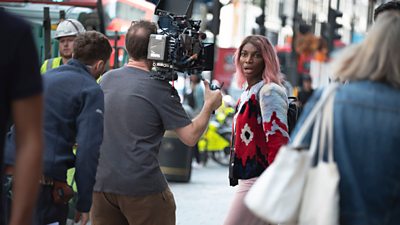
Working with Michaela has been an exhilarating experience. I felt pressure at first, but being in pre-production and then on set with Michaela - our lead actor/ writer/ series creator/and latterly co-director - it enabled the nature of the stories to be more fully realised. Michaela is able to separate her roles, so her function as a writer never seemed to impinge on her being able to give 100 percent in front of the camera.
We had a brilliant crew across the board. We worked with Paul Cross, the same designer I had worked with across several seasons of Luther. We both share a love of London and how to film it, especially the corridor of North London that runs down from Hackney through Shoreditch to the square mile, it's ever evolving and shifting.
We were strict in choosing locations that made logical geographical sense for our characters and keeping true to their worlds. If a sequence was drifting or we were struggling to nail a particular moment I would ask Michaela, what were you seeing? Or, is this how you imagined it? She was always able to step away from delivering her ferocious all-encompassing performance to discuss. Thus we were very precise in how the work was shaped and delivered.
Can you talk about the casting process?
We both have a close and fond relationship with our casting director, Julie Harkin. I worked extensively with Julie when setting up the first season of Fortitude. She and her assistant Nathan have great instincts and an insatiable hunger to find the right actors. All through the creative process we questioned and attempted to steer away from TV tropes and clichés, and in the casting process the battle lines are drawn.
I remember Tony Garnett saying to me when we were casting This Life, back in the day, that casting is 70 percent of the process. I wasn’t sure at the time as it seemed to under value the other production disciplines, but I learned to see and respect what he meant. Similar to Amy Jenkins’ This Life, the scripts for I May Destroy You had a totally authentic and unique voice.
What challenges did you face during filming? Have you come up against any challenges since finishing filming?
Finding the tone of I May Destroy You. To tell the stories whilst allowing the humour to sit alongside the seriousness, so one doesn’t rob the other. Much of learning how to film a story is about setting up rules for how your film and enact - and then it is about breaking those rules. Learning how to achieve Michaela’s vision for I May Destroy You whilst remaining a strong creative force for her. The role of the director is to answer the call of the story in whatever way he or she can.
What do you hope the audience will take away from the series?
I hope it feels full of truth. I think it has a lot to say about personal boundaries and relationships. It doesn’t shy away from how complicated life can be especially in this social-media-saturated world. But ultimately Arabella’s journey is uplifting, about self-discovery through friendship and artistic expression. Along the way it is shocking. And it’s funny.