Interview with Phil Clarke and Roberto Troni
Phil Clarke and Roberto Troni are the Executive Producers of I May Destroy You.
Published: 26 May 2020
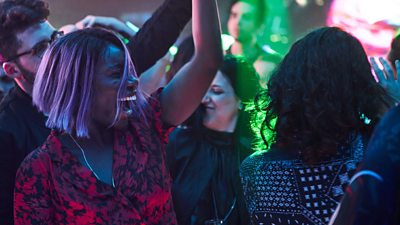
It’s about difficult issues that confront so many of us today - of consent, personal responsibility, the difficulties of negotiating your public identity on social media and of deciding who you are in real life.
Can you both introduce yourselves and tell me about your roles on I May Destroy You?
We are executive producers and also managing directors of Various Artists Ltd.
Can you briefly set up what the series is about?
I May Destroy You is a drama - this is worth pointing out, as Michaela is best known for writing award-winning comedy. But although I May Destroy You deals with serious issues, the series is full of lighter moments. Michaela hasn’t abandoned her roots.
The series is principally about a sexual assault and emotional fallout of that incident on the central character, Arabella, and her friends, over the course of a year.
But the series also explores a whole range of themes, with its central concern being consent, sexual consent. It also deals with the gender politics of a whole generation, and its relationship with social media. On a personal level it explores friendship, guilt, revenge, and forgiveness, and real people’s relationships in an ambiguous world.
Where is the story set and how does that inform how you tell this story?
The story is set in London, in the present day. There is also a subplot set in Italy.
It begins with Arabella (Michaela), a young writer and memoirist, trying to write a follow-up to her first, successful book. It’s not going well. She’s also part of a young sophisticated, hip, urban crowd who likes to party, so we start our story with her escaping her problems by hitting the town.
What made you decide to take on this story and bring it to life?
The inspiration for the story came from Michaela and it is very much her vision. But we felt she had so many valid things to say, that we were excited to work with her in bringing it to the screen.
What was the most challenging aspect of this job?
The challenges for executive producers change as the production progresses. Initially it was about the script - acting as a sounding board for Michaela and interrogating the characters and storyline. During filming it’s about keeping the show on the road, supporting the production team and keeping an editorial overview. It’s also about keeping an eye on the budget. During post-production it’s about interrogating the editing of the programme in the same way that we approached the scripts.
Michaela Coel has written the series, but she also starred and executively produced. Talk us through that process of working alongside her and how you work together.
We really enjoyed working with Michaela. We approached the writing processes as a team and would meet regularly with her, Natasha Philips, the script editor, and Tanya Qureshi associate producer to thrash out ideas and interrogate the script, plot structures and characters. But the series was written by Michaela, and she would frequently come back with twists and ideas that were much better than our suggestions!
Michaela is robust about her work and invites collaboration - she knows what she wants but she also appreciates honest feedback. It makes working with her very satisfying and stimulating.
What does Michaela Coel bring to the series?
Everything. The series starts and ends with her. There would be no show without her.
How much prep time did you have before the start of filming?
We had 12 weeks pre-production before we started filming, but however much time you have when you are producing a show, it never feels like enough!
Take us through the process of selecting the creative team?
The process involved meeting and talking to a lot of production people to find those who were the right fit, and who felt inspired by what Michaela wanted to say.
Had you worked with any of them before?
Phil: I hadn’t because my background is in comedy and this was a drama production. I had however worked with Christian Sandino Taylor, the editor, before and he is terrific. We were lucky to get him for this project.
Roberto: I too had worked with Christian and had also worked with another one of our editing Team, Guy Bensley, in the past and Sam Miller, one of the directors - many many years ago. But I have known and worked with Simon Meyers, the producer, on a number of occasions over the years.
Some of the subject matter is sensitive and could be triggering for some audiences. How do you go about portraying those scenes within the series?
We are mindful that there are some powerful, disturbing scenes in the series. Some of these were difficult to film for the cast and had to be approached sensitively. Intimacy Advisors were engaged to help with that process. Those moments/scenes are of course, integral to the plot, and there’s an honesty to Michaela’s writing which means the reason for a scene is always clear. This is very much a post-watershed show and when broadcast it will come with the appropriate warnings for the audience.
Various Artists Limited has produced a number of successful series which address slightly more taboo subject matters than others, such as Sally 4 Ever. What draws you to creating this material? What is the secret to producing it respectfully and sensitively?
Phil: There’s no secret per se. I tend to make shows that I’d like to watch, so personal taste has a lot to do with it. There’s nothing more discouraging than working on a show that you don’t believe in. It’s also about collaborating closely and respecting the writer’s wishes as much as possible. Finally, it’s about working with people who you have chemistry with, or are on a similar wavelength.
Roberto: The material comes from the writers. But as Phil says, it’s the kind of thing we like to watch, and when the opportunity to be involved in making or developing homes our way, we grab it with both hands!
Can you talk about the process of finding the right cast to inhabit these characters?
We were very lucky to work with casting director Julie Harkin and her team. They were outstanding and did a brilliant job at finding our young cast of exciting new actors. And Michaela as the lead creative force in this, and as a pretty fantastic actor/actress herself, had a finely tuned sense of who was good and right for their respective parts.
Talk us through the character of Arabella.
There are two Arabellas. At the outset we meet a headstrong, demanding and self-absorbed young woman, someone who is capable of being unknowingly selfish.
By the end, she is a different person; someone who has had to confront the things that have happened to her, but also someone who has had to deal with her demons by asking some hard questions about herself. In the end she finds a way to live with the answers.
Had you worked with any of the cast before?
Phil: Yes, I worked with Michaela when I commissioned Chewing Gum for Channel 4.
Roberto: I commissioned a show called The Aliens for E4 in which Michaela had a lead role.
What have you enjoyed most about working on this project?
Working with Michaela - she raises your game. It’s hard to keep up with her sometimes as the ideas and energy pour off her, and she always pushes for originality. She doesn’t take the easy, stock route, or pander to received wisdom. Her lack of vanity, and her vivid honesty, set a high bar.
Did you face any challenges when filming I May Destroy You?
Some of the material was very demanding to film, and as per all shoots it’s a race against time to get everything in the can. Filming in Italy was challenging. And finishing production during a pandemic isn’t easy.
What do you hope audiences will take away from the series?
The desire to watch another series written by and starring Michaela!
Why do you think I May Destroy You will resonate with a 2020 audience?
It’s about difficult issues that confront so many of us today: about consent, personal responsibility, the difficulties of negotiating your public identity on social media, and of deciding who you are in real life.