Julia Ormond plays Julia Day
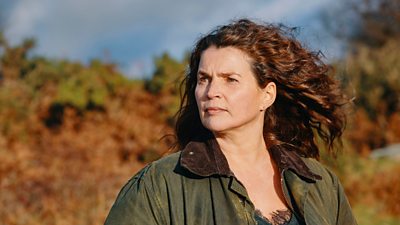
As Julia Day in the BBC One domestic noir, Gold Digger, Julia Ormond is happy to challenge preconceived notions of women and relationships.
Published: 5 November 2019
This story is beautifully revealing of how we pigeonhole people, how we write them off and how we close off certain aspects of their life because we see them as fitting a specific role.
"Gold Digger is the story of a dysfunctional family and the events that happen when Julia Day, my character, meets a much younger man, Benjamin Greene (Ben Barnes), and starts a relationship with him. It is about how all the people who are close to her have an opinion about it and a relationship to it, and how that really pushes them and challenges them as a family to confront their demons and their relationship to this woman, their 60 year-old mum, who to them is somewhat invisible.
"When we first encounter Julia she's quite wounded and bruised from the falling apart of her marriage. Her ex-husband, Ted (Alex Jennings) has left her for her best friend, and two out of three of her children have left home and moved on in life, so she's somewhat lost and struggling with quite low self-esteem.
"The story kicks off with Julia’s 60th birthday and each one of her children successively either forget it or can't turn up and so she takes herself to the British Museum, where she used to work, and she runs into Benjamin, who is someone who shows an interest in her, who finds her interesting, and she ends up rather impulsively going for a drink with him, for want of something better to do on her birthday, and that's how the relationship starts."
Julia discusses the ways in which her character’s new and unexpected relationship impacts on the Day family.
"Her new relationship with Benjamin posits challenges for Julia’s children in the way they view their mother. It defies expectations that she's now thinking of embarking on a relationship with a younger man. It's more comfortable for them if she is just to stay a divorcee and single.
"What attracted me to the story is the way that it's provocative and it challenges us in terms of how we see women who have devoted their life to motherhood - and what they do when that phase is coming to an end. To Julia’s children there is a sense that Benjamin is a threat to their inheritance and a feeling that there is something off about him, but it’s founded in this disbelief that he could genuinely love her. So each episode unpacks this, looking at the preconceived ideas about how women should be with men. Despite the fact that we’re very used to seeing older men with much younger women, to see the reverse throws into sharp relief our societal expectations of women. One would think it should not be that inconceivable, but at the same time something does feel off…"
Julia explains how the writer Marnie Dickens slowly reveals the suppressed trauma these characters are struggling with.
"As you progress through the episodes you understand why it is, for each family member, that Julia’s new relationship personally challenges them. It goes beyond just selfishness, it taps into a family secret and a trauma that's been dealt with in a way that's not necessarily healthy for all of them, and Benjamin coming into the mix stirs things up. With the use of momentary flashbacks you are privy to how that trauma has changed them or left them with baggage that they’re still acting out over in their current lives.
"These flashbacks are revealed slowly over the episodes and they become a jigsaw puzzle that you get one piece or fragment of at a time. In that sense it is similar to our memory, which is also stored in fragments. It brings into question the reliability and accuracy of our memories. Each member of the Day family has a slightly different memory of this trauma that is personal to them, but they are each affected by it in some particular way - it stays with them as a family until they’re able to unpack it. For Julia it affects whether or not she is capable of having a loving relationship, as so much of her and of her development as a person has been altered by this."
Devon locations are key to the drama, as Julia explains.
"We shot most of this series in Devon and we were on this promontory with cliffs dropping on either side, and I was a bit anxious about it because I have found that all sorts of things that didn’t concern me before in life for some reason since becoming a mum have started to. So they had all sorts of protective equipment and we had stunt guys attached to all of these cables.
"The landscape of Devon is so beautiful and it's a very dramatic setting that has this beautiful parallel with what's going on in terms of Julia’s internal landscape. Her internal and external kind of web and weave together, in a way that speaks to where she is in her life. She is on the edge of this terrifying cliff but she’s also on a beautiful beach and the relationship she has with Benjamin, and the fallout that comes through the family and how the family relates to her because she's trying to make the right choice for herself, kind of drives her to a precipice and somewhere that's quite bleak and isolated. It was definitely an apt and stunning setting to be shooting in, and there is something about the land that is an embodiment of her life.
"A portion of the story also occurs in London and so there's a section of it that we got to shoot in kind of extraordinary locations. We had an amazing day at the British Museum, where we turned up early and no one else was there, and it was definitely one of those rather jammy moments that you have as an actor."
Gold Digger explores interfamilial relationships and the secrets we keep. It unpicks important subjects like trauma and how it affects people and it brings into question the way we so easily label those around us.
"This drama has been described as a domestic noir, which I thought was very accurate. There is a grittiness to the tone mixed with moments that feel quite pedestrian and normal, very English - there are lots of cups of tea - but at the same time it becomes quite searing. It doesn’t shy away from the darker things people are dealing with as individuals and at the same time there's this beautiful kind of dance that they're all doing as family, in terms of what they're withholding from each other privately and the private agonies that are going on within.
"This story is beautifully revealing of how we pigeonhole people, how we write them off and how we close off certain aspects of their life because we see them as fitting a specific role. We decide what someone means to us, what they give to and provide for us, and we want them to stay there, perpetually frozen in that role and not have other avenues of their life explored.
"There is also something quite extraordinary about the way Marnie has written the impact of trauma on this family. There is something about trauma and how people deal with it in their lives that has a long-term effect and impact on their ability to love, love themselves and love someone else."