Q&A with the multi-awarding winning original cast of Horrible Histories
Q&A with the multi-awarding winning original cast of Horrible Histories.
Published: 8 April 2019
How did Ghosts come about? What’s the story behind it?
What’s happening across the whole series? Is Alison trying to help them to escape?
Laurence: Yep that’s the logic - if your house is haunted, you either need to get rid of the ghosts or you need to get out of the house. But it quickly becomes apparent that neither of those things are options and it's making the best of a bad situation. There are two things pulling on her: one of them is this house that she’s now stuck with, she’s trying to make a success of it, but also trying to come to terms with the fact that she’s got to share her house with some really difficult idiots that only she can see and her husband can’t.
She’s put in an impossible situation and the series is about her trying to muddle her way through that new reality.
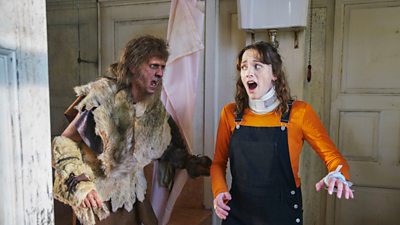
Pictured: Robin the Caveman (Larry Rickard), Alison (Charlotte Ritchie)
Tonally, how would you say this differs from Horrible Histories? Is it Horrible Histories for grown-ups?
Matthew: I don’t think so. To some extent there is common ground in the sense that there is a comic tone and the characters are from history, but beyond that it’s not a sketch show, it’s not aiming to educate in any way.
Laurence: That’s the thing with Horrible Histories - as performers we were always fighting against the facts in a way, we could sell the facts if we did something ridiculous enough around it… So the things we’ve done since then have always been free of that constraint.
Matthew: It’s also, I think, the most grown up thing we’ve done, in the sense that we’ve matured and we find this funny… there’s an edge of darkness to it. There are bits that are a little bit spooky and a little bit scary. We’ve allowed ourselves a little more cheek than that you are restricted to in a pre-watershed slot. The kids who are watching Horrible Histories, at least the first time around, now they are all grown up - hopefully we’re making something so they can continue to watch us!
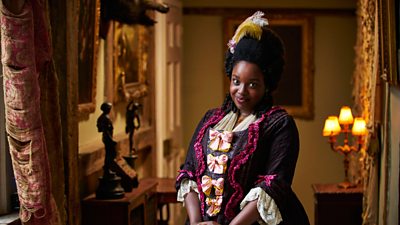
Pictured: Kitty (Lolly Adefope)
Is it a family show?
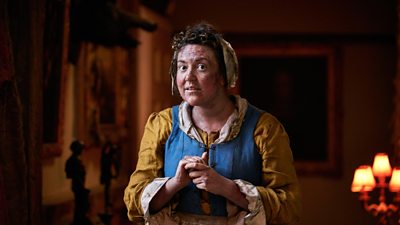
Jim: I think so.
Laurence: We were talking about the things we loved when we were growing up and often they were things like Blackadder and things that were around before the division between kids and grown-up content existed. I watched Blackadder and so did my parents. Sometime in the 90s comedy became something that adults watched at 10pm and there were children’s shows that children watched. It was a split - and it never really came back together again. Or it was things that were slightly cheeky but… I’ve got a vivid image of watching the Life Of Brian though the rippled glass of my parents’ 1980s living room door. I wasn’t supposed to be watching it! There’s a little bit of that.
Simon: I wasn’t supposed to watch it either!
Matthew: I’d love to think it’s the sort of show that people will let their kids stay up a bit later for. I’d like for it to feel like it’s a bit of a treat to allow them to watch it.
Laurence: The fact that we’re doing something for BBC One - we don’t feel like we’ve been pushed into a corner, this is the tone of what we’re doing and this is what we want to be doing.
Matthew: There’s been lots of times filming this when we’ve been saying to each other, BBC One actually want this!. We don’t feel at any point that there’s been any pressure to make it any less distinctive. I’d say that it takes up some of the tone of Yonderland possibly more than Horrible Histories. It has a kind of clash of surrealism as well as the broader, more accessible sense of adventure.
Pictured: Mary (Katy Wix)
How many of the ghosts are products of their time and do they jar against each other?
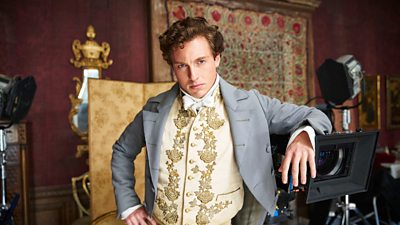
Jim: The pop culture of my character, for example, who died in the 80s… it gives you a nice window into the time. It allows him to introduce things like pop music.
Ben: He probably had an early Walkman, but now he sees they’ve got iPhones. The internet blows all of their minds!
Laurence: They say leopards don’t change their spots, and to an extent that’s true. Your moral compass and everything is set in the time you’re growing up and the time in which you’re born. It’s been so fun to write because you’ve got people with completely different ideas of what is and what isn’t acceptable.
Jim: For some of them, life is cheap. The idea that you can solve a problem by killing someone, for some of them, is perfectly acceptable.
Laurence: The caveman’s first suggestion to most problems is to kill them.
Simon: There are interesting clashes.
Matthew: Ghosts can pass on, but they don’t know how or why. They also don’t know why they are stuck there. It’s a metaphor for life really. We’re stuck here, we don’t know why, and what do I do to fill my time? Instead of thinking, well it could be centuries, so I could learn every language and read every great work of literature, they still approach it day by day.
Jim: It allows us to have a jeopardy too.
Matthew: We’re all aware that we could die tomorrow, but does that mean that I live every day as if it could be my last? No. None of us do.
Ben: I do! I’ve just bought a sports car.
Martha: That’s a mid-life crisis.
Pictured: Toby Nightingale (Rory Fleck Byrne)
Do you have a lot of Ghosts that you had to discard?
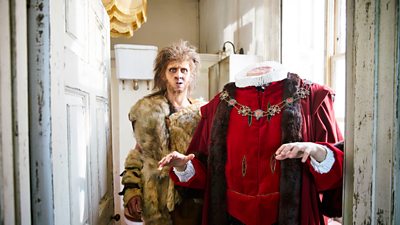
Matthew: Some of them were folded into characters that we’ve got. There was an idea early on that the wisest ghost in the house would be a six year-old child, because she’d been there for centuries, and they’d all find it really creepy going to ask her for advice - and for a number of reasons, that’s unpractical.
Simon: Martha and I played a couple where I had killed her and then killed myself. Then of course, in that scenario you both end up as ghosts and then you think, great - now I’m stuck with her.
All: She killed you!
Matthew: The whole thing was, they were a couple that hated each other and to escape the marriage she killed him but then immediately died by accident and therefore ended up stuck with him for eternity.
Simon: So that went, for obvious reasons.
Pictured: Robin the Caveman and Headless John (Larry Rickard), Headless John s body (Yani Aleksandrov)
What would you say is so funny/interesting about exploring the Afterlife?
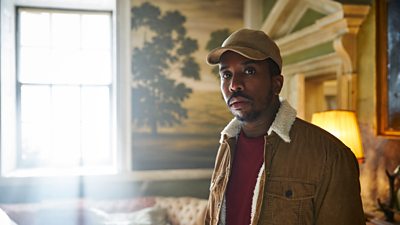
Matthew: I’ve really enjoyed it in a metaphorical sense, it’s actually a way to talk about existing.
Laurence: We’re almost the antithesis of that in the show. Rather than saying there's an afterlife - a place you go on to - we’re saying there’s not, and you’re stuck! You end up doing exactly what you had to do again, in the last place you were when you were alive. You’re back there and now you’re stuck with it. It's more like a purgatory than an afterlife.
We've got these white-light moments when the ghosts pass over, and the feeling from the other ghosts is just real petty jealousy. In the same way we do, when someone dies you mourn them and to a certain degree you think about where they are and what they’re doing, if there is anything. In the show, that big bright light is that annoying thing and that lucky get-out. It just makes the ghosts more angry.
Simon: My favourite scenes are the ones where they’re arguing over really tiny things that become so important because that’s all they’ve got.
Jim: Julian can just about touch stuff, Larry’s character Robin can affect the lights and Mary can omit a smell. So we do have a very very small practical effect on the world, but we try to use the skills in a haunting in the first episode which doesn’t work.
Pictured: Mike (Kiell Smith-Bynoe)
Will you take the Ghosts outside the house or would that destroy them?
Matthew: That’s against the rules.
Jim: We can go as far as the drive, because my character didn’t die in the house, he died on the grounds, and Mat’s character died on the grounds as well.
Laurence: In the very early stages of developing we sat down and went, okay - what are Ghosts and how do they work in terms of stories? It's saying, this place is haunted because someone died here and for some reason there’s this geographical link which means people stay where they die.
When you have individual projects, how does it all work together as a group?
Laurence: It gets increasingly difficult. We try to carve out two or three-month periods where we can all be together, because it’s still really enjoyable, it’s like a homecoming.
Simon: We have days where we get down and throw as many ideas out as we can - usually we’re all around for those.
Matthew: So far, we’ve all continued to want to work together.
Which characters are you most recognised for still?
Matthew: The thing about Horrible Histories, we were every version of ourselves we could be - long beards, short beards, no beards, moustache. You can’t present yourself in any way that you’re not going to get recognised for it.
Do you guys miss it at all?
Laurence: It was such a joy. We’re six very different people but we’ve all got the same sense of humour and always made each other laugh. We would get in the car at the end of the day and our faces hurt from laughing, and that doesn’t happen on other jobs.
We all get to work on fun exciting things and we’re very lucky to be in the careers we’re in, but there’s something different about this, and the reason we started to develop Yonderland and Bill was we were always terrified that the thing we were doing would be the last chance to work together and we tried to avoid it - so far!
You started on CBBC and now this is your big BBC One show. People have been comparing you to them for years, but is this your big Monty Python moment?
Ben: It would lovely if it was!
Matthew: There is a crossover but our history is different to them - we didn’t come through together through university and that sort of thing. It makes me nervous being compared to them, you know!
Laurence: When we sit down and talk about things that make us laugh that’s one of them, but there are a thousand other shows, a million other YouTube clips or people you pass in the street who've just got a funny voice, there are so many influences and that’s just one of them.
Matthew: The reason it probably keeps coming up is because there aren’t gangs any more. Python was the most famous iteration of that era of comedy troops, and since The League Of Gentlemen there haven't been many groups. The audience enjoys it, it’s the fun of seeing the same people in different guises every time you watch a new thing - we’ve all had that as fans of Python and League.
Laurence: We could not have been more diligent in trying to make the best show we possibly can.
Matthew: All you can do is make a show that you're proud of. So far that's what's happened and our approach is no different now, thinking that there’s a big audience who can watch it. It hasn't affected how we’ve approached the writing process at all.
Would you ever do a pure sketch show?
Matthew: The Venn diagram of all our particular tastes has this spot in the middle where they cross over. Working on sketches, because they’re nuggets and individual ideas, you don’t really get to explore that space.
Instead of making a virtue of this melting pot of our different tastes, a sketch show feels like it would be tonally uneven - and all over the place - because it would feel like three different sketch shows of three different sensibilities.
Sketch shows that work tend to be ones that have a really good sort of identity, some sort of over overarching reason to exist beyond, 'here’s a sketch show from these two people’. With Python, you always think of the animations and the fact that they make much out of how you link to sketches. Horrible Histories had a reason, it had such a clear identity, it had themes. We never found a reason for us to make a sketch show outside of Horrible Histories.
Simon: We’ve come to enjoy working on narrative and structure, things that lend themselves to some emotion and poignancy, and it’s really hard to get that in a sketch show because it’s all about the laughs. In this we’ve got death and we’ve got bits here and there where you get a bit of emotion.