Interview with Tom Vaughan-Lawlor
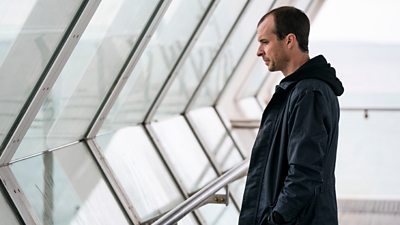
Detective Frank Mackey played by Tom Vaughan-Lawlor in Dublin Murders.
Published: 1 October 2019
Normally you’ve got the IRA story, the famine stories and the civil war stories. But modern contemporary Dublin isn’t really examined or explored. I think that’s what’s exciting to see - it’s the more gothic side, the underbelly.
Who is Frank?
Frank heads up all units within the undercover section of the Dublin Murder Team. His headquarters, or ‘his office’, is not on-site and doesn't fall within the confines of the regular police infrastructure, as Frank is more of a hit-and-run kind of guy. He’s got an unmarked office somewhere in town that his informants and agents can drop in as and when. I would describe Frank as a renegade, and I suppose he is really an anarchic: he is irreverent and anti-establishment, and his moral code is ambiguous.
What’s his relationship when we first meet him with Rob and Cassie?
Frank doesn’t really know Rob at all. But with Cassie, he handpicked her from out of the new recruits as a low rank-and-file to front up a new operation. Frank needed a young cadet/young police officer to go undercover in specific cases and as soon as Cassie came into Frank’s office, he sees straight off the bat that she’s ambitious, hungry and has a similar world-view to him that is nihilistic and strange.
Frank, I would say, is drawn to Cassie in many ways emotionally and psychologically. They have a very fluid relationship that is hard to identify, I personally would say that their relationship was a strange mix of paternal and sexual, making for an interesting play. Frank also uses his status and power when it comes to Cassie. Frank can be manipulative but he’s not a villain, but not quite a goodie, he is in the middle in a grey area.
How did you come to be involved?
Strangely enough, three or four years ago I read The Secret Place, which is book five of Tana French’s Dublin Murder Squad series. The book is set in a Dublin boarding school and it was recommended to me. I happened to be in Sweden one time and it was there in the airport, so I just grabbed it going on to a plane. The book is quite long - about 600 pages - but I think I read it in a few days. It was a total page turner. So, when this came up, I jumped at the chance to be involved. Especially playing a character like Frank: someone who operates in the grey area and who is hard to pinpoint, in an exciting way. He’s in The Secret Place as a character as well as the novel Faithful Place, in which he is the lead character, so potentially he would go into further series.
What did you make of the script?
It's clever in the sense that it plays with time. There’s a split timeline, and it jumps forwards and backwards. There are also two cases going on simultaneously, which run alongside each other, and you have two main characters pinballing off each other within those two cases. This is really smart, and it gives a landscape for characters to have room to play in. There are a hell of a lot of balls in the air and spinning plates, whatever the metaphor is. Tana French and Sarah Phelps are both really clever and together they have created a brilliant landscape of characters, as well as nuanced and complex storylines.
What will surprise viewers about the Dublin in Dublin Murders?
People’s understanding of Ireland internationally, I would say, is still drinking, leprechauns and maybe literature and music. With Dublin Murders audiences, especially American audiences will get to see a different darker Dublin that sometimes isn’t given a full airing internationally.
Normally you’ve got the IRA story, the famine stories and the civil war, independence stories. But modern contemporary Dublin isn’t really examined or explored. I think that’s what’s exciting to see. It’s the more gothic side, the underbelly behind all the drinking and paddy-whackery or whatever you want to call it. All this other stuff is much more interesting. When you look at the great plays and books and music that comes out of Ireland, it’s much darker and more complex and stranger. It’s funny that we have this image of a Catholic country, yet the kind of secular, ancient madness that’s there is also quite potent. That side is also very predominant in Ireland and in Irish folklore and I think that’s quite exciting to explore.
With a predominantly Irish cast and crew, did this production feel different to others you’ve done?
What I think was interesting is when you have an Irish cast and an Irish crew, alongside an English director (Saul Dibb) and an English writer (Sarah Phelps), that actually they come unburdened. They don’t come with a certain cultural or historical baggage which means that they can have fresh eyes. That is really healthy and exciting. It’s that mix between Saul, John Hayes, Rebecca Gatward (Directors), Sarah and the producers with the Irish crew and cast that works really well.