Interview with Killian Scott
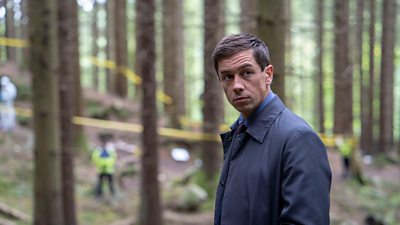
Detective Robert ‘Rob’ Reilly is played by Killian Scott.
Published: 1 October 2019
One of the things I liked about this show was that the humour felt uniquely Irish. It’s extremely dark, there’s a certain type of gallows humour that the characters have with each other.
What is the basic story of Dublin Murders?
The show revolves around two detectives in Dublin who investigate a murder. There is Rob, who is an English detective who has moved to Dublin working with the murder team, and he is partnered up with Cassie Maddox, played by Sarah Greene.
At the beginning of the show a body is discovered in the woods and Rob and Cassie are sent to investigate it. It transpires that this particular murder is relevant to a back-story of the characters. In the process of investigating this murder over the course of eight episodes, we see Rob and Cassie’s lives begin to self-destruct. The show begins with Rob and Cassie as a duo and then over the course of the eight episodes you get to see earlier moments in their relationship.
Who is Rob?
Rob is one of those characters entirely focused on his work to the detriment of everything else in his life. He’s obsessive yet also very talented. By virtue of this particular case both he and his partner Cassie begin to unravel, in the sense that a lot of regular boundaries are crossed, both personally and professionally. We also see how far people go to get what they perceive to be the truth. I would say that’s where Rob’s real fixation lies: it's in the truth, which he pursues ruthlessly.
How does Dublin Murders differ from other detective dramas?
The primary characters are both fractured and broken individuals, who are managing to keep all of that at bay by being rigorously focused on their professional life - but the mask, with all of these layers underneath, is beginning to crack.
I found that complexity interesting. There’s also a quality of the supernatural that runs through the show - it doesn't shy away from the darker recesses of the human mind and the scripts are very authentically convincing. There are elements of the storyline that are inevitably slightly heightened, but the scripts were still rooted in believable individuals and believable circumstances.
With Rob, the only person he has in his entire world is his partner Cassie. Otherwise, he’s a lone wolf. There’s a very troubled past that has forced him to be an island - you get no real suggestion of someone with an active social life or personal interests. However, Rob seems to be relatively content in that universe.
Rob is an Englishman in Ireland, what are the aspects of Rob that make him stick out?
There are two things that make Rob stick out: his distinct boarding school accent and the fact that he seems to have modelled himself on a 1960s French detective - he wears a suit and looks quite sharp. The specifics of how he ends up in his role in Ireland are not apparent initially as they are tied to a spoiler in the story.
You’re the one Irishman in the cast who’s wound up playing an Englishman, how is that?
I know! It was certainly an odd dynamic to be filming in Belfast surrounded by Irish actors, some of whom I’d come across before, and not be playing an Irish character. To be in that context and almost the entire time be in this finely-tuned British accent was a little discombobulating.
The show I did before, Damnation, I played an American character. That was much easier because we were filming in Canada with American and Canadian actors, none of whom knew or met Irish actors, so I just arrived with an American accent and went from there. Whereas in Ireland, shooting with this wonderful Irish cast, it definitely made me feel a bit like a fish out of water at times. It’s also been amazing how quickly you relax in to the environment. Saul Dibb was really useful to have as a first director because he’s English. So, he was a really good barometer for whether the accent was working.
How did you get to your English accent?
It helped that I had a fantastic dialectic coach called Brendan Gunn. He has worked with almost every great actor and was massively influential. What can often happen when doing accents is that you go too far to one extreme, so it becomes a caricature. It’s important to bring an accent back to a natural organic place so you’re still speaking like you would speak, just the sound is different. But your rhythms are not.
You know Dublin. What Dublin will viewers see here?
One of the things I liked about this show was that the humour felt uniquely Irish. It’s extremely dark, and it is something I miss when I'm away from Ireland. There’s a certain type of gallows humour that the cops in the show have with each other, and it’s a little bit cynical but very Irish.
As for the version of Dublin that is portrayed, we see tightly-knit small communities completely unravel due to a local incident, in this case a murder. That element was particularly Dublinesque for me. Previously, I worked on a show called Love/Hate which focused on gangland stuff in Dublin. It’s a topic that has been explored before when using Dublin as a setting. What Dublin Murders does is that it goes further in depth, giving greater insight into other elements, such as the police department and property development.
The show also doesn’t romanticise Dublin, it shows the gritty, dark underbelly of the place. There is also this mythical quality to Dublin Murders, there is an ominous presence, you start to get this idea that these woods are somehow alive. It’s a haunting quality that’s hard to describe, but when you see it, with the sound and the visuals, it’s something you get a sense of very quickly.