Interview with Wunmi Mosaku (Gloria Taylor)
Gripping, feature-length drama that tells the true story of the family of Damilola Taylor, going beyond the headlines to reveal a surprising and affecting portrait of family, fatherhood, loss and love.
Published: 26 October 2016
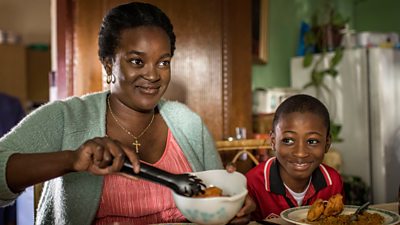
I think the saddest thing is how people take on guilt and blame that isn’t theirs or doesn’t belong to them, and how hard it is to forgive yourself.
Do you remember hearing the news when it happened at the time?
Yes, I remember I was in year ten at school and I was 15. I came from Nigeria as a child. Until I read the script, I didn’t know how long they’d been in the country for so I thought he was probably just like me, having just started school. I thought they were just like the rest of the Nigerian community that I knew in Manchester. I grew up on an estate in Manchester and people I’ve known from school have died in gang trouble and I always thought, if I’d been on a different estate at a different time, it could have been me.
Everyone in Nigeria knew about it. It felt like everyone around the world knew about it. It was so tragic. Everyone at school was talking about it, our parents were talking about it. It felt like we’d lost a brother.
What research did you do for the role?
We got a factual dossier from production about the family and the interviews that they’d done with Tunde and Richard. As Gloria had passed away, it was really interesting hearing about her through other people’s opinions of her. It was quite eye opening because you think that you’re one way and you hear about yourself through someone else, and you can be quite shocked or pleasantly surprised. It was nice because it was great to be able to see her energy in the world and not just what she thought of herself. She might not have thought of herself as this wonderful mother who kept her family together.
What did you find most challenging about the role?
The thing I was most scared of before we started filming was that I’m not a mum. I don’t think any parent can imagine, unless you’ve been through it, what it would be like to lose a child so I was already a step behind having to imagine what it’s like to even have a child, let alone lose a child. I have a niece and nephew and that is the closest thing I had to draw on. I love those two with all my heart.
Whilst we were rehearsing, I sometimes couldn’t keep control of my emotions. The scene where the police officer walks us through Damilola’s last moments caught me off guard in rehearsal. I wasn’t even in my costume and I just broke down because it was real, and this is the staircase in South London and it’s the closest thing to what he would have experienced in his last moments. I found that difficult to cope with and to control when to display the emotions. It was hard to get that again when it came to the actual filming as it was so shocking. The emotions would just sneak up on you.
How did you find working with Babou and the rest of the cast?
It was a joy. I loved working with them all, especially the kids. I still get calls from Sammy every so often. Babou is surprising as an actor as you’d think he would be very serious on set but he was just a joker. He’s really fun to be around and then he just turns it on. He was perfect casting for this. In a way he almost looks like Richard. He’s just a gem.
What do you think Levi has brought to the story?
When I read it for the first time, it was a shock to read how much blame and guilt was in that family, especially because Richard and Gloria were always a united front in the media. I think the saddest thing is how people take on guilt and blame that isn’t theirs or doesn’t belong to them, and how hard it is to forgive yourself. That’s definitely what Levi has brought out in the story.
Why do you think it’s important we revisit the story of the Taylor family?
Even when we were filming, someone was stabbed yards away from where Damilola was killed. Knife crime is still so present in our society and I think people just need to watch it and if one person decides not to carry a knife as a result, I think that’s a success. That’s important.
I just can’t believe how young people are dying for nothing. I don’t think anyone can understand how it affects the whole family. It’s not just grief, or loss, it’s so much more. There’s an African proverb that I always quote as I think it’s incredible which is, ‘if the children are not initiated into the village, then they’ll burn it down just to feel its warmth’. It sends shivers down my spine as everyone involved were children.
What do you hope the audience will take away from watching it?
I don’t know what can be done about knife crime, gang culture and people carrying weapons because it’s a world I don’t know about, but I hope that people decide to disarm and walk away from conflict.