Interview with Susan Horth (Producer)
Gripping, feature-length drama that tells the true story of the family of Damilola Taylor, going beyond the headlines to reveal a surprising and affecting portrait of family, fatherhood, loss and love.
Published: 26 October 2016
I think in many ways this is a drama about choices, and consequences.
How involved have you been with the Taylor family whilst making the drama?
We've spent many hours in conversation with Richard and Tunde, earning their trust, so they could speak honestly and candidly to us about their memories. Their extensive private interviews with our research team formed the basis of Levi's script, supplemented by interviews with thirty other friends, family and colleagues, and at every stage we consulted Richard and Tunde on specific details, described how the production was evolving, and explained our creative choices. Richard very generously shared his family archives with us and he encouraged us to tell the story that we felt was important to tell, to be unflinching and truthful about the most uncomfortable parts of their experience - so that, in the most painful and intimate moments, it felt to both Richard and Tunde that the script rang true.
From this research we gained an overlapping sense of the family’s experience, and Damilola’s personality shone out from these interviews with so many people who had known and loved him. Likewise, Gloria’s strength, her warmth, and her love for her family, was very clear from all of the people we spoke to. We hope Richard and Tunde feel the film is an honourable interpretation of their family's experience.
What were your biggest challenges in making the drama?
Most other challenges seemed mild compared to our responsibility to the Taylor family! There were a number of iconic moments in Damilola's story which we wanted to honour, and getting these right took quite a lot of focus, such as the silver jacket, which our costume department hand-made to fit Sammy, or the CCTV footage which we re-staged outside Peckham Library. The biggest of these challenges was probably setting the scene for Babou, playing Richard, to visit the scene of the crime. This moment of raw grief was captured at the time on news footage and we were choosing to capture it as intimately within the family as possible; the original estate was demolished shortly after Damilola's death so we relied on that news footage as visual reference, and the senior investigating officer has since confided that we'd recreated the stairwell 'exactly as I remember it'. That means a lot, to the whole team.
We were keen to root the film in an authentic sense of place, so with the help of the local community we filmed in Peckham, Bermondsey, Blackheath and Shooters Hill, but like all parts of London there's been a great deal of change in just 16 years so there were plenty of smaller challenges shooting a near-period drama in a real-world environment - such as avoiding the Shard, or passers-by glued to their smartphones.
How did you set about casting Damilola?
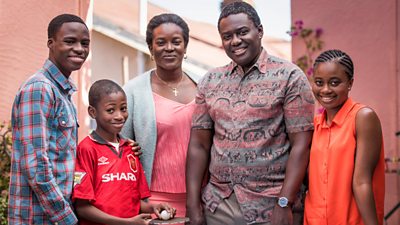
Thanks to our amazing casting director and her team, who worked very hard to find a child who could embody Damilola’s effervescent personality and joy. We wanted to be as authentic to the Taylors’ experience as possible, so we were looking for a young actor from a West African background who could take direction naturally alongside Babou, Wunmi, Juwon and Juma, and we were really keen to root the film in the local community in South London.
We held open casting sessions in local schools, and that’s how we found Sammy. For a child who's never acted before, Sammy bowled us over with his charisma and intuition. When I showed Richard a photo of Sammy, there was an instant sense of connection, which was very special. Sammy was born in South London, a few years after Damilola died, so giving Sammy this opportunity to explore his talents and learn new skills is one way we hope our film can honour Damilola's legacy.
What do you want the audience to take away from the drama?
A sense of hope, and empathy, and understanding, a sense that the Taylor family are no different to the rest of us, and that we are capable of overcoming immense and inconsolable loss, with enormous effort and love - and a sense that Damilola was not just a headline, he was a boy full of potential. I think in many ways this is a drama about choices, and consequences. We hope that sharing Richard, Tunde and Gloria's extraordinary determination, can inspire other people facing difficult times. There's also undoubtedly a sense that Richard's mission goes on, and with so many young lives senselessly lost we hope efforts will continue to tackle knife crime, and we can all play a part in that.