Interview with Juwon Adedokun (Tunde Taylor)
Gripping, feature-length drama that tells the true story of the family of Damilola Taylor, going beyond the headlines to reveal a surprising and affecting portrait of family, fatherhood, loss and love.
Published: 26 October 2016
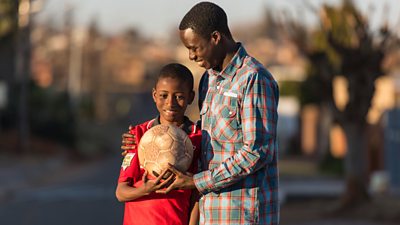
I have a little sister and brother who are similar ages - my little brother is actually the same age that Damilola was when he died - so I could relate more to the character.
How did you find taking on the role of Tunde?
Being Nigerian myself, it allowed me to connect more to the character of Tunde. I have a little sister and brother who are similar ages - my little brother is actually the same age that Damilola was when he died - so I could relate more to the character.
What did you find most challenging about the role?
The relationship between Tunde and his father was what I found the hardest because they’re close but yet not close. He loves his dad, he really does, and his dad loves Tunde, but they don’t show that type of love and I think that’s what was hard. They were good at first but then after the incident it went downhill and kept going downhill. It broke like a glass.
What do you think Levi has brought to the story?
Levi is an amazing guy. He brought the life to the script and made it feel real. Every word I said I thought; this is what a Nigerian would say on a daily basis. He brings that naturalism. He allows the characters to be comfortable within themselves to bring out the emotions, everything that we needed to show people what happened.
How was it working with Babou and the rest of the cast?
I love them all! They are my second family. Little Sammy is a lovely, lovely boy and he’s going far. Because he’s the same age as my brother, I was able to connect with him that little bit more. On set we used to fight all the time! He was bantering me!
Wunmi was the anchor to the whole family. We were able to feed off what she was giving us emotionally. She was able to give so much to the rest of the characters and allow us to bring out emotions that I never even thought I had. She was a great person to work with.
Babou is my older brother, a father, a friend. He’s my mentor. He’s given me a vision of how and what to actually go towards in life. We bounced ideas off each other and he got me to understand my character emotionally. Tunde has to be emotional throughout the whole thing and it’s that type of emotion where if you don’t feel it, people won’t feel it. Babou, with Euros, was able to get me to that mind-set to give the most to the character.
Why do you think it’s important we revisit the story of the Taylor family?
It’s definitely important and it’s not just an isolated issue. It happens in different areas on a regular basis and it’s life changing, especially from a family aspect. To have the youngest son who’s not even lived life yet, to be killed only three months after you come to England, that’s just a bigger issue in itself. It shows that knife crime is devastating and it can happen to anybody. That’s why we need to relive those moments to show, look this is the effect that it’s going to have on somebody’s family and this is how their life is going to be after you’ve done what you’ve done, so take a look and change.
Did you have any awareness of Damilola’s story whilst growing up?
I wasn’t conscious of it at the time as I was only three, but as I grew up, I used to see Damilola’s face on TV. Now, to actually be able to tell his story is crazy. I didn’t understand the gravity of what had happened to Damilola but, through the film and learning what happened to him, something clicked in my head and changed the way I think about how youths are these days and how they treat others. It’s a life changing experience telling Damilola’s story, because a ten year old being killed is an issue that everyone needs to look at and to take time to think about how we can change.