The Crimson Field: Suranne Jones
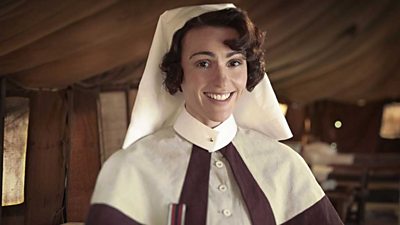
Interview with Suranne Jones, who plays Sister Joan Livesey.
How did you initially become involved with The Crimson Field?
I was doing a play called Beautiful Thing and we were at The Arts Theatre in London, and I’d got this script - I’d been in a play whilst also filming before and I’d promised myself that I was going to have a break.
I read the script and I thought it was beautiful. I knew Sarah Phelps's work before - I’d auditioned for Great Expectations a long time ago – and I didn’t get the job but I did get this so that’s all right!
When I got to the audition, lovely David Evans was there who’s our first director, and who directed me in Unforgiven. I just kind of went for it in the audition, I thought it was a beautiful script and when I left I said good luck with it and I’d definitely watch it – and then I got the call! It’s my first period drama so that’s exciting too.
Why was the time right now to be involved in a period drama?
I don’t know why I’ve never done a period drama before. I’ve been filming now for 15 or 16 years – it’s just the script I guess. The right script and the right time.
Joan Livesey is a very modern woman. She’s a suffragist. She’s a politically forward thinker. I guess that having done contemporary roles, perhaps what the producer and the writer saw is that it was the right time to fit an actress that was known for contemporary work into a period piece, because the character was. I come in riding a motorbike in men’s clothes - neither fish nor fowl, one of the characters calls me. It was just at a time when it just fitted script, actor, writer, producer, everything – so I’m thrilled.
What is your character Joan like? How are we introduced to her?
Joan is from Liverpool. She’s a reservist – so she’s a bit different to the VADs that come in – she’s already been working in a hospital. When she gets to Boulogne, the van she was meant to take has already gone, so she decides that she’s going to buy a motorbike, because back home in Liverpool she’s part of a motorcycle club.
Joan buys a motorbike, she buys a big great coat – a male army jacket – and she turns up on a bike, and she’s quite a few hours late as she arrives.
Filming wise, everyone had started on The Crimson Field two weeks before I’d started. So I was late, as my character was late - that was quite nerve-wracking sitting at home thinking what are they all doing? What’s it like? I’d seen this amazing set, but when I actually got there and saw all the supporting artists, and the horses and the cars and everything, it was brilliant.
Joan is full of life. She’s lived in Liverpool with people that look at each other as equals. Being a suffragist obviously she’s already on that political track, and then there’s an old guard represented by Kerry Fox and Hermione Norris. The way that Joan fits into this hospital is quite interesting because she believes that the new would improve the old guard, and that the VADs should be doing a lot more work, and she’s very aware of what’s to come and how many men they’ll have to treat – that they need to reinvent and modernise themselves. That doesn’t go down too well.
Does Joan take the VADs in hand and try and encourage them to do more?
There’s some really beautiful scenes with myself and Marianne Oldham who plays Rosalie. Marianne’s character – she plays her beautifully – is from a very well brought-up moneyed background where women don’t work. The beauty of this period is that when the war broke out, lots of people who wouldn’t necessarily meet each other started to mingle, especially in somewhere like the field hospital - people from different backgrounds.
Joan's and Marianne’s characters have this wonderful affection for each other because they’re different, and Joan tries to lead her in the direction of being able to handle men, as it were. Again, Joan with all her forcefulness and forthrightness tries to bring people out of their shell a bit too quickly.
Does Joan clash with Grace quite a lot? Or do they understand where each other are coming from?
The relationship between Grace and Joan I think is very respectful. I’d never met Hermione Norris before and after the read-through I completely fell in love with her – we were going to live together in a cottage near the field hospital whilst we were filming.
We didn’t have a lot to do together as characters, but what we did have I think is very respectful. Grace – having got the job instead of Margaret – she realises that the world is changing and nothing will be the same again, so I think there’s a definite respect and understanding between our two characters, and I just loved those moments - acting with Hermione.
Joan rides a motorbike – did you have to learn to ride a motorbike for the role?
I didn’t ride the motorbike myself but a brilliant stunt lady called Steph did - she’s fantastic. I’ve worked with her on numerous things before, and when she turned up I was like ‘Great! I’m going to look brilliant!’ It’s an amazing contraption because you’ve got the pedal, then you’ve got the oil lamp at the front, then the machinery kicks in and once it starts you zoom off!
The goggles that my character had were made for men and men’s faces being a little bit wider than female faces means the goggles slightly went to the side – so you couldn’t actually see out of the goggles unless you looked to each side! I wouldn’t have stood a chance anyway even if I’d have taken motorcycle lessons because it’s a vintage model! But the stunt ladies did a brilliant job, and my heart was in my mouth every time she rode off!
Did you do any research into the First World War?
When I got the job I reminded myself of how the country was before the war broke out, and then obviously the track of what happened to our country and to the other countries, and where War was breaking out at each point, and our role in that, and then I went to the War Museum. In Manchester at the time I was doing my research, there was a brilliant exhibition about medics on the Front Line. It spanned from the Great War all the way to the work that they’re doing now. That was fascinating.
You mentioned briefly a part in the script where a lot of injured men arrive at the field hospital. What was it like filming a scene of that scale?
A lot of the big scenes that we filmed involved horses, cars, lots of supporting artists. The make-up artists did an amazing job, because at one time we have a convoy in of 200 men, and they’re all wounded – they’re walking wounded, they’re coming on stretchers, they’re blind, they’ve got trench foot – it was a sight, and you suddenly realise that yes we’re making a programme obviously to commemorate the 100 years, but at the same time, it does take you back to that moment.
There was a supporting artist that couldn’t see because he had gauze over his eyes, and they shouted ‘Action!’ - and I just grabbed him because he couldn’t see where he was going! He couldn’t see anything and it really made me cry – and my character wasn’t meant to be upset at all.
I don’t want to sound a prat about it because it is a television programme but it really did make us think at moments what a horrific time it was, and how humanity and community happened in that awful terror. The people were brought together, and really excelled themselves in those situations.
Will the audience see the humanity in all this suffering too?
Sarah’s so wonderful at writing characters, so this is a big ensemble piece, it’s character led, set in a period of history that we all know about and hopefully those that don’t know about it will through this programme, and through what the BBC are going to put on during the year, they will now really start to think about what happened. Sarah’s writing is so easy to say because she really does feel a depth of character that as an actor is beautiful to play. And in that setting, it really does bring out those human heartstrings that you just get for free within her script.
What was it like when you first set foot on the set?
When we first set foot on the set it was for a read-through, so it wasn’t quite finished and even then it was amazing. Because at first I was thinking ‘I got the job! Yes I’m going to France! Oh no I’m going to Wiltshire...’ and then when we got to Wiltshire and saw the set, it was amazing but they were still building it!
When I finally got to the set a few weeks later, to see the work that had been put in was incredible –we’d been looking at old photographs of nurses and wards from the actual period – and you walked on to the set and it was just like walking into the photograph. They did a spectacular job.
And I remember our first AD had a microphone, he needed that, because he wanted to tell the supporting artists right at the back of the field what they were going to do. So you’d get this man booming across ‘Just right! Just left!’ - that gives you an idea of the scale of what we we’re working on. We were very lucky to have a set like that.
What do you think viewers will get out of The Crimson Field?
I hope that Sarah’s script will educate. I just hope that people fall in love with the characters, remind themselves of what community can be, and just remind ourselves what happened a hundred years ago. To me a hundred years ago doesn’t seem that long ago. And then remind ourselves what we’ve got today, and how lucky we are – and enjoy!
