The Crimson Field: Richard Rankin
Interview with Richard Rankin, who plays Captain Thomas Gillan.
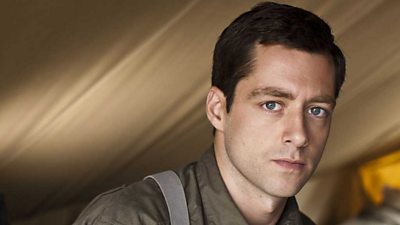
How do you describe Thomas?
Thomas Gillian can be misinterpreted I think, as being quite cold, quite harsh, quite ruthless - but I think the reasons for that is that Thomas has a great passion for his work, a great passion for the medicine and the medical advancement. And not so much due to his career, but more because he really cares about the patients, and the people that he’s seen coming in.
He knows that the medical techniques of the time can be vastly improved, so he works really quite hard to do that. I think with Thomas, he doesn’t take too much to the formalities and the discipline and the red tape of being an army officer - in fact I think he very much feels that gets in the way. So he’s quite irritable at times and he just wants to get things done for the benefit of the patients, and the benefit of the hospital. He can be quite a complex character at times but it’s all for the better good.
What is his role within the hospital?
He’s one of the principal surgeons, so he’s a surgeon as well as being one of the officers in the hospital. Essentially, he spends most of his time either in surgery or pottering about the hospital doing official medical things.
Who are his allies amongst the staff?
He doesn’t have many. He keeps himself to himself, and he can come across as being quite brash. Even if that’s never his intention, that’s just how he is. He’s very forward. His closest friend, as well as ally, is Captain Hesketh-Thorne who’s played by Alex Wyndham. He has a great respect and great support in Roland – Lieutenant-Colonel Roland Brett. It comes across that Thomas is a bit of a protégée of his. I think there’s a great mutual respect between the two of them, and he knows that his commanding officer is always there to back him up whenever he requires it. Actually there’s only the two of them, he doesn’t really warm too much to anyone else.
What’s his opinion when the VADs arrive?
He has an opinion of one or two of them. He’s has quite an instant opinion of one of them in particular, but I won’t go too much into that!
How have you got on with the rest of the cast?
Brilliantly. They have been great – every single one of them. I’ve had such a good time shooting on and off camera, and I think we’re all very supportive of each other. I’ve made a great many friends amongst the cast from the youngest to the most experienced of them all.
How much research did you do into the First World War for the role?
Too much. I think I did too much research, and the reason I say that is because you can tend to get too involved in the statistics and in the research of it all. I found actually the most valuable research that I took away was research in the period itself - research into the time - research into the social structures of the time, how people lived, what music they listened to.
One of the first things I looked into when I was starting to come up with ideas about my character was what music he might have listened to back home – just to get a basic feel for the time, which I found to be much more helpful than looking through statistics and medical books - which I enviably ended up doing, but you can get kind of lost in that.
Then I tried to not research too much past 1915 because that’s when we finish. I did a lot of research into the medical side of things. If I knew there was a procedure coming up – an amputation - or one of the episodes focuses strongly on a technique that was used at the time.
Throughout the series, do we see a different side to Thomas?
We see a very different side to Thomas, especially from episode three onwards. In episode one and two I hope you get a sense of what he’s about in terms of his passion for medicine, for advancing medically, but from episode three onwards, he gets quite antagonised by another character who comes into the hospital, and there’s a great deal of conflict there.
From then on he gets a bit distracted from his work – that’s not something that sits too well with Thomas. He’s all about his work, and when he finds himself thinking about other things and being led slightly astray, it really gets to him. So we see a much more agitated and much brasher side to Thomas from then on, until maybe the end of episode six.
