The Crimson Field: Kevin Doyle
Interview with Kevin Doyle, who plays Lieutenant-Colonel Roland Brett.
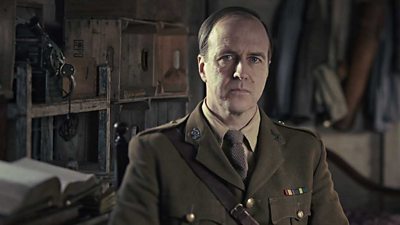
I’m playing Roland Brett, who is Lieutenant-Colonel and he is the Commanding Officer of the hospital, which we imagine to be one of several hospitals along the north-west French coast. There was a chain of them. They are called base hospitals, and they’re set back from the Front about 50 miles.
If a casualty was wounded on the Front Line, he would be helped immediately by regimental medical officers, and if this injury was deemed serious enough he would then be sent to what was called the casualty clearing station, and that would be a few hundred yards back from the Front Line.
There they could do quite complex things, they could do operations under bombardment, and they must have been incredibly brave, and an incredibly scary place to be. A lot of people were patched up there and then, or they were either sent back to the Front Line if their injuries were deemed insufficient to keep them, and if they were considered serious enough, then they would be sent back here, either by train or by ambulance, to what is called the base hospital.
The hospitals are larger, and mostly under canvas, although there would be a few wooden constructions where drugs would be kept, and where offices were, but mostly it was under canvas, and so they could quite comfortably hold several thousand patients here, and they had the patients coming in and leaving all the time by convoy.
So this is where the VADs are sent. They wouldn’t go any further forward I don’t think because it would be too threatening to them I imagine. But even here, they would have come across sights that they would never have imagined, especially because the injuries that were being seen here were so new.
How would you describe Roland as character?
Roland seems to be a career surgeon. He spent some time in the Royal Army Medical Corps prior to this, so he’d be used to military life, but there are some aspects of military life which rub up against him, simply because his priorities are different to military commanders. Their emphasis is very much on getting casualties sorted out here and back to where they would be most useful, whereas the doctor's priorities of course are different. They are more concerned about the welfare of the patients, so there’s an inevitable tension there between the two, and it’s a tension that hopefully we capture in the show.
Roland is a family man. Does he find being away from home difficult?
Roland is married and he has two sons. One of whom is fighting not too far away, but even though we’re 30 miles away from England, I can’t imagine that he would get home very often, nor any of the other staff that work here. So there’s a tension there, and so there’s difficulties when you’re reliant on letter-writing and the post couldn’t have been very quick I imagine then, and so there would be times when you would feel very cut off from life back home. When you do go home I would have thought there would be tensions, because these people are seeing things which no matter how it’s portrayed in the press back home, you can’t expect family and friends who aren’t here to understand what these men and women have seen, and are having to cope with. So yes it’s a difficult life, even though it’s not on the Front Line. It’s a difficult life.
How would you define his relationship with Grace?
Roland has just chosen a new Matron, and that choice creates tension among some of the staff. He’s nominated somebody who wasn’t perhaps seen as first choice. Grace wasn’t the senior nurse in the hospital and so it’s a surprise, and it’s a surprise to Grace as well. She’s having to come to terms with that new role, and it’s not something which necessarily sits comfortably with her, but Roland has a lot of faith in her.
I would describe Grace as a beacon of humanity really, amongst all of the chaos and terror. She’s quite firm, especially with the new staff, but she has a heart of gold, and she’s very careful about how she dispenses that. She and Roland have a very good working relationship.
You studied the First World War through the Open University – has that helped with your character?
Well I did a history degree, and it incorporated the politics of Europe up to and including the First World War and going into the Second World War. That was terribly useful in terms of contextualising all of this. I knew what these characters would know in terms of the build ups, the attempts to ward off conflict, and the various alliances that were going on to prevent war - but also those same alliances were coming together to create war as well.
There was a lot of stand offs and rising tensions. So that was terribly useful. It meant I wasn’t having to comb through period newspapers. I kind of already knew what led to all of this, which was terribly useful – not that I ever needed to use it but it’s useful in the back of my mind when we refer to certain political characters in the show. I kind of knew who they were, and what their roles were in the build up to all of this.
Was it a coincidence that you began your degree before you started filming?
Oh yes! Studying for the OU was just something I’d always been interested in, and when you’re doing television it affords you a certain amount of time off to do other things. You find that even when you’re on set and you’re hanging around, you’ve got a lot of time waiting around to be called, and so I found that rather than reading newspapers, I’d much rather learn something new.
I’d been reading lots of history books anyway; it’s just something that interested me. I found that I just loved it! I’d recommend it to absolutely anybody. It’s a wonderful way of learning.
For some people education doesn’t fit comfortably with them when it’s supposed to – 18, 19, 20 years old - you’d much rather be off doing other things. Whereas I went straight to drama school and so I didn’t have a chance to do all of that, and so I was kind of ready to get my head down.
It’s nice for actors to think about things other than scripts, so it’s nice to sort of dive into new territory and read about new things, learn about new things, and use a different part of your brain as well - rather than just reading and speaking.
