The Crimson Field: Jeremy Swift
Interview with Jeremy Swift, who plays Quartermaster Sergeant Reggie Soper.
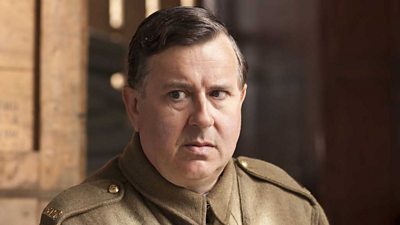
What is your character Reggie like?
Well he runs the Quartermasters Store, and he is corrupt, and indulges in a lot of black marketeering of commodities - not munitions - that would be on too large a scale for Reggie. So he does sort of seedy things like sell cigarettes to French men in forests and things like that. Although he wants to be on everybody's side, he is a very self-orientated person and not a good person.
He’s the worst kind of sentimental right-winger who is there to be a war profiteer really, to exploit things to his own advantage, and although he will try and maintain friendships with people at the hospital, if he can he will exploit them or undermine them to his own advantage and he has a very old school military sense.
He is very misogynistic, and quite misanthropic. He’s a bully to the men who work in his store, and yet he has a vendetta, as you will see in the series, against Sister Joan Livesey, primarily because she represents a new woman. She wears male clothing. He thinks she’s a man - he salutes her as she drives past him on her motorbike. He’s very jealous of the motorbike, which becomes a bone of contention.
What is Reggie's relationship like with the other doctors and nurses? Does he have any allies?
I think he plays along with them. He thinks he has any ally in Margaret, but she’s got a better mind than him, and ultimately exploits him.
Can you describe his relationship with Joan?
He commandeers Joan's motorcycle because it’s not an army vehicle, and his superiors know that he’s going to sell it for a profit which will disappear into his books. You’d have to be pretty clever to get away with war profiteering on a long-term scale. You have to be able to diddle the books very well.
Did you do any research into the First World War for the role?
I didn't really research the First World War. I was reading Steven Pinker's The Better Angels Of Our Nature, which is a book about the de-escalation of violence in our society, and it does cite of course 20th century and the 17th century as the worst fatalities in battle.
But I think what is interesting to think about with this series and the characters, is that they don't know that yet. They don't know that the First World War, the extent and devastation, they don't know what is going to happen to it, because if you look back at the previous century, in Europe alone there are wars and campaigns. Dozens of them. Three or four a decade in Europe alone - a lot of which amount to change of power structure, but not the loss of life that is going to happen in the First World War.
What was it like filming on the set?
The set is incredibly evocative. I don't get to go on it very much because I sort of stay in my store, apart from selling cigarettes to French men in woods - which when I got to do that was like being free from prison or something! It was very exciting! I am at my store a lot of the time. It's very comfortable and it’s quite dry, and I don't have to go outside very much and do scenes in the rain.
How did you find acting in a period drama? Did you enjoy wearing the costumes?
Reggie is 52, so he is essentially a Victorian who's crossed over a little bit into our time, but he is very very old school, and loves the uniform. Something that I don't particularly! When I first went for my costume fitting, the costume designer hadn't yet arrived and I was put into a uniform that was above my rank, which was really quite lovely, and I though ‘Oh actually yeah I see the appeal’, but then I was sort of demoted and I was wearing essentially tailored sacking - you know, khaki.
Is there anything you have learnt about the First World War you didn't know before you worked on this drama?
I don't know whether I personally discovered any facts about the First World War from the series, but I think the value of the series is its perspective, because it has rightly been written about, dramatised, historically appraised for a century, and we should never forget the human stories, because what history can do is start to evaluate it in statistical terms and campaigns, obviously the enormous loss of life.
I think to see the war from this perspective is really unique, I think so far, because we’re seeing the suffering, and we are seeing it from a female perspective, and the female dilemma of having a husband or a son, and the empathy is very very powerful. I think that is going to be its huge strength.
