The Crimson Field: Hermione Norris
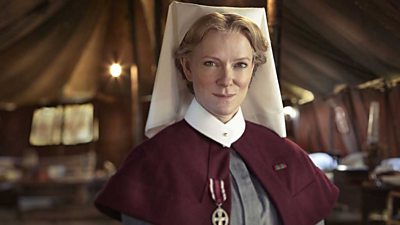
Interview with Hermione Norris, who plays Matron Grace Carter.
How did you initially become involved with The Crimson Field?
I read Sarah Phelps’s script which was amazing – it’s probably the best script I’ve read in years. It’s just beautifully crafted, beautiful characters, and I really wanted to be a part of it.
Can you tell me a little bit about what The Crimson Field is about?
Sarah Phelps has written the most extraordinary script about a group of men and women in a field hospital in France in World War One. A time of great loss and suffering, it’s about people coming in and out of the hospital, and how the nurses and the men relate to each other.
How would you describe Grace Carter?
Grace Carter is Matron of the hospital. She’s a fierce disciplinarian, but she has a heart of gold, and is interested in the healing of the men, not just the military discipline – running a military hospital. She’s forward-thinking as well with the way she treats the men, and she’s also has a past which is quite hidden.
In the first episode, we see the arrival of the VADs. What is her opinion of them?
The War started in the summer and everyone thought it would be over by Christmas, so I think a lot of the nurses felt in amongst such carnage that unskilled help would be no help at all – actually it would be a hindrance. So some of the nursing staff were against the VADs coming, but obviously as the War went on, they really needed all the help that they could get. As the young girls come in and prove themselves, obviously everyone is very grateful for their help.
In the drama, Grace runs the hospital with Roland. What is the dynamic like between Grace and Roland?
Roland Brett has appointed Grace Matron over and above the character Margaret, which causes quite a lot of conflict with Margaret – but they get on really well. They have a similar attitude and outlook to the men, the care of the men, and I think they genuinely really like each other and respect each other enormously.
Who else are Grace’s allies in the hospital?
Well I always thought Grace was quite on her own actually. She has this wonderful relationship with Roland Brett, but apart from him – I suppose it’s that thing of being responsible for all of the nursing staff, and therefore having to be slightly detached and to make quite tough decisions, sometimes she is quite isolated within that. And although Margaret has been her caretaker if you like, she’s not really a safe person for Grace so I do think she’s quite isolated sometimes and quite lonely.
Did you have to do much research into the First World War for the role?
When I got cast in it, I felt a huge sense of responsibility like nothing else I’ve ever done before. The First World War is such a huge subject matter, it affects people still – personally. I’ve read a huge amount but it’s just vast! You could read until you were 90 probably and still not feel certificated or qualified to talk about it.
Was there anything from the research that really stood out for you?
I think what stands out most is the human suffering - all that human loss. Just that level of suffering without any anaesthetic, and attitudes then – now we have post-traumatic stress, combat stress. What those men went through and what that generation witnessed, and a generation of women losing a generation of husbands, boys and sons.
Do you know if your family were involved in the First World War?
Yes, my grandfather fought in the First World War and lost a lot of his brothers in the trenches, and I remember being four and he was very confused. He was sitting on the kitchen floor calling out to boys in the trenches. He asked me to come and sit with him, and being four, I thought I’ll go and sit with him and keep him company, and my Grandma saying, “Oh he’s calling out to the boys again.” And that was sort of normal for him, every year he’d have to go to hospital and have shrapnel removed from his leg – severe injuries from the First World War. What those people did in the name of duty, and then returning to normal civilian life. It’s just beyond imagining really.
The set for The Crimson Field was incredible. Can you remember what it was like the first time you visited it?
The set is amazing. I remember it was Kevin Doyle who said ‘come on we’ll show you round. The set designer just did a beautiful job. You couldn’t not be moved, and that didn’t ever go away, every day you walked on set. It was like a huge active remembrance of the First World War every day really.
In terms of your costume, what was that like? Were you corseted?
Yes my costume was corseted - when women were doing that kind of labour, or looking after very ill men, bloodied and septic, in their corsets and cuffs and starch, they had to be immaculate because the uniform represents the Army. The nurses and the care, and having to maintain that discipline amongst that carnage – it all just makes me reflect what all those people went through.
Is there a big difference between doing costume drama and modern-day drama?
Costume drama takes a lot longer, and it’s much more uncomfortable when you’re waiting around! It can take hours of preparation and everything just takes longer. It’s tougher because there’s a lot of time waiting around in a corset in the searing heat or the freezing cold. It’s not a comfortable experience.
