Dawn French and the Can You Keep a Secret? cast and creatives on finding the balance between relatability and outlandishness in a family comedy with a criminal twist
The story of an odd little family you haven’t met yet, but that you already know...
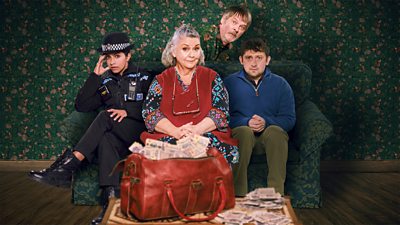
Dawn French plays widow Debbie Fendon - granny, lawn bowler, tinpot dictator - who will stop at nothing to make sure her family’s protected. Unfortunately, most of the time the person they really need protecting from is her. When her hermit-like husband William (Mark Heap) unexpectedly dies, she makes an outlandish decision that will put the family under more pressure than ever before.
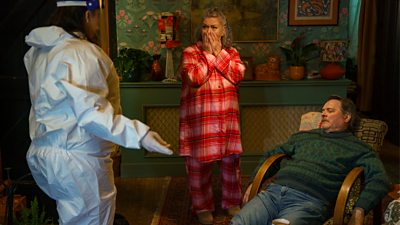
Because Debbie isn’t actually a widow and William didn’t really die – he was just mistakenly declared dead and the two retirees found themselves staring down the barrel of an opportunity too good to pass up. Just a few months hiding out in the loft waiting for the life insurance to pay out and then they can live out their golden years in peace.
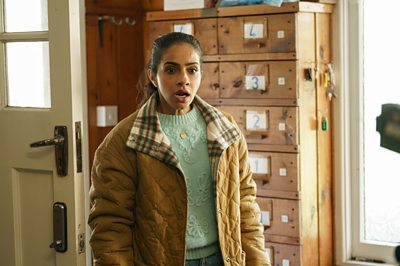
This all proves a bit much for their easily frazzled son Harry (Craig Roberts) who - despite his emotional shortcomings - has managed to acquire a family of his own and a potentially life-changing insurance payout from his father’s ‘death’. What’s especially tricky for Harry is that his pathologically pragmatic wife Neha (Mandip Gill) is a local police officer and, if she finds out about her in-laws’ fraudulent ways, the Fendons might have an issue.
Clearly Harry – reunited with a dad he’s just buried and the reality that his parents have turned into a pensioner version of Bonnie and Clyde – suddenly has a lot more to juggle. Sandwiched between two generations of toddlers, he finds himself navigating a very common stage of life - only this time, it’s criminal.
Written by Simon Mayhew-Archer, the producer of hit BBC Comedy This Country, and filmed and set in the West Country, Can You Keep a Secret? is the story of an odd little family you haven’t met yet, but that you already know - a sitcom that places comedy icon Dawn French in the middle of some mischief we can all relate to.
Can Debbie Fendon and her family keep their secret? Or will one of them spill the beans?
GC2
Meet the cast
Dawn French (Debbie)
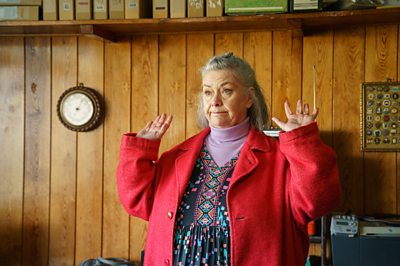
Why did you say yes to this role?
It's an interesting hybrid, and I think that's one of the things that attracted me to it because it is a sitcom, without a doubt, but it's also a thriller, and I think it’s quite hard to pull both those things off. It’s funny, but it’s also about the dynamics of this oddball family that have almost accidentally pulled off a massive crime.
William, played by Mark Heap, is very poorly with Parkinson’s, and he’s been shafted by health insurance companies. So when this opportunity arises for my character Debbie to fake her husband’s death and claim William’s life insurance, I don't think she has any qualms about going ahead and committing the crime. She thinks it's justice and she feels righteous about it.
Why did you want to play Debbie: can you tell us a bit more about her?
Right from the off I could see that she's one of those people that absolutely believes she's always right. I don’t think I’ve ever done that in my life, been sat firmly in that righteous place the way Debbie is. I may have often imagined that I could be right, but I’ll err on the side of thinking, ‘I'm probably wrong about this’. Debbie just doesn't have that anxiety or filter. She’s made a split decision in a mad moment, and once the decision is made, unless she’s prepared to go to prison, she knows she’d better man up and deal with it. I mean, I've never been in this situation, but I guess once you make a life-changing decision like that, and you jump into the dilemma of it, you've got to gird your loins and get on with it because once you’re in, you’re in.
She’s quite a complex character, and not always likeable; but did you like her?
She’s not a bad person; she's a bossy person, and she's determined that this will work, and so she has to lead the cavalry and she minimises a crime. It’s terrible that she does that, and she puts the whole family into a moral dilemma, and the whole thing is her idea and her fault, and she's prepared to go a long way, and she's prepared to betray her friends and do a lot of things that aren't very likeable, and she’s manipulative. But that said, she’s quite real, and it’s a real dilemma that makes me think, ‘What would I do?’.
Without getting too method about it, I did have to try and think like her. I had to think, why is she doing this? From that Sliding Doors moment that’s offered to her, it’s impossible to stop. She didn’t plan this at all. Everybody thinks William is dead, and he doesn’t go out much anyway, so it’s not going to be too difficult to keep him indoors. They’re both angry because they haven’t been able to claim on their medical insurance. And putting that together, this stupid, mad idea becomes feasible in her head. It’s a split decision and on she goes: she puts blinkers on and just marches forward.
What’s her marriage to William like?
She’s honest and sometimes a bit brutal with him, but I could also see from the script that the marriage has been going for a long time, so it can withstand that. She might have misjudged it occasionally, but you can see the marriage can withstand this robust banter that goes on. After all, she’s doing all of this for William, and for their son Harold.
Did you enjoy shooting this series?
At the very beginning I said to Simon, ‘I'll happily do a sitcom, but we need to set it down here near where I live’, partly because I want to bring more work down to Cornwall, and partly because that puts me close to my family and other logistics. Simon completely agreed to this, but of course, Simon’s not in a position to agree! But we ended up doing it near Bristol which has all the studios and stuff.
That meant most of us were away from home and, when you’re working away from home, the cast and crew become your new family. This is your new gang. That's where you get your laughs and that's who you moan to, and who you cling to. When you’re away, it helps when it's a happy gang. And it was a particularly lovely gang, from the camera crew to the sound guys to the drivers. Everyone was up for it. Even the guys who were doing the catering said the story sounded intriguing. It didn’t feel like we were on any old job, doing any old thing, and that’s everything.
I think that's the other thing about this: it was a younger writer, a younger director, younger producers, people that were prepared to make a gang without having hierarchy, and they were listening, and their collaboration was good.
Did you enjoy specifically working opposite Mark Heap?
So much. I had a little worry that we'd already worked together on Whatever Happened to Maggie Cole? and the legacy of that might be a hurdle for this. I didn't want people thinking about that when they're watching this, but the desire to do this job trumped my worry about that. He’s a wonderful human. I don't see him all the time or anything like that, but we bob each other a couple of texts every now and again, and there's instant love whenever we're together, and massive support. That's what you need on set. He's a proper mensch.
And the rest of the cast?
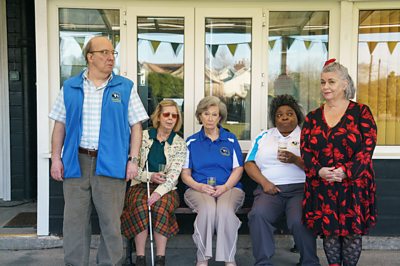
Really, it’s an ensemble piece. For all that there are four of us at the centre, there’s an entire gang around us who provide lots of hilarious comedy like Geraldine McNulty and Paul Chahidi. But all of them in that little gang matter very much to this story and are key because we need to know who’s blackmailing Debbie, and so we’re looking at everybody. Simon’s written a good ensemble of characters.
Mark Heap (William)
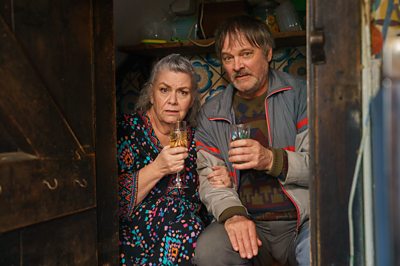
Tell us about your character, William?
He's a loner. He's someone who is quite happy in his own company, as am I. There's a good line where Debbie says “no one would notice you're dead anyway, because you don't go out, you just sit around upstairs”. So there's a bit of that going on, I think.
What is Debbie and William’s relationship like?
Debbie and William's relationship is one of a comfortable old sock that you put on or a jumper. They've been together for a long time. There's a little bit sometimes zoning in and out of each other's thoughts or words. She's quite bossy, Debbie, but I don't mind being bossed around. We're still very much in love, I think, in our own peculiar way, as is with a lot of couples who've been together for a long time. But we still, as it says in one of the episodes, like to engage in mutual pleasuring, much to the chagrin of our son. No, but it's very easy company, as are my feelings towards Dawn French. She's very easy company.
What has been your favourite moment to film?
Watching my fellow actor Mandip struggling to watch me vomiting. Watching her retching, genuinely. So that was quite good. I don't mean to be cruel, it's quite funny.
What would you do if you were in William’s situation?
If I was in William's situation, I wouldn't have any trouble at all hiding away for months and months. I've got my inner voices to hear, and I've got thoughts to think, and sights to see, and sounds to hear. I think that's all the senses. Feelings to feel, there's another one.
Who is the best bluffer in the cast?
The best bluffer in the cast, I think, would weirdly be the writer, Simon Mayhew-Archer. He pulled a trick on me. I like to know my lines well in advance, and he approached me with a new scene to be done the following day, which involved a long speech and Welsh and all kinds of things. He played it really well, and my reaction was exactly as expected, like, “I'm not doing that”, and all that. And they went, “oh, no, we're only joking”. So, yeah, he was very good.
Craig Roberts (Harry)
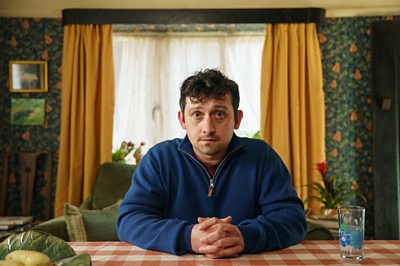
What is Harry like?
Harry's super anxious before he finds out that his dad is actually alive, and then gets even more anxious. That's pretty much the series for him; just trying to keep it all contained and trying to help his parents.
His mum Debbie doesn't give him a chance to breathe, really. She's constantly on his back about stuff, and I think that's where a lot of the comedy comes from. Even when he makes a joke, he's making the wrong joke. I think the relationship throughout the series is him getting to know them a lot more, really, when their backs are up against it, and then them all rallying together to fix it.
Is Harry the voice of reason?
I guess, yeah. Harry is the voice of reason because his parents are so crazy, but he's also a bit neurotic and keeps on about it too much, so his mum's constantly telling him to shut up.
The whole show is like a Russian doll of events. Like, it just keeps going and going and going. And there's no time for him to even think about reaping the benefits of it all. Because, before he knows it, something else is happening. That's what I really like about it. It's not just a domestic comedy. It just feels bigger than that, really.
What was it like working with Dawn French and Mark Heap?
I mean, they're iconic, both of them. They're very kind, really, which I think is the most important thing. The whole experience has been lovely because of them. So it's been really great. Sometimes you never know how these jobs are going to go because it's kind of the big brother experiment of going into things with people you don't know, but this has been really wonderful.
What do you think audiences will enjoy?
I think it's going to be very fun. I think you kind of get a bit of everything. I feel like it's going to be for everyone because you've got the bigger gags, the more slapstick kind of physical comedy. And then you've got the other stuff. And, you know, and then you've got the heart like you talked about. Simon's really nailed it with the script. So hopefully a bit of everything and a bit of mystery.
What’s the biggest secret you’ve kept?
My biggest secret is I've not seen the Vicar of Dibley.
Mandip Gill (Neha)
Describe Neha
Neha is a mum of two little ones. She's a police officer in the community. She's come into the village, she hasn't always lived there. I think she's looking for a little bit of excitement, but also she doesn't tend to police the way that you would expect. I think she has a lot of humility, and she sees a lot of good in people, whether they are doing weird and wonderful things. She doesn't just want to go around arresting people. That's not really how she works. She's in with the community and she can see the good in everyone.
What made you want to audition?
I saw that Simon Mayhew-Archer had written it, and I'm a big fan of This Country, one of my absolute favourite shows. So straight away, without reading it, I was like, “I need to do this”. I'd manifested being in a comedy for ages with my best friend, but how do you really go around and say to someone, I think I might be funny? But then when I started reading it, honestly, it was such a page-turner because you wanted to know, how are they actually going to get away with this?
The script from the beginning was so full, interesting and funny. It actually was genuinely funny. As soon as I started reading the first episode, I was like, this would be an actual dream. I think I might have manifested this job.
What do you think is behind Neha’s choice to allow her in-laws to continue on with the scheme? What does this tell us about Neha and her allegiance/priorities?
She wasn't always aware of the secret and then she's brought into the secret and initially, as a police officer, it’s a bit of a line cross for her. But, as she starts to understand why they're doing it, she can sort of go along with it. Because they're doing the right thing, that's how they manage to persuade her. She can see why they’re doing it, so she can look the other way on a few of the bad things that they’re doing.
What can audiences expect to see from the family and their antics as the season progresses and story evolves?
I think they should expect the unexpected. This is a family that's not too dissimilar to most families in the way that they function and the way that they speak to each other and bicker. It's like a lot of families, but in an extreme, funny way. Even though it's extreme, I do also think it's really relatable, it has heart.
Why is Neha so nice to Pigfish?
Neha is nice to everyone, I'd like to think, apart from her husband sometimes. Sometimes she's a bit mean to him. I think she just doesn't police the way that everybody polices, and sees the good in people. Pigfish isn't a bad person, he just does some quite interesting things. But it doesn't make him a bad person. Greg, who plays Pigfish, is just so nice. Even if he's doing weird things, he's so sweet with it.
What was your favourite moment to film with Craig?
We’ve had loads of really nice moments. The thing with me and Craig is we can have really nice, meaningful chats away from set and we've really got to know each other in quite a short space of time, but then when we get on to set, we can have a laugh with everybody and each other. He's really funny, though. He has this thing where he speaks gibberish, and I keep falling for it. I'm really desperate to know what he says, so I'm like “what did you say?” and the whole thing's just gibberish and I keep falling for it because he's so natural. He’s absolutely brilliant.
Did you have any favourite moments on set or particular scenes that made you laugh the most?
I've enjoyed so much of it. I've really enjoyed sitting back and watching the way that Mark Heap works. There's a scene where he gets in the back of the car, and it was just like watching an acting masterclass, the way he’d say the same lines but differently. It's those moments that I've really, really enjoyed.
There was this whole discussion in rehearsal - if something comes through your post-box, is that automatically called “post”? Or does “post”need to come with a stamp? And there was this whole back and forth between Dawn and Mark, and I was agreeing with Mark. I was like, well, anything that comes through the post-box is post. But that ended up being a bit of dialogue in the script, because it was so real and funny that Simon Mayhew-Archer was like, “we need to write this”. Those are the bits that I've really liked watching because I got to see that. It's been amazing to sit there and watch someone unpick the script and then add stuff to it or take stuff away, or be given notes and change it.
Which member of the cast would you most trust to keep a secret?
I would trust Dawn the most to keep a secret, and that is purely because I think she's so busy, she actually just would forget to tell anyone.
If you had to hide in real life, like William does in the series, where would you pick?
If I had to hide anywhere in the house I would hide in a secret room. I feel like that's the obvious answer. It would be behind like a bookcase or like those stairs that you lift up and then you get into it. But I would need much more room than the little cupboard that William has.
Which castmate is the best bluffer?
The best bluffer is between Mark and Craig, because they will tell me things. I must be really naive, or they are very, very good at lying. So I can't really choose between Mark and Craig, but they are both really, really good at it.
Kention Allen (Executive Producer)
Describe Can You Keep A Secret?
It’s a family comedy with a criminal twist.
How did you first hear about it?
Can You Keep A Secret? arrived in my life as a script put in front of me by a member of my team who said, “have a read of this, it’s quite good”. As they were leaving my office, they went “Oh yeah, and Dawn French said she’ll do it”.
Reading the script knowing Dawn French would play Debbie immediately made it leap off the page, even though it was already a really good script. I kind of fell in love with it. We’re always looking for that little twist of a family comedy. This is another family comedy that has this outlandish but believable twist about the husband, Mark Heap, bring pronounced dead, incorrectly. As you would do, in any normal life, you claim insurance money and make him hide in the loft.
The morality of it is complex, but I think there is a Robin Hood element to it, because we all pay into pensions and life insurance. So often, when you come to try and claim one of these schemes we’ve paid into for our entire professional life, the small print kicks in and there’s all sorts of exclusions that mean no, you can’t have any of the money back that you’ve given us over the last 30 years because we’re bastards!
Debbie and William decide they’re not going to stand for it, and they’re a bit hacked off about life and taxes and all of that stuff of life I guess. They decide to go for it and put in a fraudulent insurance claim for her dead husband for 250 grand. That’ll do me, you can get a lot of patio cleaners for 250 grand.
Whose side do you think the audience will be on?
Who knows? I hope the audience will be onside with Debbie and William, but yes, it’s not a “how to” instruction manual, it’s “don’t do this kids, it’s illegal and you will go to prison”. But morally, I’m with the little guys rather than with the big corporations. Go Debbie and William! If only we could all be as brave, bold and idiotic as them. But yeah, do not do it. It is not a guide on how to defraud insurance companies.
Tell us about the writer, Simon Mayhew-Archer.
The writer is a young man called Simon Mayhew-Archer who I met 10 years ago when he was an up-and-coming producer; he produced This Country. His father is Paul Mayhew-Archer, who I knew as this uber script guru-cum-writer of The Vicar of Dibley. So you think, there’s got to be a bit of DNA in young Simon that’s been passed on from brilliant Paul. The Mayhew-Archer of it turned my head, and it turns out that Simon has got a bit of the old father-to-son fairy dust DNA. Simon grew up on set, Dawn French remembers Simon on the set of The Vicar of Dibley aged 4, being annoying. And nothing’s really changed.
How was it casting the show?
Casting the show was pretty effortless, given that we had Dawn French attached to play Debbie. Dawn is a comedy magnet. She attracts fellow comedic professionals, both on and off camera. So casting was pretty straightforward. We'd worked with Mark Heap extensively on Friday Night Dinner, and I think Mark is a comedic genius. He embodies a lot of what William is in William's eccentricities and kind of slightly bizarre view on life. Putting Dawn together with Mark was a sort of no-brainer.
Then the search for Harry was quite extensive actually. We met a lot of amazing actors and then Craig Roberts popped into our lives. Craig brings a brilliant sense of the comedy and the tragedy of the situation he's in but also this incredible anxiety and terror of his parents and what they might do next in an incredibly humane and funny way.
Then we met Mandip and she brings a kind of firm but fair but always amusing steeliness to her character Neha and they feel like a couple. So we made a family out of these four brilliant actors.
But there is a chemistry there. They've all got their own skills and rhythms and abilities, but when you put them together, they become greater than the sum of their parts. So I think we have got the Beatles of comedy. I think Craig's Ringo, Mark Heap is John Lennon, Dawn is obviously Paul McCartney, and Mandip is George Harrison.
What do you think audiences will think of the show?
I hope that you will be rooting for this family who you find some similarities with and you realize that they're doing the wrong thing, but you really want them to get away with it.
Simon Mayhew-Archer (Writer)
What would be your elevator pitch for the show?
I wanted to do a show that was both a sitcom, but also had enough of a mystery hook narrative that pulls you through. I looked at my life and I thought, my parents do really annoying things and I wonder if I can make a show out of how irritating I find what they do.
The elevator pitch for the show is — a man has a very tricky relationship with his mum and when the dad unexpectedly dies and the mum discovers that the son has been depressed, she decides to cheer him up by revealing that the dad didn't really die, he's been living in the loft, and they took the insurance money.
Talk to us about the casting process – did you have Dawn French or any of the actors in mind as you were creating these characters?
I grew up with Dawn being sort of one degree removed, through my dad. It’s funny because you would think that that means that there's this great sort of historical close relationship, but actually, they were friendly and they were very professional and they had a great relationship, but my dad never really involved us that much.
So, I wrote it with Dawn very much in mind, and originally I wrote it on spec, and I was not expecting it to be any good. I still don't entirely trust that it is any good, but it's almost too late now because we're here. I sent it to a few friends in the industry and I got better feedback than I was expecting. Then I sent it to my dad and I got much better feedback than I was expecting because he's usually really blunt and quite brutal. So my confidence was up. I don't know why, I think I'd been listening to a self-help book about seizing the moment and not overthinking things and I just thought, fuck it, send it to Dawn. The worst she can say is no. And I did and she said that she was really busy and she couldn't read it for a few weeks, but she would take a look. Then she emailed me two days later and said she loved it. And I cried.
Dawn was always earmarked as Debbie. Then I met Mark. I'd done about three scripts when I met Mark, and that was instant. He is so perfect for it. Harry and Neha, they were really tricky because I didn't have a clear idea of who those people were going to be and the way I work and the process is that it's like every stage of the writing is like an offer. So you write enough and hopefully good enough that you get commissioned for a second script. Then you write and hope that you do it well enough that you get to meet some interesting actors. Then once you get the actor, then you rewrite to who that actor is and you try and make the character and the actor sort of meet in the middle so that they're doing stuff that makes them feel as funny and confident as possible.
I can honestly say for both Craig and Mandip, as soon as they walked in the room, I was like, oh, it's them. Then comes the anxiety, because it's like once you fall in love, you're like, oh, my God, what if they don't love me back? And that's the fear, because I can't now not think of them being those characters. So when they were up for it, it was the biggest relief because they make it come alive.
How would you describe each of the main characters’ arcs and trajectories throughout the series?
I suppose there's an old quote about sitcom writing, which is that your job as the writer is to chase your character up a tree and hurl rocks at them. Whenever Debbie or Harry or Neha think they have solved the problem, they've created another bigger one. That's very much Debbie's sort of MO, is that she is thoroughly convinced of how good her ideas are, and they pretty consistently turn out to be quite a bad decision. It just hopefully snowballs from there in an organic way.
I suppose the way the story unravels is that, if you asked Debbie, has she done anything wrong, she would be unequivocal in saying no. She has simply been presented with a set of circumstances, and she has chosen a certain path at each moment. When William is mistakenly declared dead, that's not their fault. That's the mistake of the doctor. The fact they took the insurance money really is only a kind of a karmic rebalancing, because they've done all the right things through their life. They've played by the rules. They paid that insurance company all those years, and they didn't get a payout when he got Parkinson's so, to them, it's really only fair that they take their share now. So, no matter what she does, Debbie is always on the right side. She's in the good and everybody else is in the bad.
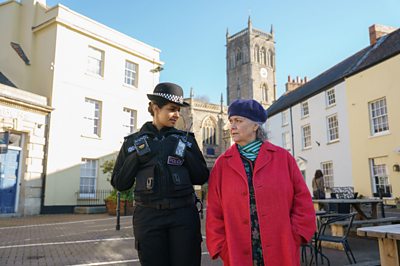
For me, Neha represents that sense of when you're dealing with your parents or your parents-in-law, sooner or later you have to come to some level of acceptance that they're not going to change and they're going to do really annoying things. The path of least resistance is just to let them do it and not get too involved. Obviously, there is a dramatic complication insofar as they are criminals and she's the police, but I suppose the underlying emotional journey is the same, which is, it's just not worth unpicking. Just don't get involved.
Given the premise of the show, the stakes are high, but this is also a comedy. What is making us root for these characters that are doing morally transgressive things?
I think, hopefully one roots for the characters because they are only playing the cards that they've been dealt. They haven't gone out and done too much themselves. I guess there's some moral ambiguity about what you might do in that situation. I don't know what I'd do. Would I do insurance fraud? I might. I don't think I feel particularly sorry for insurance companies.
Why now, and how do you see this show resonating with the global audience?
There is something both beautiful and depressing about the circle of life, and that we come in as bald, dribbling halfwits, and we leave as bald, dribbling halfwits. Anywhere between 30 and 50, you really are sandwiched between it at both ends and you've got nappies everywhere. That is just the circle of life.
Despite the outlandish antics of the family, all of them are incredibly relatable and you can understand why everyone makes the choices they make (for the most part).
What was your process like in bringing these characters to life?
Finding the balance between relatability and outlandishness — that is the essence of comedy, because you have to do both. If you fall too far on one side or the other, you risk making something that's either so silly that it's not believable and you don't connect, or it's boring. I think that when you look at real life and you just walk out around, there's a lot of mad people out there and so you've got to try and find a way to put those mad people on screen and give them a story that pulls you through and makes you want to watch but at the same time is always still rooted in some sense of, I recognise this. They're not just doing things to try and make me laugh. They're doing things because they really believe it's the right thing to do at this moment.
This story also is about an older couple who’ve been wronged by the system, unapologetically taking advantage of a chance to live again with a new lease on life.
How do you hope this couple and their actions will be received by the viewers? Are there any universal themes you hope come through for the audience?
Ultimately, the message of the six episodes is that Debbie and William have made an insane decision. It’s definitely unethical. However, they did it because they wanted the money for their family; their grandchildren; their friends. It's the Robin Hood thing. Is he a thief or is he a hero? That's certainly how Debbie would see it. She's Robin Hood. I suppose then on an emotional level, what I really want people to have at the end of the series is that, no matter how annoying your family is, it's nice to spend time together. They are brought together by this scheme and, ultimately, they enjoy being in each other's company, even though they find each other maddening. I hope I'll get there with my family at some point.
What inspired the idea for Can You Keep a Secret?
The inspiration for this was very simple. I wanted to write a comedy about my parents because I'm an only child, my dad's an only child, my mum's mum married my dad's dad, so they subsequently became stepbrother and sister. It's an incredibly small, weird family, and I find them so annoying that I had to do something with it, and this was therapy. You always try to write from some kernel of truth. Ultimately, I was writing sort of loosely based on my parents and my mum makes incredibly bad decisions that are infuriating and my dad has Parkinson's and lives in his own world and every now and then comes into our world. Harry is loosely based on me and he wretches a lot and is very anxious.
What do you hope audiences take away from the series?
All you ever want is for people to enjoy it and not hate it. That is it.
Your father wrote on Vicar of Dibley. What has it been like to have Dawn star in a show you’ve written?
When she said she wanted to do it, that was the most incredible confidence boost and I cried. She's not a soppy person, so I would never say it to her, but I will never be able to thank her enough. It's been the best professional experience I've had. It’s thanks to her because she makes it happen.
Follow for more
Latest from the Media Centre
All newsSearch by Tag:
- Tagged with ComedyComedy
- Tagged with Media PackMedia Pack
- Tagged with Latest NewsLatest News
