The Turners
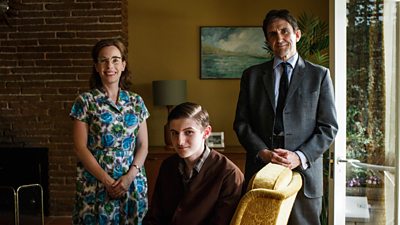
Shelagh Turner played by Laura Main, Timothy Turner played by Max MacMillan, Dr Turner played by Stephen McGann.
Published: 15 January 2018
Patrick is a go-getter, he’s a forward-thinking medic, but he’s still a man of his time and it’s nice to see these young kids growing beyond him. I think that’s quite right.
- Laura Main plays Shelagh Turner
- Stephen McGann plays Dr Patrick Turner
Why do you think Call the Midwife has remained so popular and successful?
Stephen: Simple universal reasons: it’s a show that reaches out directly to its audience and it makes a very strong emotional link. If you go online after an episode you’ll see a peculiar thing: people on Twitter or Facebook, person after person saying, "I cried", "I’m crying"- it has an astonishing, visceral effect on people’s emotions. It uses the most universally human issue of childbirth as a starting point to an examination of the most fundamental things that it means to be us and to be a society. People keep coming back to compelling stories about issues of humanity that they want to grab onto in a very uncertain world.
Call The Midwife has always been thrusting forward and we’re moving through years in Britain which were so tumultuous and full of such rapid change that to be here now in 1963, it feels to the actors very different from those old days when Jenny Lee was riding around on a bike.
Laura: I think it’s an incredible team effort in every department. Everybody cares about Call The Midwife. But ultimately, it is the writing, it’s Heidi Thomas and it’s those incredible scripts. They are about what it is to be human, what it is to be alive. It’s not just about birth; it’s about death, it’s about what happens in between, and family. It just touches people and you feel it when you a read a script, you can be at a read-through and crying with everybody, you can be preparing it the night before and crying on your own. It seems to be when the audience watches it; they are in bits as well. They are just brilliant, brilliant scripts.
How exciting is it for the Turners to move into a new home?
Laura: This is one of the big changes for the Turners this year. They realise they are in need of more space now they have baby Teddy. When we see Shelagh in her new home she is thrilled with all her new appliances. That is quite a shift from seven years ago and being a nun. Shelagh is certainly enjoying what the 60s bring with all the new things that are out there.
Stephen: This was one of my favourite things! Their house is fabulous - it’s your ideal 1963 home. You look back and this period classic home for a doctor, his younger wife and their lovely family, it’s a real suburban dream for the 60s and I think they’ve caught the period wonderfully.
The Turners embrace a new solution to childcare in this series - tell us about it.
Stephen: There are many changes being met in the early part of the 60s in the dynamics of families, the dynamics of parenting and also the social dynamics of race. And so in the Turners’ home Shelagh is facing more challenges to get the work-life balance right, so they find a newfangled solution to their childcare problems by hiring an au pair - this was quite the thing in those days, it’s brand new.
Laura: It is something Shelagh has read about and decides it’ll be a great thing. Dr Turner offers that she could have some help but it takes him quite by surprise that he’ll have somebody else living in the house. Shelagh hires Magda, an au pair from Hungary, but when she turns up she doesn’t look anything like her stern passport photo! She’s glamorous and young, and Shelagh is a little worried that son Timothy’s head will be turned. Magda is just a total dream and wonderful with the children, Shelagh really can’t do without her.
Now Timothy is 16, how is his relationship with his dad?
Laura: We do see a little bit of friction between Timothy and his dad in this series. Timothy is growing up now, he wants to go out with his friends, and he wants to go to rock concerts, specifically The Rolling Stones. Dr Turner doesn’t think it’s a good idea. Shelagh wisely stays out of that, even though she can see it from both points of view. Timothy is now a young man.
Stephen: Timothy is getting a little bit difficult, he’s a teenager, it’s the early 60s so he’s beginning to listen to music, he’s beginning to be influenced by the outside world, and although he’s a clever boy, he’s going to be a little bit harder to control and that’s perfectly natural. For me it’s very funny because I’ve watched Max, this wonderful young man who joined us back in 2012, growing up on screen who argues back both in real life and in drama! Patrick is a go-getter, he’s a forward-thinking medic, but he’s still a man of his time and it’s nice to see these young kids growing beyond him. I think that’s quite right.
I do understand where Timothy is coming from, absolutely. My father used to shake his head at the TV set when he used to see these bands on and me and my brothers would say, "dad you don’t understand". And with my 20 year-old son now, he looks at me sadly - I don’t understand the street, I don’t understand these bands, the language they use in texts - and I see my late father laughing at me, I very much enjoy that part of a relationship.
Can you explain how the Turners are involved in Sister Monica Joan’s plight this series?
Laura: Shelagh encourages Sister Monica Joan to get her failing eyesight tested by a specialist. She really tries to convince her that having the cataract operation will be a wonderful thing. They have a great history; Shelagh understands and cares about Sister Monica Joan very deeply. She’s known her now for 17 years and was a nun alongside her for 10 years, she just wants to help and for her to have the best life that she possibly can. Sister Monica Joan can’t do the things that she loves, like reading. She is always quoting something, whether it’s from the bible or a book, so to not be able to read would have a very negative impact on her life.
Stephen: Another aspect of this storyline is that as anyone knows who goes to an NHS hospital, you have to share wards with people who aren’t necessarily like you or you wouldn’t normally choose to spend time with, but actually you can learn a lot from the people in the next bed. It’s our preconceptions, but then suddenly you find maybe you have something in common, maybe you can find common ground and that’s a lovely strand of this story.
What fashion styles have you loved from the new series?
Jennifer: I love Valerie's look because it's incredibly different to what I have in my day-to-day life, and that's always helpful when you’re getting into character. It's 1963 now and Valerie’s hairstyle - the beehive - was a huge trend of the early 60s. It tells me that although she might not say she does, she definitely follows trends and she's up to date on that kind of thing.
Her fashion sense is pretty early 60s. She's a very modern woman, she's forward thinking and I think fairly liberal in her attitudes. She often wears trousers, which are still quite unusual for that time, and I loved wearing them - they’re more comfortable than the dresses, and they illustrate her practical nature. She wears lots of really nice bold colours, she's not a shrinking violet when it comes to fashion, she's pretty daring and she's got great clothes.
Helen: This series has been a bit of a challenge for Trixie’s fashion because I was pregnant and so I was growing in size quite substantially. Ralph (Wheeler-Holes), our Costume Designer, really had his work cut out. We were going for very strong 60s silhouettes, but obviously my body was changing. We went for a lot of capes, lots of gloves, lots of bright colours, lots of geometric prints to try and hide the pregnancy, but to keep it looking like a period costume as well.
It was hard because pregnancy clothes in the 60s were quite ‘mumsy’, so the challenge was to make her not look pregnant and keep her fashionable. I think Trixie is looking towards the Bardot style; she’s not 20 anymore and doesn’t want to dress like a teenager. She’s dressing like a woman but she wants to be sexy, she wants to be looked at, she wants to be glamorous, but still functional because of her job.