The Sisters
Jenny Agutter plays Sister Julienne, Judy Parfitt plays Sister Monica Joan, Victoria Yeates plays Sister Winifred.
Published: 15 January 2018
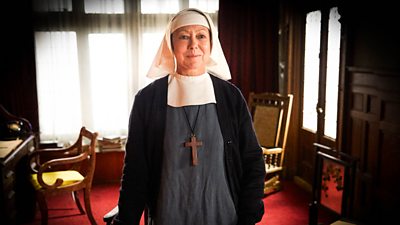
Sister Winifred decides it would be good for men to come to the Mother Craft classes. A lot of the mothers are against it. They think the men should go to the pub and come back when all the nasty, dirty stuff is done, nice and inebriated.
- Jenny Agutter plays Sister Julienne (pictured)
- Judy Parfitt plays Sister Monica Joan
- Victoria Yeates plays Sister Winifred
Tell us what impact the Big Freeze of 1963 has on the community of Poplar. Do you have any of your own memories of the Big Freeze?
Jenny: There is something so particular about the beginning of ’63 because the Big Freeze really affects the community, who have to pull together once again, not quite like the war but even so, electricity is cut off, people aren’t getting heat at home, there is the real possibility of the elderly dying from the cold, of babies being born without electricity.
I do remember it as a child - it was actually quite astonishing with the icicles hanging off the roof. It affected people’s travel, the milk floats didn’t arrive, houses didn’t have their electricity, it was a big thing.
Judy: I remember the freeze - the ice was on the inside of your house and all your plants died! It was incredibly difficult driving because everything froze up as you were driving along, and there were great banks of snow everywhere. Milk froze in their bottles and silver tops were pushed off because the milk sort of expanded, you basically had lolly sticks of milk with no tops on.
What does 1963 bring to our screens in this series?
Victoria: This period is so very interesting. This is the year JFK dies and you’ve got the first woman in space. Politically, musically and fashion-wise, we’re really going into an interesting time.
Jenny: The first woman in space is a lovely moment for the women to be inspired, and indeed this has an effect within Nonnatus House. As we know, Sister Monica Joan loves her television and she loves watching those programmes, so she is very keen on watching this historical moment.
I think the beauty of Call The Midwife is that Heidi Thomas (the writer and creator) takes the stories year by year and looks at how this affects people and the community. It’s not just stuck in a general time, it is specific, whether it’s JFK being shot and the repercussions of that, or understanding what is happening with Martin Luther King, the Space Race, the Beatles coming along, The Rolling Stones, all those things.
What can we look forward to from your character during the upcoming series?
Judy: The thing that has kept me here for seven years is that I can do whatever I want - and who is going to stop Sister Monica Joan?! It can be a challenge because some of the lines are archaic; nobody really speaks like her anymore. She is not really walking among the normal people; she is a still a bit doolally, eccentric, complex, but very kind and funny.
In this series Sister Monica Joan is really struggling with her failing eyesight, she has cataracts and they have just been getting worse and worse. Back then, the operation to correct a cataract was a very serious one, you were under a general anaesthetic and they actually cut into the eyeball. You had to have special glasses that you wore for life afterwards. Her friends try to cajole her into having the operation and she fights against it. She is absolutely panic-stricken and thinks she’s going to pop her clogs.
I had a cataract operation about 10 years ago and they just lay you down and put a bit of an anaesthetic around the eye, you are wide awake, they do something, put a lens in and then you’re off. The progress of medicine in the last 50 years is quite incredible, absolutely phenomenal.
Victoria: Sister Winifred trying to drive does become an issue and she becomes quite frustrated with herself - everybody else is doing it, so why can’t she? You do start to see her throw a few tantrums actually. She gets quite feisty and you see the red head come out in Sister Winifred.
I’m learning to drive myself at the moment. I think I’ve picked it up quite quickly, and I feel quite confident driving. I’ve been working so much lately that I haven’t had time for any more lessons. I might just go and do one of those quick courses just to finish off.
Sister Winifred has quite a forward-thinking idea in this series when she decides it would be really good for men to come to the Mother Craft classes. She wants them to learn how to support their wives, how to do the breathing exercises and so on, which is unusual for the 60s. A lot of the mothers in the classes are against it. They all think they should go to the pub and come back when all the nasty, dirty stuff is done, nice and inebriated. Sister Winifred pushes through and actually has a father in one of her births, but the mother thinks he’s more of a hindrance than a help. The father though, realises how much he would have missed out on by not being there.
Jenny: Sister Julienne discovers some of the darkest elements of human nature in this series, one of abuse in the family. It is that terrible thing of the victim feeling they are unable to do anything, but there is enormous strength in this person.
Heidi (Thomas) gives such a strong back story for Sister Julienne and knows her absolute faith would carry her through something like that. My breath was quite taken away by this story - it would make one question what people are about and how dark things can be.
What fashion styles have you loved from the new series?
Jennifer: I love Valerie's look because it's incredibly different to what I have in my day-to-day life, and that's always helpful when you’re getting into character. It's 1963 now and Valerie’s hairstyle - the beehive - was a huge trend of the early 60s. It tells me that although she might not say she does, she definitely follows trends and she's up to date on that kind of thing.
Her fashion sense is pretty early 60s. She's a very modern woman, she's forward thinking and I think fairly liberal in her attitudes. She often wears trousers, which are still quite unusual for that time, and I loved wearing them - they’re more comfortable than the dresses, and they illustrate her practical nature. She wears lots of really nice bold colours, she's not a shrinking violet when it comes to fashion, she's pretty daring and she's got great clothes.
Helen: This series has been a bit of a challenge for Trixie’s fashion because I was pregnant and so I was growing in size quite substantially. Ralph (Wheeler-Holes), our Costume Designer, really had his work cut out. We were going for very strong 60s silhouettes, but obviously my body was changing. We went for a lot of capes, lots of gloves, lots of bright colours, lots of geometric prints to try and hide the pregnancy, but to keep it looking like a period costume as well.
It was hard because pregnancy clothes in the 60s were quite ‘mumsy’, so the challenge was to make her not look pregnant and keep her fashionable. I think Trixie is looking towards the Bardot style; she’s not 20 anymore and doesn’t want to dress like a teenager. She’s dressing like a woman but she wants to be sexy, she wants to be looked at, she wants to be glamorous, but still functional because of her job.