The Midwives
'Midwives' Linda Bassett, Leonie Elliott, Helen George, Jennifer Kirby and Charlotte Ritchie discuss the new series.
Published: 15 January 2018
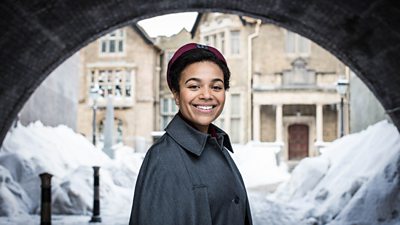
- Linda Bassett plays Phyllis Crane
- Leonie Elliott plays Lucille Anderson
- Helen George plays Trixie Franklin
- Jennifer Kirby plays Valerie Dyer
- Charlotte Ritchie plays Barbara Hereward
How do your characters feel about the arrival of new midwife Lucille?
Helen: We’re very excited. She’s a very strong, lovely character, a great girl and she’s from the Caribbean. Lucille initially does have some problems being accepted in the East End, and although it does smooth itself out a little it remains an ongoing problem for her. For Trixie it’s exciting to have some young life in Nonnatus House, and for all of us it’s exciting to have a new character.
Trixie and Lucille really bond over one particular pregnancy. When Lucille assists with a birth, Trixie realises that this new midwife really knows what she’s talking about. Lucille is on it, she’s read the textbooks and she knows exactly what to do in each situation. Although Lucille is new to midwifery, Trixie’s pretty impressed with her knowledge.
Jennifer: Valerie meets Lucille at the start of this series and they become really good friends. Circumstances bring them closer together and Valerie opens up to Lucille in a way that she hasn’t to many other people in Nonnatus House. Valerie always puts on a veneer of being strong, but like many of us at heart she’s soft and has things in her past she feels sad about. Valerie feels like she can open up to Lucille because if anybody knows about being bullied and feeling insecure, Lucille does.
How is Lucille’s arrival greeted by the wider community of Poplar?
Leonie: When Lucille delivers a baby for one family, the grandmother of the child is not pleased to see her, saying she doesn’t want a foreign midwife to look after her daughter. When complications set in days later, the grandmother believes it’s because Lucille delivered the baby. Of course this is ridiculous but that is her view and she takes a firm stance on that.
My parents and grandparents are Jamaican so I drew upon some of their experiences. Sometimes it’s not very nice, but I feel that we’ve come a long way since the 60s. I feel that through my storyline I’ve been able to get to know more my parents’ and my grandparents’ history, and what they had to go through. Obviously, it’s great that we’ve come a long way since then.
Jennifer: When an old school friend of Valerie’s goes into labour at the hairdressers on Valerie’s day off, she telephones Lucille for backup. When Lucille arrives she encounters racism, and for Valerie this is a major turning point. Valerie has to address the fact that some of the people she has lived with her whole life - her family, her friends – are people who have very wrong views and she realises that she needs to speak up. Lucille is her very good friend now, and someone who she feels protective of. Valerie has always felt strongly about injustice, and this behaviour puts the topic in front of her, and she can't avoid it.
What does living in the early 60s mean to the show and these types of communities?
Helen: Now we’re in the early 60s, there’s a sense of political change and of change amongst women. It is the start of feminism, the start of women not having to stay at home with the baby. They can have careers as well as families and there’s a sense of progression.
Television being introduced into homes was a key turning point, and technology in the home becomes more developed. Fashion is changing, as well as attitudes towards sex, towards marriage, towards careers. I think there’s a sense of freedom - we’re far away from the World War Two now. The community has come out the other side and there are fewer references to bomb sites and to the war. This series is really about looking forward to the future - the space race, Russia and America, it’s a very vibrant time in the early 60s.
Linda: In one episode Phyllis is tending to a Jewish family who the council are trying to evict from their home. The family is part of a large Jewish community in Poplar at the time, many of whom are starting to move out, indeed the daughter in this story has already moved out. It is a sad thing as it’s the break-up of a community, but they go on to form new communities elsewhere. The 60s are a time of big change, and the same is true for Poplar.
Charlotte: We saw last year when Barbara was getting married, that she’s getting into contraception and sex, so that’s a big part of her world! You are starting to see women being able to look after their own bodies more, but you also see things like women having to go through a separate door to get the contraceptive pill, because it’s all hush hush. There are still big leaps to make, but to see women starting to have more autonomy is really exciting.
What fashion styles have you loved from the new series?
Jennifer: I love Valerie's look because it's incredibly different to what I have in my day-to-day life, and that's always helpful when you’re getting into character. It's 1963 now and Valerie’s hairstyle - the beehive - was a huge trend of the early 60s. It tells me that although she might not say she does, she definitely follows trends and she's up to date on that kind of thing.
Her fashion sense is pretty early 60s. She's a very modern woman, she's forward thinking and I think fairly liberal in her attitudes. She often wears trousers, which are still quite unusual for that time, and I loved wearing them - they’re more comfortable than the dresses, and they illustrate her practical nature. She wears lots of really nice bold colours, she's not a shrinking violet when it comes to fashion, she's pretty daring and she's got great clothes.
Helen: This series has been a bit of a challenge for Trixie’s fashion because I was pregnant and so I was growing in size quite substantially. Ralph (Wheeler-Holes), our Costume Designer, really had his work cut out. We were going for very strong 60s silhouettes, but obviously my body was changing. We went for a lot of capes, lots of gloves, lots of bright colours, lots of geometric prints to try and hide the pregnancy, but to keep it looking like a period costume as well.
It was hard because pregnancy clothes in the 60s were quite ‘mumsy’, so the challenge was to make her not look pregnant and keep her fashionable. I think Trixie is looking towards the Bardot style; she’s not 20 anymore and doesn’t want to dress like a teenager. She’s dressing like a woman but she wants to be sexy, she wants to be looked at, she wants to be glamorous, but still functional because of her job.
Tell us why Valerie and Lucille introduce sex education classes.
Leonie: Lucille and Valerie want to give the young girls of Poplar sex education classes. Lucille isn’t as keen on it as Valerie, especially on unmarried girls using tampons - as she feels that a sanitary belt is perfectly sufficient. Because of her beliefs she feels that unmarried girls don’t necessarily need to know all the details. It was a nice story to play as Lucille comes full circle and gradually realises that it is better that the girls are educated, rather than making mistakes.
Jennifer: Valerie introduces her health and relationship class, which is essentially a sex education class, for girls over 16 who still require signed permission slips to attend the class. Valerie feels very strongly that young women should have as much information as possible. This was still quite a taboo subject at the time: many people felt strongly that young women shouldn't be given all this information, that they should be innocent for as long as possible. Valerie disagrees and wants to give them scientific knowledge to help them in their lives and relationships, and to make sure there aren’t any unwanted pregnancies. The more information they get the better, in her opinion.
Teaching the class with Lucille, who has much more conservative views on the subject, makes for a very interesting double act. But it’s a lovely journey they go on together and we learn lots about their characters. Lucille learns quite a few things too, and it shows just how important it is that women were given as much information as possible.
What is in store for your character in this series?
Charlotte: When Barbara arrived at Nonnatus House she wouldn’t say boo to a goose, and now she’s brave. We saw her get her confidence when she was in South Africa with Trixie. I think her relationship with Tom has really propelled her into adulthood and being a wife now. She’s looking after somebody who isn’t someone’s baby, and now she has to do his washing and also her own work. She’s definitely growing up.
Linda: Heidi has written a wonderful character that I can really play with. Nurse Crane is old fashioned, stern and rigorous, she’s not modern, lax or free and easy, the way people can be nowadays. She is quite fixed but has a fun side which I recognised in the adults I knew when I was growing up. Every now and again I get a chance to express her playful side. She is also a very good midwife, very kind to all the mothers in her care and has a great affection for the babies.
When Nurse Crane first arrived, Barbara and her shared a room, which would immediately make you feel sorry for Barbara - she had this woman going, "I’ve put a line down the centre of the dressing table so we have a side each" and that sort of thing. However, they became really close and my character was bridesmaid when she got married, so we’ve seen her fly the nest.
The new policeman, Sergeant Woolf, seems to be a thorn in Nurse Crane’s flesh. He is always there... like a one-man health and safety brigade... and he’s even more pompous than she is, so he is a bit of a match for her. Naturally, if you see your own bad qualities reflected in someone else, you don’t like them much do you?
Helen: Trixie and Christopher are still going strong; she’s really trying to be what she imagines he would want in a partner, by cooking meals for him. It’s quite interesting as he puts a little pressure on her to spend her first night with him, which really brings up thoughts on sex before marriage and the idea of contraception. She confides in him quite a lot about her drinking and he’s there for her as support outside of Nonnatus House. The only problem with their relationship is that he has an ex-wife, with whom he shares a child, who isn’t necessarily happy that Christopher is seeing a new women. His daughter Alexandra is lovely little girl who Trixie really takes to and they have quite a strong bond.
At the start of the series, Trixie is still sober and going strong with her AA meetings. We take a glimpse into one of her meetings, and it’s good to revisit that so we see that Trixie has this ongoing struggle with alcohol and it’s not fixed, it’s not solved. And you really hear her share and you hear how much time Trixie actually spends on this, how much time she spends going to AA meetings, but more importantly how much she thinks about drinking, or rather not drinking. Drink’s always on her mind and you really get to grips with her struggle and how at the forefront of her thoughts it still is, even though you see her not drinking, it’s still there.
Jennifer: Valerie is such an interesting character because she's really two ends of a spectrum - she’s incredibly warm and loving and makes very deep emotional connections with people but she's also got quite a fiery nature as well. When she feels a strong sense of injustice she can’t censor that. She's all or nothing in my opinion, which is really interesting to play.
Valerie’s struggling with her workload at the start of this series. She has a very large extended family and one particular aunt, who owns a ballet school, has moved to Frinton to retire. Her aunt leaves her in charge of the dance school in addition to her midwife duties. Valerie’s a much bigger woman than I am, because I would have just said no. So poor Valerie is teaching toddler tap and baby ballet as well as delivering babies. Thankfully help isn’t too far away.
Leonie: Lucille meets a young Jamaican mother called Alicia Palmer and they strike up a friendship. Alicia invites her to a weekly Sunday gathering. Her husband is a pastor and they gather, sing hymns and worship because, I suppose at the time, their experience of mainstream church was not the most pleasant. So once a week they gather in Alicia’s front room and her husband carries out the service. That was a really interesting and touching storyline.
I think for any immigrant to come here it’s hard because you want to fit in. Lucille is torn: she wants to fit in, but also wants to have reminders of home and some home comforts, which is what Alicia provides. At the beginning Lucille is quite conflicted because if she goes to Alicia’s is she then not trying to fit in? But she soon realises she might be able to have both, to have some home comforts now and again, and still fit into her new world.
Just being in London is an interesting journey for Lucille. I don’t think Lucille has ever experienced city life before; she’s had her rural upbringing and her training in Somerset. It’s been an eye opener for her, and she’s made some great friends like Valerie and Phyllis, and I suppose she’s been toughened up by some of the experiences she’s faced.
Why does Call The Midwife remain so popular?
Helen: I think none of us can quite believe that our audience has stayed so strong, and there’s definitely more word on the street about it. I think because the writing is so strong, people have fallen in love with the characters - there’s a strong sense of community that people miss in their day-to-day life, there’s a harking back to this era - to the 50s and 60s - and there’s a familiarity about it. Yet it also has strong, dramatic, underlying medical issues as well. But who’d have thought a programme about midwives and nuns would be this successful?
Charlotte: I think what’s amazing is the wealth of characters; you just have endless opportunities for new storylines, with a fine feminist thread running through. Also the changing times really lend themselves to the fact that it evolves continuously and remains interesting. The world is always changing and the boundaries they’re all operating within are too - so I love that. I think that’s why it’s lasted so long. Each episode you have two or three guest characters and through them you get to look into elements of the East End, but you also have this thread of regular characters who you’ve grown to love, and I think that’s a big part of how it has grown and kept a loyal fan base.
Jennifer: For me, it’s the perfect perfectly constructed drama. If you look at Shakespeare you always have one scene that's very heavy and then one scene that's lighter and that's what this show does all the time. You have all the warmth and light, and you have friendship which gives you that warm fuzzy feeling, but then at the same time you have very real, and often very scary situations that they don’t shy away from. It's just a perfect representation of life, which is not always good but not always bad, and you feel both things incredibly keenly, and that's why I love it.
The characters are so inspiring, not just the regular characters, but the people that they come across and meet. Amazing people who get through their problems. It makes you realise how many everyday difficulties and struggles there are in people's lives, and that people just carry on and they get through it. People are hugely resilient, and I think that's amazing to watch.