The Midwives
Created and written by Heidi Thomas, Call the Midwife returns to BBC One for a sixth series in January 2017.
Published: 9 January 2017
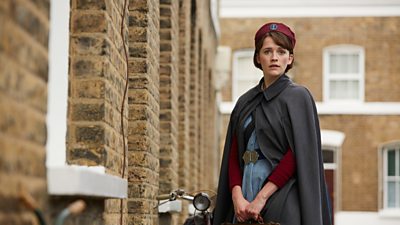
I think the overarching theme of Call The Midwife, and the one that ensures its popularity, is humanity. The stories we see are about people, not necessarily in extraordinary circumstances but caught in the conditions of time, opportunity or fortune.
- Helen George plays Trixie Franklin
- Charlotte Ritchie plays Barbara Gilbert
- Linda Bassett plays Phyllis Crane
- Kate Lamb plays Delia Busby
- Emerald Fennell plays Patsy Mount
Q&A
Describe the universality of the themes in Call the Midwife, and its enduring appeal.
Helen: It’s been taken into the hearts of so many British homes… and families as well. It’s become a real family drama which is interesting because the subject matter is something that you’d think would be for adults only, and we do tackle hard issues. But, it’s lovely we have such a young fan base as well. A lot of the people I talk to are young girls – thirteen year-olds, even as young as eight year-olds. People allow their children to watch it because they see it as a wholesome programme, but also a programme that’s educational.
The series does so well and seems to be getting more popular because we’ve got such a good writer – Heidi Thomas – she has really good stories and writes brilliant scripts. Plus, we all get on and I think that comes across on TV. People want to be at Nonnatus House with us…I hope!
Charlotte: It’s a show about women’s issues with a majority female cast and that’s not that common. It’s also a social history of sorts, and people don’t necessarily get taught it. I learned hardly anything about it all at school. I think the way they manage to weave in historical facts and education into a show that ends up being about relationships is pretty good going.
If you’ve been watching a long time, viewers really get to know the characters. Many of the issues the characters are dealing with are pretty huge. We’ve had depression, post-traumatic stress, alcoholism and many others, but they largely take place in a domestic setting we can all relate to. It’s definitely one of the strengths of the show.
Linda: Call The Midwife is so good because it is gritty and real. It doesn't sugar coat the hard experiences of life but it believes love conquers all so shows people finding that out and applying it.
Kate: I think the overarching theme of Call The Midwife, and the one that ensures its popularity, is humanity. The stories we see are about people, not necessarily in extraordinary circumstances but caught in the conditions of time, opportunity or fortune. For those people their stories are quietly momentous, and I think Call The Midwife is wonderfully sensitive to those small lives changed. I know the reason I love the show is that it’s really mostly about people doing their very best to live, love and help others and I think audiences respond to the humanity in that. It’s how we all should live.
Emerald: It's a show which really shows the staggering bravery and strength of women, whether they're delivering babies in impossible circumstances, or trying to keep food on the table for their families. It's a show which draws on the universal themes of love, hope, friendship, as well as heartbreak and loss: all of life is in Call The Midwife.
How has the series embraced the Sixties?
Helen: The Sixties, they were a really interesting time for Trixie. In terms of fashion you see the silhouette of the woman change, it becomes less of the big skirts and the pointy bras, and it becomes a much more feminine, slim, fitted outline. And I love wearing things like that. The make-up also changes. You get a bit more eyeliner and the flick starts getting larger and I’m hoping that we get to 1967 so I can do the Twiggy thing at some point. And also the hemlines are getting shorter and shorter, so it’ll be the miniskirt soon – fingers crossed!
Charlotte: We’re entering 1962 and it feels like there is big social change coming. We’re moving out of the Fifties and women are becoming more liberated. Poplar probably isn’t in the Swinging Sixties yet; changes are afoot but it doesn’t feel like a sudden impact. This is what the show does very well, a gentle drip-feed from one era to another. Definitely an interesting time, especially for women.
Linda: I think the main thing that has altered, or is altering, in Call The Midwife is that authority is being challenged. We don't have so many scenes of wise elders counselling young midwives, but often older midwives challenged and accepting wisdom from the youngsters. Apart from the things that were actually happening in the early Sixties, which are featured in stories, I think this is the main change.
Kate: The Sixties makes itself very present this series, unprecedented things were happening in ‘62! We make it through The Cuban Missile Crisis with the Nonnatus women and, of course, Trixie gets some stunning new outfits.
Emerald: The music is tremendous, and Patsy has some stylish new 60s trousers. You can feel the modern world creeping in bit by bit.
Could you deliver a baby for real?
Helen: I suppose I just wouldn’t be as surprised as some people as to what’s going on. And I would know how to cut a cord.
Charlotte: Absolutely 100% not, no way.
Linda: Of course not! It takes years of training and experience to make a good midwife. However, women have been known to deliver their own babies, so if it was a very easy birth with no complications I daresay I could help out. I would certainly be willing to try.
Kate: Actually, on balance, absolutely not. I could be supportive and calm and I don’t think I’d pass out or anything, but I am utterly unqualified. Make no mistake, I’m calling a midwife.
Emerald: I'd give it a go in a moment of mad confidence and then instantly regret it once I realised I hadn't a clue what I was doing.