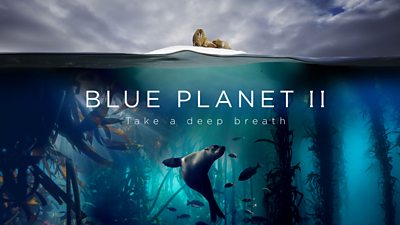
Music by Hans Zimmer
Hans Zimmer has scored more than 120 films, which have, combined, grossed over 24 billion dollars at the worldwide box office.
Published: 15 October 2017
The idea is to depict the abundance of life as well as the movements and vibrations of the ocean. By using the orchestra in an unconventional way, we wanted to create 'living' chords that ebb and flow throughout the series.


His most recent film project is the critically acclaimed Christopher Nolan film Dunkirk, and his work will next be featured in Denis Villeneuve’s upcoming sequel, Blade Runner 2049. Zimmer has been honored with an Academy Award, two Golden Globes, three Grammys, an American Music Award, and a Tony Award. His most recent Academy Award nomination for Interstellar marks his 10th career Oscar nomination with the Academy. In 2003, ASCAP presented him with the prestigious Henry Mancini award for Lifetime Achievement for his impressive and influential body of work. He also received his Star on the Hollywood Walk of Fame in 2010, and in 2014 was honored with the Zurich Film Festival Lifetime Achievement Award. In 2014, Zimmer completed his first concerts in the UK, Hans Zimmer Revealed, at the Eventim Hammersmith Apollo, and concluded his first ever European tour, Hans Zimmer Live, in 2016. Zimmer recently completed the European leg of his Hans Zimmer Live 2017 tour as well as the US portion tour which came after Zimmer’s wildly successful and well-reviewed performances at Coachella in April.
Other recent projects include: BBC’s Planet Earth II, Ron Howard’s Genius on National Geographic with Lorne Balfe, the main title music for Netflix’s The Crown, DreamWorks Animation’s The Boss Baby, 20th Century Fox’s Academy Award-nominated Hidden Figures, with Pharrell Williams and Ben Wallfisch, Ron Howard’s Inferno, Zack Snyder’s Batman v Superman: Dawn Of Justice, Mark Osborne’s The Little Prince, Peter Sollet’s Freeheld, Simon Curtis’ Woman In Gold, The Amazing Spider-Man 2, Steve McQueen’s 12 Years A Slave, Ron Howard’s Rush, Zack Snyder’s Man Of Steel, History Channel’s miniseries The Bible, the Christopher Nolan-directed films Inception, The Dark Knight and The Dark Knight Rises; and Guy Ritchie’s Sherlock Holmes: A Game Of Shadows. Some of Zimmer’s most notable works include his scores for Rain Man, Driving Miss Daisy, Thelma & Louise, Crimson Tide, The Thin Red Line, Gladiator, Mission: Impossible II, Hannibal, Pearl Harbor, Tears Of The Sun, Spanglish, The Pirates Of The Caribbean franchise, the Kung Fu Panda and Madagascar films, The Da Vinci Code, Frost/Nixon, and The Lion King, for which he won the Academy Award.
Blue Planet II: The Prequel
Radiohead, one of the world’s most acclaimed rock bands, and Hans Zimmer, one of the planet’s most successful movie and TV composers, joined forces to produce an exclusive track called (ocean) bloom for the five-minute series prequel, released globally in the lead up to Blue Planet II.
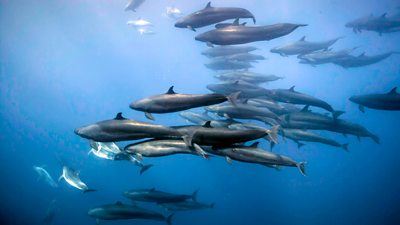
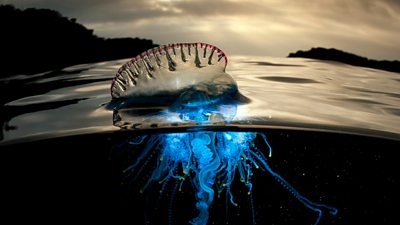
This introduction to the show, narrated by series presenter Sir David Attenborough, features an array of some of the most awe-inspiring shots and highlights from the new series, as well as several exclusive scenes that do not feature in any of the seven episodes.
Inspired by the sounds and musical palette of Blue Planet II, Radiohead and Hans Zimmer recorded an orchestrally reimagined version of the Radiohead song Bloom, with Thom Yorke re-recording the vocals. The track was produced by Russell Emanuel of Bleeding Fingers Music.
Q&A with Blue Planet II composers: Hans Zimmer, Jacob Shea and David Fleming of Bleeding Fingers Music
What excited you about producing the musical score for Blue Planet II?
After our spectacular experience of working on Planet Earth II, we were incredibly excited when presented the opportunity to collaborate again on the score for Blue Planet II. The scope of the project was immense giving us the chance to take a whole new approach at an epic natural history score. The camera systems and technology used to explore the Earth’s surface and ocean’s depths have evolved to a remarkable extent that we are now able to acquire footage unlike ever before and we felt compelled to provide an equally elevated sonic experience and immerse our team on another important project that brings awareness to and focuses on the beauty, omnipotence, and vibrancy of the environment.
You produced the score for Planet Earth II and now Blue Planet II – how was the experience similar or different?
With Blue Planet II, we took the opportunity to build upon the vocabulary of Planet Earth II. This time Hans was intricately involved in the entire score rather than just the theme. We also expanded our team with the addition of David Fleming. The main difference from Planet Earth II is that whilst each episode is diverse the series is always surrounded by water so we aimed to underpin the score with a more homogenous texture. The sonic palette for Blue Planet II is more unified and for this we created “The Tidal Orchestra” to express the motion within the sound of the ocean.
The score adds so much drama to natural history, as we experienced with Planet Earth II. How does your approach differ between documentaries and feature films?
Similar to Planet Earth II, we approached Blue Planet II exactly like a feature film. The themes of life and death and new found love are relatable and deeply resonate with individuals in a visceral, personal way yet also on a global scale. The variety of underwater life and stories explored in this series are equally as epic and fantastic as any written script.
Is there a particular orchestral instrument that particularly lends itself to natural history landmark soundtracks?
For such an important project, we wanted to create a sound that would underpin the entire series. This was the genesis of “The Tidal Orchestra”. The idea is to depict the abundance of life as well as the movements and vibrations of the ocean. By using the orchestra in an unconventional way, we wanted to create 'living' chords that ebb and flow throughout the series.
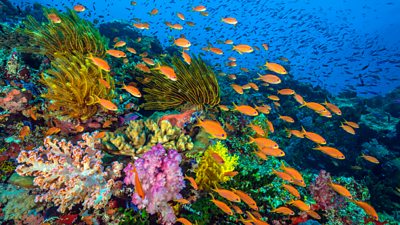
Inspired by Impressionism, more specifically the works of Claude Monet and his depiction of water, our concept was to similarly convey the vibrancy and movement of Impressionist paintings. Like using multiple strokes on a canvas, we had the string players pluck and trem between notes of a chord at varying speeds and entrances forming flowing textures, rather than traditional sustained notes. The same effect was applied to the woodwinds, choir, a hall filled with numerous harpists, mandolins, and marimbas. The result was more spectacular than we had hoped as these different organic colours intertwined, creating varying depths of sound and movement and sonically emulating the life at the bottom of the sea.
What was a highlight for you when working on this project? For example, an inspiring moment, seeing some of the footage or when it all comes together?
One of the most inspiring moments working on this project was the culmination of “The Tidal Orchestra”, when we heard all the various sounds of the instruments come in and we knew immediately it would breathe life into the score. It was a moment where we saw an idea translate into a creatively useful and successful delivery that was emotionally moving.
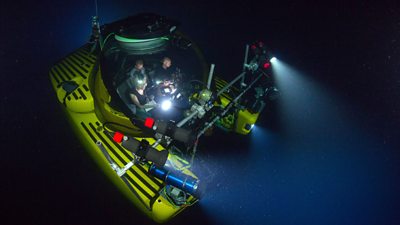
One of the highlights of the project was the various opportunities to experience the creatures and environments within the depths of the Earth’s oceans as they are being discovered or captured for the very first time by film. It provided us with a unique glimpse into undiscovered life and also a deeper understanding of the world we live in. The variation in storytelling on this project, from exploring parts of the very bottom of the ocean and discovering new animals to seeing fish jump through the air caught by birds or intelligent creatures thriving in their natural habitats, communicates the expansive and majestic nature of the ocean while also hinting that we’re actually just scratching the surface and there is still enormous life yet to be discovered.
In film and TV you work around scripts and actors talking. How does this work with animals that don’t talk - or is it a case of having to navigate Sir David?
With Blue Planet II or any project without scripts or actors talking, the score is all the more forefront and principal to the storytelling. The music must provide a voice for the animals and also complement Sir David as our story guide in the ocean journey.