Green Seas
Green Seas
Published: 15 October 2017
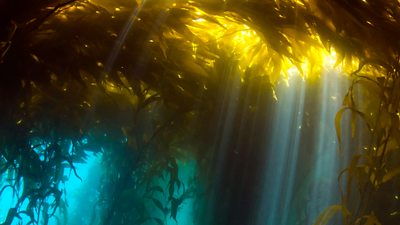
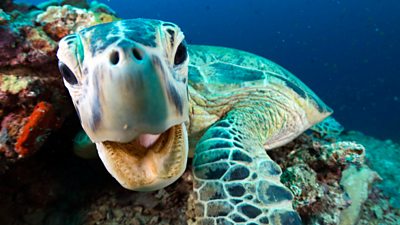
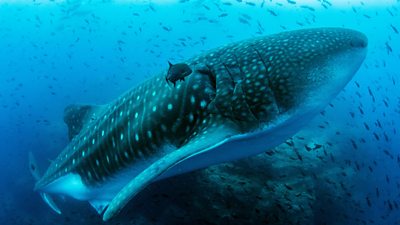
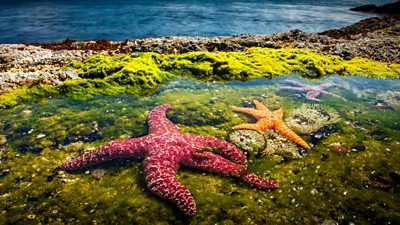
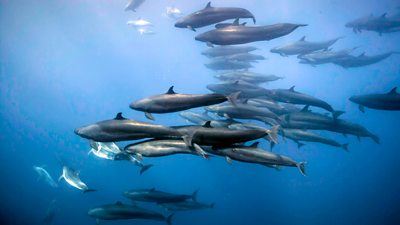
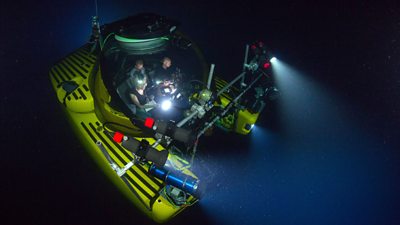
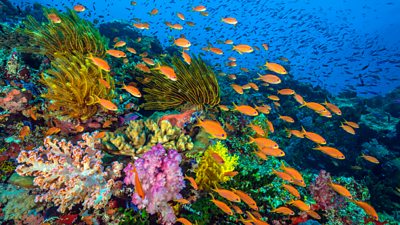
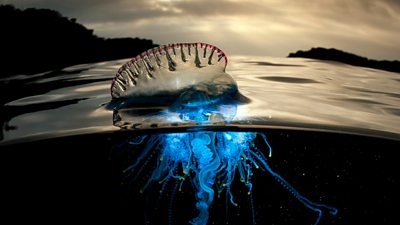
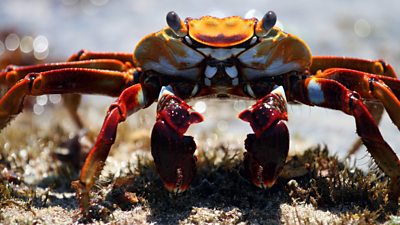
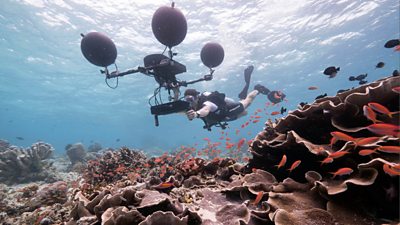
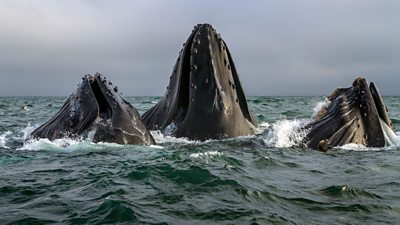
In our green seas, competition is fierce. Sunlight powers vast kelp forests, mangroves, prairies of sea grass and blooms of algae. Here animals must fight for space and food.
In kelp forests, a Common Octopus must become the ultimate escape artist to avoid its nemesis, the Pyjama Shark; and a Garibaldi Damselfish defends its seaweed garden from marauding sea urchins - but Sea Otters prove an unlikely ally
On prairies of Seagrass, Tiger Sharks play a game of cat-and-mouse with Green Turtles. This keeps the Seagrass healthy.
In shrubby meadows of seaweed, a vast army of Spider Crabs emerges from the depths for an annual mass moulting, while trying to avoid predation from monster, up to four-metre-long stingrays. And male Giant Cuttlefish compete for a mate... while smaller male wins by pretending to be female himself.
In the mangroves, a Mantis Shrimp abandons his mate of possibly 20 years for a larger female. Elsewhere, dolphins, whales, sea lions and birds race to a feast - vast shoals of plankton eating fish attracted by a bloom of microscopic algae.
Key story - Cuttlefish spawning aggregation
Written by Yoland Bosiger, Researcher
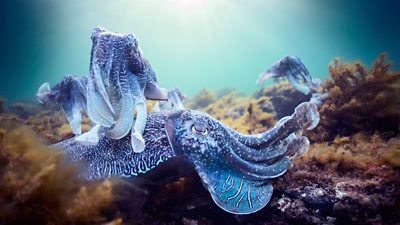
Every winter over a hundred thousand Giant Cuttlefish aggregate to spawn along a restricted area of rocky reef in northern Spencer Gulf, South Australia. These cuttlefish are the largest cuttlefish species in the world reaching 10 kg in weight. It is also the only known spawning aggregation of cuttlefish in the world and males can number eleven to one in the aggregation. This huge bias is thought to have produced an array of different behavioural strategies to win the females affections. Large males use size and brute force to fight off rival males while smaller individuals use a sneaker strategy to try to slip unnoticed past a larger male to get to a female. Some smaller males even mimic females to deceive the larger males.
New science, since Blue Planet reveals that unbeknownst to the larger males who are battling amongst each other to gain access to a female, it is in fact the wily female who decides who to ultimately mate with. By flashing a white stripe along her flank she can tell an unappealing male that she is not receptive and be left alone while switching it off if a more attractive suitor approaches. As there were so many cuttlefish and so many different behavioural strategies playing out, it took the filming team a couple of days to be able to get their eye in for this white stripe behaviour. It was only when the cameraman Hugh Miller decided to swim over the top of the cuttlefish rather than staying at their eye level that the stripe became readily apparent. Hugh was then able to capture a female displaying a white stripe to her larger cuttlefish protector whilst showing no stripe to a male mimic. The female then mated with the mimic right under the giant male’s nose! Blue Planet II has filmed the white stripe behaviour professionally for the first time.
Filming locations
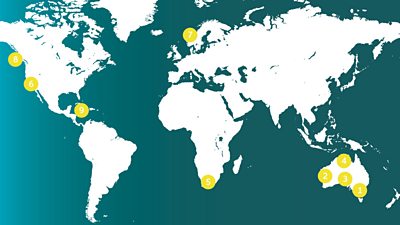
1. Weedy Sea Dragon, Seagrass, Giant Spider Crab, Smooth Stingray - Victoria, Australia
2. Tiger Shark, Seagrass, Green Turtle - Western Australia
3. Giant Australian Cuttlefish - South Australia
4. Mantis Shrimp, Mangrove, Seagrass - Northern Australia
5. Common Octopus, Pyjama Shark, Sevengill Shark, Cape Fur Seal, Bamboo Kelp, Split Fan Kelp - South Africa
6. Anchovy, Common Dolphin, Californian Sea Lion, Humpback Whale, Garibaldi Damselfish, Pacific Electric Ray, Crowned Sea Urchin, Giant Kelp, Sea Otter - California, USA
7. Starfish, Digging Red Sea Cucumber, Brown Sea Cucumber, Sea Penns - Norway
8. Red Sea Urchin, Purple Sea Urchin, Bull Kelp, Giant Kelp, Sea Otter - Pacific coast of North America: Alaska, British Colombia, California
9. American Crocodile - Cuba
Key facts
- About half of the planet’s total atmospheric oxygen is produced by ocean phytoplankton
- Kelp is one of the fastest growing organisms in the world - Giant Kelp can grow up to half a metre, or 50cm a day!
- Kelp grows along the coastlines of all continents except Antarctica
- Mangrove swamps absorb more carbon than tropical rainforests by area
- Scientists estimate that the net loss of sea grasses since 1980 is equivalent to one soccer field every 30 minutes. This is significant because this environment can be 35 times more efficient than a rainforest at storing carbon dioxide, a greenhouse gas
Crew filming facts:
- Over four years the Green Seas team spent 196 days filming, 170 days involving being underwater and 664 hours diving!
Sea Otters
Location: USA, California
Species: Californian Sea Otter
Facts:
- Sea otters must eat a staggering 20-25% of their body weight each day just to get enough energy to maintain their high metabolic rates.
- They possess the densest fur of any mammal - almost 1 million hairs per square inch.
- It is thought sea otters can spend their entire lives without leaving the water
Giant Australian Cuttlefish
Location: South Australia
Species: Giant Australian Cuttlefish
Facts:
- The world's largest cuttlefish species, growing to 50 centimetres in mantle length and over 10.5 kg in weight
- Cuttlefish males disguise themselves as females to get past competing males to mate with a female
- Cuttlefish have three hearts! Two hearts are used to pump blood to the cuttlefish's large gills, and the third heart is used to circulate oxygenated blood to the rest of the body