Big Blue
Big Blue
Published: 15 October 2017
The big blue is a marine desert, far from shore, kilometres deep, with almost nothing to eat - and home to some of the largest and most spectacular creatures on Earth.
With special pressure-proofed cameras, we witness record-breaking feats of endurance as Sperm Whales hunt for squid a kilometre down in the abyss.
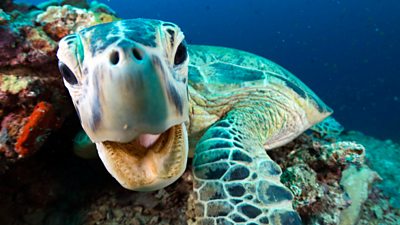
Until recently, no one knew how baby turtles survived in the vast open ocean. Big Blue reveals that they head to the centre of the ocean, where they use floating debris like life-rafts.
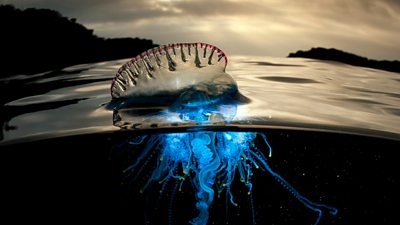
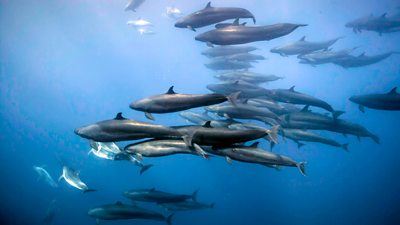
Jelly-like Portuguese Man-of-war harness sail-power to trawl for fish. Thousands of dolphins herd vast shoals of Lanternfish to trap them against the surface. Unique aerial footage reveals a centuries-old legend: the savage feeding frenzy of the 'boiling seas'.
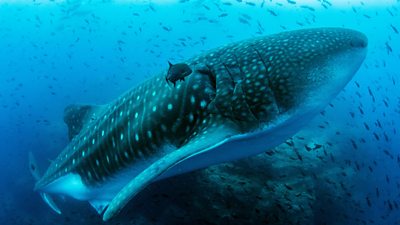
Whale Sharks make an epic voyage across the Pacific to a spot where, scientists now think, it may be safest to give birth. And a pair of ageing Albatrosses give their lives to raise their very last chick.
Yet even thousands of kilometres from land, there is evidence of human activity. Globe-spanning currents carry plastic into the heart of every ocean, often with tragic consequences. Could plastic be one challenge too far for the creatures of the Big Blue?
Key story - Lanternfish and Mobula Rays
Written by Sarah Conner, Assistant Producer
Lanternfish are part of a mass daily migration of animals that live in the deep sea in the daytime but rise at night into the warmer shallow waters in the open ocean to feed. However, these Lanternfish are thought to also stay at the surface at certain times of the year into daytime to spawn. As predators attack the Lanternfish, it can turn the sea white making it look like the sea is boiling. The team had tried and failed to film this in the Coral Sea, off Australia in December 2014.
So when, 18 months later, the team heard of sightings of a ‘boiling sea’ from the other side of the Pacific Ocean, off Coast Rica, they reacted quickly. Series Producer, Mark Brownlow developed a plan - they would look for the predator of the Lanternfish, which off Costa Rica wasn’t just Yellowfin Tuna but the larger Spinner Dolphins. Mark worked from a research vessel, the Umbra, stationed 20 miles off-shore, as a base for searching and filming by helicopter. Being able to cover vast distances allowed Mark to find the dolphins and with perseverance manage to film the boiling sea of Lanternfish being feasted on by tuna from the air. Underwater cameraman, Roger Munns also managed to capture the action underwater to create the dramatic sequence of Spinner Dolphins and tuna as they hone in on the Lanternfish in the Big Blue.
The surprise was that Mobula Rays also joined the feeding frenzy. Previously it was thought these rays only ate by filter-feeding plankton. There had been a couple of scientific papers published that showed small fish in the stomachs of dead Mobula Rays but science had assumed the fish were eaten by accident until the Blue Planet II footage was shared with Josh Stewart from the Manta Trust & Scripps Research Institute. Upon analysis of the Blue Planet II footage, Josh felt confident that it proved for the first time that the Mobula Rays were deliberately and actively hunting the Lanternfish.
Filming locations
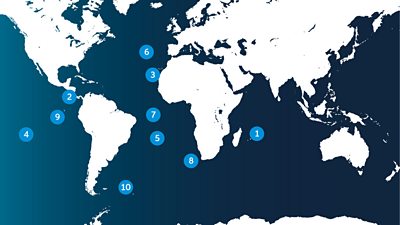
1. Sperm Whale - Worldwide Open Ocean
2. Lanternfish, Spinner Dolphin, Mobula Ray, Sailfish, Yellowfin Tuna - Costa Rica, Eastern Tropical Pacific/Pacific Ocean
3. Yellow rubber ducks - Canary Islands, Borneo, Bahamas, Costa Rica, Scotland, Arctic, Worldwide - Atlantic & Pacific Ocean
4. Silky shark (juvenile), Hawksbill Turtle, Green Turtle, Moon Jellyfish, Sea Nettles - Pacific Ocean
5. Portuguese Man-of-war, Short-Finned Pilot Whale, Loggerhead Turtle - Atlantic Ocean off Canary Islands
6. Atlantic Wreck Fish - Azores
7. Blue shark - Worldwide, Atlantic Ocean
8. Great White Shark - South Africa, Atlantic Ocean
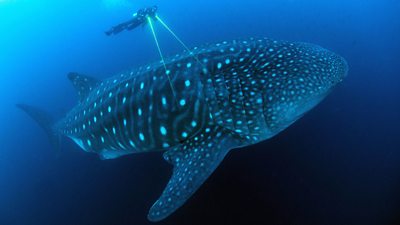
9. Whale Shark (pictured below) - Galapagos, Pacific Ocean
10. Wandering Albatross - Bird Island, South Georgia
Key facts
- The team spent the equivalent of almost two months solid underwater filming (1,200 hours diving), on over 200 filming days
- 65% of the surface of the Earth is open ocean
- Shoots were often searching areas the size of Belgium to find pods of dolphins that could form an area no bigger than a football pitch
- Every day, around 1,000 billion tonnes of water evaporates from the world’s oceans!
- It takes any given cubic metre of water around 1,000 years to complete the journey around the world’s oceans, via the ‘global conveyor belt’
Pilot Whale
Location: Atlantic Ocean off Canary Islands
Species: Short-Finned Pilot Whale
- Pilot Whales are highly social and have strong bonds with other members of the pod. Like Sperm Whales, females share nursing duties of calves, and some females will lactate even though they don’t have their own calf
- Pilot Whales have been observed to ‘mourn’ the death of their calves by carrying them around for days