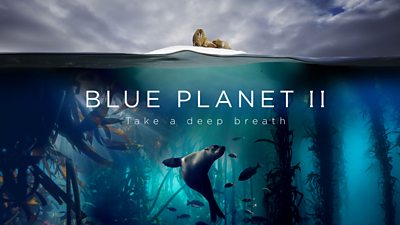
About the series
About the series
Published: 15 October 2017
- In 2001 we brought you The Blue Planet
- The first ever comprehensive series of the world’s oceans
- Sold to 240 territories around the world
- When The Blue Planet premiered in 2001, it received nearly 10 million viewers
- The Blue Planet won two BAFTAS and two Emmys
- But today, 90% of our oceans still remain unexplored
New science
One Ocean
False Killer Whales and Bottlenose Dolphins interactions - 2013 (scientific paper to be written)
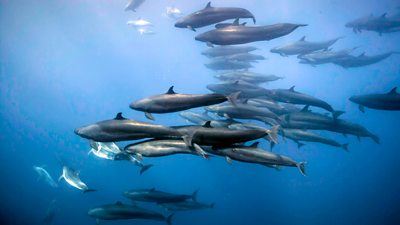
In New Zealand False Killer whales form relationships with Bottlenose Dolphins - an entirely different species. Both False Killers and Dolphins were scientifically described socialising and foraging together for the first time by Jochen Zaeschmar in 2013. Jochen Zaeschmar plans to write two publications from the data collected during the Blue Planet II shoot. One will focus on the oceanic Bottlenose Dolphins and the other will focus on False Killer whale population size.
The Deep
Methane volcanoes - scientific paper will be written by Dr Samantha Joye
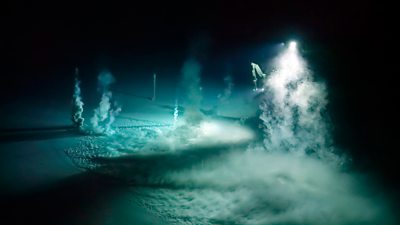
The deep seafloor looks barren and inert. It is, in fact, anything but. Its sediments are made from organic matter that has fallen over millennia from the ocean’s surface. Over time, in certain parts of the deep, this organic matter becomes compressed into sub-surface pockets of methane gas. Sometimes, this gas must escape. Observations during filming of Blue Planet II in the Gulf of Mexico will lead to two potential papers: one which will report the deep (>500m water depth) water temperature trends in the Gulf of Mexico deep which look to be increasing and another, which models the temperature data to predict the stability of methane deposits on the seafloor. If stability decreases this could have wide scale implications for our climate and the animals that live in the deep sea.
First deep manned submersible dive in the Antarctic by a wildlife film crew - scientific paper will be written by Dr Jonathan Copley
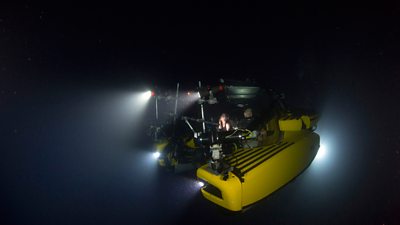
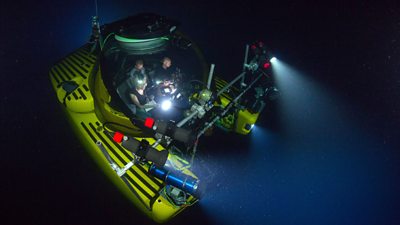
The deep sea bed in Antarctica has been surveyed by remote vehicles. The first few hundred metres have been glimpsed by humans in shallow submersibles. But no human has ever been before to where the Deep team landed on their final filming expedition - a thousand metres beneath shifting icebergs the size of a city-block off the tip of the Antarctic Peninsula. The expedition's footage will help us to understand how seafloor slopes and car-sized boulders dropped by passing icebergs influence the pattern of life on the deep ocean floor around Antarctica
Coral Reefs
Grouper gesturing and hunting with Octopus - 2006/2013
Grouper use the fish equivalent of sign language, dubbed the ‘headstand signal’, to reach across the vertebrate-invertebrate divide and encourage another species to help it hunt. Until now, this kind of gesturing behaviour has been associated mainly with apes and birds in the crow family, such as ravens, but several species of Groupers are now known to ‘point’. In 2006 Reduan Bshary was the first to comprehensively demonstrate the communication between Moray Eels and Groupers. This was expanded on in 2013 by Dr Alexander Vail who described the communication and signalising behaviour between Grouper and Reef Octopus.
Monocle Bream mobbing behaviour - 2015
In Great Barrier Reef, Australia, Bobbit Worms are large ambush predators which lie in wait in the sand and attack passing prey. Monocle Breams have figured out how to mob the Bobbit Worm by blowing water on their exposed jaws. In doing so they alert other fish to the worms location, ruining the predator’s chances of a meal. This behaviour was first described by Jose Lachat and Daniel Haag-Wackernagel in the journal Nature in 2015.
Clownfish dragging and pushing nesting material to their nests - scientific paper to be written
Saddleback Clownfish live out in the open sand in Borneo away from the reef and have no hard material to lay their eggs on. The unique aspect of this behaviour is that these Clownfish actively finds pieces of material to lay their eggs on. These tenacious fish will move objects many times their size from plastic bottles to coconut shells. Dr Alexander Vail and colleagues plan to publish a paper showing that these little hoarders push objects many times their own body weight metres to their anemones, and have very specific tastes of what makes a good home for their unhatched babies.
Reef Manta Ray cyclone feeding - 2008
In Hanifaru in the Maldives, when plankton levels become dense, chains of feeding Manta Rays loop around to form a cyclone of as many as 150 reef Manta Rays. Guy Stevens was first to observe and coin the term ‘cyclone feeding’ in 2008. The behaviour was scientifically described for this first time in Guy’s PhD thesis published early this year (2017).
Big Blue
Lanternfish baitballs being hunted by Mobula Rays – scientific paper to be written
Fish have been found in the stomach contents of Mobula Rays but it has never been clear whether fish where intended prey or simply incidental ingestions, mixed in with schools of zooplankton that the mobulids target. Footage captured by Blue Planet II demonstrates definitively that Mobula Rays are capable of targeting schools of fish and this will form the basis of a scientific note written by Joshua Stewart.
On-animal perspective Silky Sharks and Blacktip Sharks rubbing against Whale Sharks - scientific paper to be written
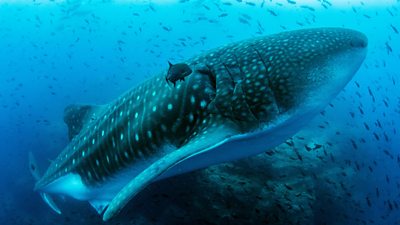
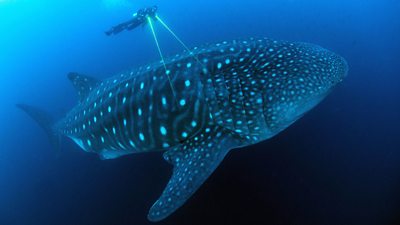
Silky Sharks and Blacktip Sharks were filmed rubbing up against pregnant Whale Sharks in the Galapagos. As far as we know this is the first time sharks rubbing themselves in this manner for cleaning against a Whale Shark has been documented. Jonathan Green and Dr Alex Hearn plan to write a short paper on the footage obtained from onboard cameras about the cleaning behaviour of Silky Sharks on Whale Sharks.
Albatross Sacrifice - 2013
Story of older Wandering Albatross caring more for their last chicks was studied by Hannah Froy in 2013.
Green Seas
Giant Cuttlefish white stripe behavior - 2002/2014
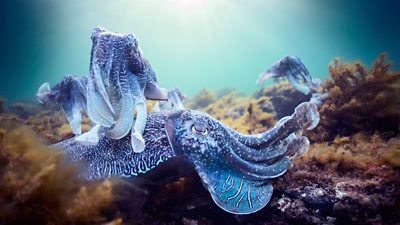
While multiple males fight amongst each other to gain access to a female, it is in fact the wily female that decides who to ultimately mate with. Female Cuttlefish display a white stripe to signal their intention to reject a mating attempt. Details of this behaviour have been newly confirmed in papers in 2014.
Coasts
Pacific Leaping Blenny - 2009
The Pacific Leaping Blenny is thought to be even more land-based then the mud skipper but it still needs to keep its skin moisturized and often feeds on algae near to the surf zone. To avoid being swept off the rocks into the surf zone the Blenny can leap a number of times its body length. The story is about males attracting females by flashing an orange patch on their dorsal fin and eventually attracting her to his nest in the rock crevice.
Technology
UHD Low-light cameras
Mobula Rays, Sea of Cortez
We used Canon and Sony cameras to film Noctiluca ‘sea sparkles’ glowing at night, around the wing beats of shoaling Mobula Rays, as they gather off the Mexican coast. The result is a magical experience, with rays swooping around the camera, glowing sparkles trailing in their wakes.
UHD Underwater Probe camera
Reef life, Great Barrier Reef, Australia
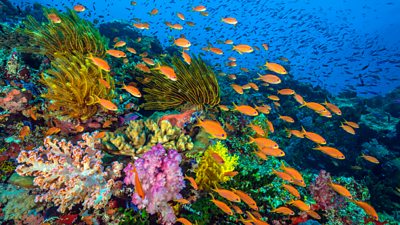
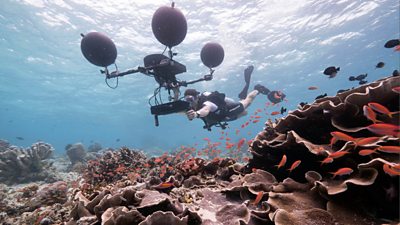
The team built probes (straight-scopes) that allowed us to get a low-angle view of life on a coral reef. Probing between the branches of coral, which seem to tower above us, we enjoy meeting reef creatures on their eye-line, in their world - an immersive experience.
UHD Drones
Sea Lions, Isabella Island, Galapagos Archipelago
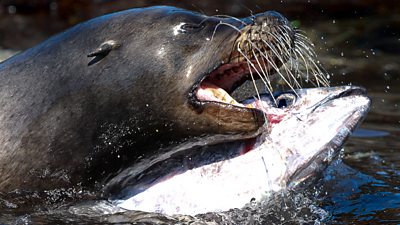
We took a drone to the Galapagos, to record some previously unknown hunting behaviour by sea lions. Their strategy is to drive yellow-fin tuna from the open ocean into their cove, where they trap their prey, and force the tuna to beach themselves. With the drone’s unique perspective we reveal their hunting strategy, and witness how sea lions, like the lions in Africa, take on different roles during the hunt.
Manta cyclone
In Hanifaru, when plankton levels become dense, chains of feeding Manta Rays loop around to form a ‘cyclone’ of as many as 150 reef Manta Rays. This was only scientifically described in 2017 and filmed for the first time from the drone by our series.
Suction cameras
Sperm Whales, Dominica
In collaboration with scientists, the team built suction-cup cameras that could be attached to the backs of large cetaceans and large sharks. One was attached to a Sperm Whale that dived into the Abyss, hunting for squid. Although the image darkens, we hear the whale hunt and catch its prey.
Orca, Arctic Norway
One camera was attached to an Orca hunting Herring, that takes us into the heart of a giant baitball. Another suction cam was deployed on the back of a pregnant Whale Shark travelling through the Galapagos. The team also worked with CATScam, a company that makes these scientific instruments.
UHD ‘Mega-dome’
White Island, High-Arctic
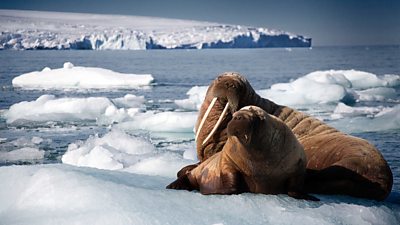
Collaborating with Gates housings, the team built a huge, domed port, 24 inches across, allowing us to gain perfect focus and exposure, both above and below the waterline. Using this, we achieved an iconic shot of a mother Walrus and her calf, hauled out on an iceberg.
UHD Underwater motion-control time-lapse rig
British Columbia, Canada
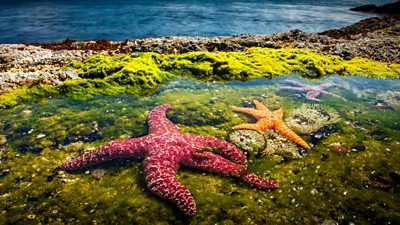
The team, working with in-house designer Mohan Sandhu x built a ‘mo-co’ rig, used to great effect, to film a rock pool in time-lapse. As the tides rose and fell around it, the rig would keep filming, its steady tracking time-lapse allowing us to reveal the underwater life of a rock pool like never before.
UHD Tow-cam
Spinner Dolphins, off Costa Rica
The team built camera to be towed behind a boat, allowing us to film fast-moving Yellowfin Tuna and huge shoals of Spinner Dolphins, as they travel at speed through the Open Ocean.
Some filming firsts
One Ocean
Tuskfish tool use
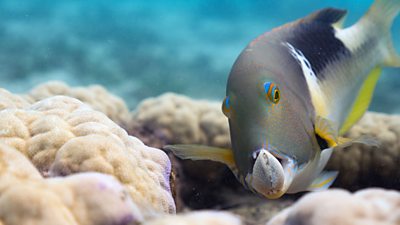
Ingenious Tuskfish break open hard-shelled Clams by cracking them against coral outcrops. This is the first time that this behaviour has been filmed professionally in detail.
Mobula Rays and bioluminescence
Beating their cloak-like wings as they feed, Mobula Rays stir up plankton, some of which produces bioluminescence when disturbed. As the Mobula Rays move through the plankton they leave beautiful blue trails in their wake. This behaviour is newly filmed by Blue Planet II and has likely been made possible with increasing light sensitive camera technology (we used two very light sensitive cameras).
False Killer whales and Bottlenose Dolphins interactions
In New Zealand False Killer whales form relationships with Bottlenose Dolphins - an entirely different species. Both False Killers and Dolphins have been documented socialising and foraging together. This is the first time this behaviour has been filmed professionally and was filmed by our series both from the air and underwater.
Giant Trevally predating flying terns
Giant Trevally aggregate off a beach from which fledgling terns are learning to fly. If the birds land on the water, the Giant Trevallies will attack from beneath. Most incredibly though, if the birds are flying low enough to the surface to the water the Giant Trevallies will launch themselves out of the water and grab them in mid-air! This was a ‘fisherman’s tale’ that proved true. The predatory behavior of these aerial predators has not been studied before.
The Deep
Squid stunt – first sub dive into the squid zone
Working from science and exploration vessel the Alucia, the Deep team and scientists mounted an expedition off the central coast of Chile to film Humboldt squid from a submersible. The team captured squid hunting at depth - and even cannibalism.
Methane volcanoes
The deep seafloor looks barren and inert. But its sediment, made from organic matter fallen from the surface over millennia can become compressed into pockets of methane gas. For the very first time, the Deep team has filmed violent eruptions of bubbles of gas the size of basketballs, shooting out of the seabed almost a half-mile down.
First truly deep manned submersible dive in the Antarctic by a wildlife film crew
No human has ever been before to where the Deep team landed on its final filming expedition - a thousand metres beneath shifting icebergs the size of a city-block off the tip of the Antarctic Peninsula. They were the first humans to film the unimaginable abundance of life from manned submersibles from fish with anti-freeze in their blood to fields of giant sponges and swarms of krill that glow in the dark.
Wedding shrimp love story
The male and female shrimp enter the Venus Flower Basket sponge when they are small, but eventually become too big to get out. This means that they spend the rest of their lives entrapped inside. This is the first time that these shrimp have been filmed in situ in the deep seas.
Coral Reefs
Grouper gesturing and hunting with octopus
Grouper use the fish equivalent of sign language to reach across the vertebrate-invertebrate divide and encourage another species to help them hunt. Until now, this kind of gesturing behaviour has been associated mainly with apes and birds such as ravens.
Monocle Bream mobbing behaviour
Bobbit Worms are large ambush predators which lie in wait in the sand for passing prey. Monocle Breams have figured out ‘mobbing’: blowing water on the Bobbit Worm’s exposed jaws - alerting other fish its location.
Clownfish dragging and pushing nesting material to their nests
Saddleback Clownfish live out in the open sand away from the reef and have no hard material to lay their eggs on. Uniquely, these clownfish actively finds pieces of material to lay their eggs on - moving objects many times their size, from plastic bottles to coconut shells.
Reef Manta Ray from the Air
In Hanifaru, when plankton levels become dense, chains of feeding Manta Rays loop around to form a ‘cyclone’ of as many as 150 Reef Manta Rays. This was filmed for the first time from the air by our series.
Big Blue
Aerial filming of Lanternfish baitballs being hunted by Mobula Rays and Spinner Dolphins
Mobula Rays and Spinner Dolphins feed on Lanternfish forming a huge, dense baitball at the surface.
On-animal perspective of Silky Sharks and Blacktip Sharks rubbing up against Whale Sharks
Silky Sharks and Blacktip Sharks were filmed rubbing up against pregnant Whale Sharks in the Galapagos for the first time.
Green Seas
Octopus armouring behaviour
The Octopus grabs shells and rocks in its suckers and uses them as body armour as a camouflage and physical defence strategy against predators like sharks. This behaviour was discovered by naturalist Craig Forster and is new to science.
Giant Cuttlefish white stripe behaviour
Unbeknownst to the multiple males who are fighting amongst each other to gain access to the female, it is in fact the wily female who ultimately decides - displaying a white stripe to signal her rejection of a mating attempt.
Coasts
Pacific Leaping Blennys
The Pacific Leaping Blenny, thought to be even more land-based then the mud skipper, spends its days on the rocky shore. is needing to keep its skin moisturized it often feeds on algae near to the surf zone. To avoid being swept off the rocks the Blenny can leap a number of times its body length. By flashing an orange patch on its dorsal fin, the male attracts a female to his nest in the rock crevice.
Sealions hunting tuna
Sealions work together to hunt tuna in a labyrinth of small bays in the Galapagos Islands- a behaviour not filmed professionally until Blue Planet II.