Episode Three
Scientists are studying cats in more detail than ever before, and what they are discovering is groundbreaking. Join them in the field as they test new theories and challenge our conventional ideas about cats.
Published: 9 January 2018
New approaches and technologies are allowing us an intimate look at cats' hidden lives. It's a new age of discovery, one which is revealing how much there still is to learn about the cat family.
Using high-tech collars Professor Alan Wilson has discovered that it’s not straight-line speed that’s a cheetah’s greatest weapon, but their ability to brake, change direction and accelerate. His research is rewriting what we understand about the fastest animal on land.
This is also a crucial time for cat conservation. While many are threatened, facing extreme habitat loss and conflict with humans, many positive stories exist of cats bouncing back from the brink and the programme showcases the tireless work of the cat conservationists who are fighting to protect them.
Just five years ago the Iberian lynx was considered the rarest cat on the planet. Now, due to a groundbreaking captive breeding programme, lynx numbers are increasing in the wild. A huge amount of effort has gone into breeding and releasing these stunning cats, and the hard work is now paying off.
Cheetah’s Speed
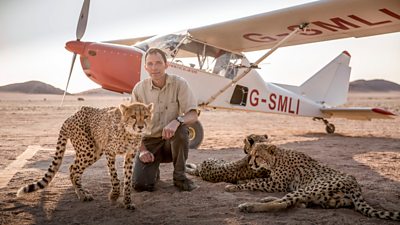
Professor Alan Wilson is fascinated by the relationship between cats and their prey. He uses high-tech collars to collect a whole host of bio-metric data from a sprinting cheetah. He’s discovered it’s not straight-line speed that’s the cheetah greatest weapon, but their ability to brake, change direction and accelerate. Cheetah are gymnasts, the speed is a by-product of their amazing agility. Alan’s data is rewriting what we understand about the fastest animal on land.
Alan uses huge amounts of technology to study cheetah, much of it developed for the mobile phone industry. His collars record data of the cheetah’s movement 300 times a second. But he had trouble keeping up with the planet's fastest land animal; his solution was to build a plane from scratch, learn to fly it, then full it to the brim with the latest technology.
Alan plans to publish the latest findings in January. They’re set to rewrite our understanding of this famous cat, using the research that went into filming for the Big Cats series.
Lion Intelligence
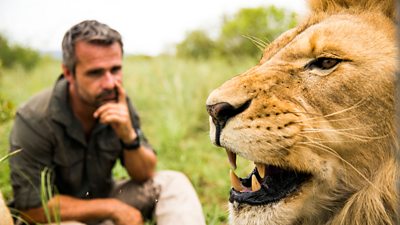
Natalia Borrego has been trying to get into the mind of lions for ten years, designing experiments to test their intelligence and behaviour. Cats are notoriously tricky to work with, so designing an IQ test for lions was going to be difficult. Her latest experiment tested whether lions can work cooperatively to solve a complex puzzle - a true sign of intelligence. Her results suggest that lions are able to hunt cooperatively making them the smartest cat.
To carry out her experiments Natalia works with lion conservationist Kevin Richardson (pictured) known as the lion whisperer. He has a unique relationship and approach to working with lions, and for decades he’s immersed himself in a pride, working directly with rescued lions.
Borneo bay cat
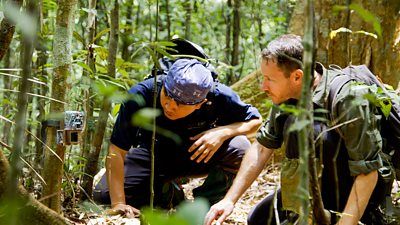
Twelve years ago Oxford University scientist Dr Andrew Hearn (pictured left) had a chance encounter with a mysterious animal.
Sitting alone, surveying a remote region of the vast tropical island of Borneo, out of nowhere an unrecognisable cat walked out in front of him. He quickly sketched what he saw, and when following up his sighting he discovered the enigmatic cat was a bay cat and that virtually nothing was known about them.
Since then Andrew has dedicated his life to finding out more. Using camera traps, an invention that has revolutionised the study of cats, he’s trying to piece together the clues of their lives. However, in all those years Andrew has managed to capture just one video and just 60 photos. The video remains just one of the only two ever recorded of a wild bay cat. It goes to show just how little we know about these animals.
For Andrew, having another encounter with a bay cat would be like winning the lottery all over again, and he’s determined to persevere. But he faces a race against time: Borneo is suffering one of the highest rates of deforestation in the world, much of it to make way for palm oil plantation. And one thing Andrew has discovered is that the bay cat will disappear once the forest has been cleared for palm oil.
Mountain lions caught on camera
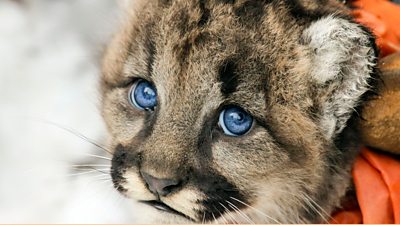
In the Teton Mountains of Wyoming, a long-term camera trap and collaring project has made some amazing new discoveries.
Mountain lions, also known as cougars and pumas, are renowned for living lonely solitary lives; but by combining GPS collar technology with remote cameras, head researcher Mark Elbroch has pieced together their complex social lives for the first time.
He often recorded mountain lions in pairs or larger groups, and to his surprise discovered that they were far more social then previously realised. Mark also discovered that they were able to recognise each other and are even more likely to share a meal with a cat that been generous with them in the past.
Mark Elbroch's latest scientific paper - Adaptive Social Strategies In A Solitary Carnivore
Iberian lynx
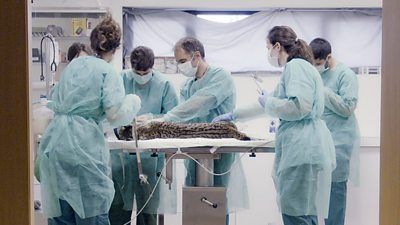
Just five years ago the Iberian Lynx was considered the rarest cat on the planet. Now, due to a pioneering captive breeding programme, the cat has bounced back. A huge amount of effort has gone into breeding and releasing these stunning cats.
In a multi-million pound facility the breeding cats are monitored around the clock using CCTV technology, so that the vets can observe them with no human contact - vital if the releases are to be successful.
The series follows two lynxes, Navio and Noa, who are scheduled for release after they pass a series of health checks.