Episode Two
Cats have conquered the planet - from the world’s oldest desert, where lions survive against the odds, to the wetlands of Asia, where fishing cats teach their kittens to hunt in water.
Published: 9 January 2018
Cats have adapted to the challenges of life in almost every environment on Earth - high in the jungle of central America, the acrobatic margay leaps through the tree-tops, on a remote pacific beach a pregnant jaguar waits for thousands of turtles to arrive, while a bobcat, blind in one eye, learns how to survive by plucking sea gulls from the air.
For the first time, advances in remote, and low-light filming technology provides new insight into the secret life of the mysterious “small cats”. In the Karoo of South Africa, we follow the nocturnal pursuits of a tiny black-footed cat as it stakes it’s claim to the title of the world’s deadliest feline. In Mongolia the rarely seen Pallas’s cat, at home with her kittens, shows off her unusual profile while hunting - with a wide head, unusually low ears, and the ability to flatten her body as she takes on the disguise of a rock. Finally, in South Africa, we uncover the secret of the serval that thrives amongst the futuristic landscape of Africa’s biggest industrial complex.
These remarkable cats live surprising lives in the most extraordinary places on the planet.
Pallas's Cat - filmed for the first time in the wild
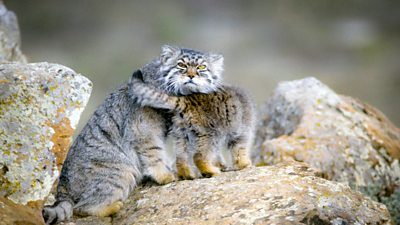
The most intimate images of this species ever filmed in the wild and an extraordinary insight into the baffling sensory world of a young cat in the wild.
Unsurprisingly, the world’s smallest cat is rarely seen, so the team paired up with conservationists in Sri Lanka to film a young male on the verge of independence in a remote rainforest reserve in Sri Lanka. Regular downpours, deep shade and a nimble cat all conspired to make this a huge challenge, but absolutely priceless images. Even armed with the knowledge that this was the smallest cat in the world… it would be a surprise just how small this little male was. His rainforest world is a baffling place, so his early explorations are full of wonder and surprise.
Ian Llewellyn, Camera operator, says: "Rusty spotted cats are a beautiful, yet elusive mammal. Filming them was incredibly challenging, both technically and logistically. As the smallest of the cat family rusty spotted cats are quick and unbelievably nimble; two factors that make them very hard to capture on film!
"Coupled with intermittent monsoon deluges, the deep shade of the rainforest canopy and lots of leeches, it made for a very interesting shoot. However with typical BBC NHU dogged determination we managed to film a sequence which I very much hope will shine at least some light on these incredible cats."
- Directed by producer Nick Easton
- Filmed by Ian Llewellyn
One of the world’s most secretive cats lives in the remote grasslands of Mongolia. A cat that few people have ever seen in the wild. Images of its human-like expressions recently catapulted it to internet stardom - but until now it has never been filmed in the wild.
Pallas’s cats resemble Bagpus: their ears are unusually low on the side of their wide heads to help them keep a low profile in the short grass, and when stalking they freeze to look like a rock. But the most peculiar covert manoeuvre that this cat adopts when hunting is one that’s been coined as ‘periscoping’. It describes how they slowly raising the top of their heads to peer from behind boulders with their high-set eyes, before slowly disappearing again.
Director Paul Williams says: "When we arrived at our remote camp we were unusually lucky - the researchers had recently filmed images of kittens on their camera traps. On the first day of filming Sue was able to film a mother with four kittens. Sadly, our luck wasn’t to last. A storm suddenly hit the camp, our dining tent and toilet were destroyed, and, even worse, the next day the cats had gone. The researchers believed that the den we had filmed them at was too exposed for the weather, and there was an eagle nesting close by (which is one of their main predators). The mother had likely moved the family to somewhere more sheltered.
"To find the cats again required weeks of searching and climbing countless hills. The tried-and-tested technique to find Pallas’s cats is to climb a hill and sit still for hours on end, scanning the landscape with binoculars for the slightest movement. It is like looking for a particular boulder in a field of boulders. There’s lots of activity among the grass, but more often than not it turns out to be a rodent.
"Eventually, we found the same family living among a rocky outcrop high on a hillside. While the mother was out hunting, Gaana (our scientific advisor) and I belly-crawled towards them in a clumsy approximation of the mother’s hunting technique. After we reached the cover of a large boulder, 75m downwind from the den, Gaana nudged me excitedly: four tiny faces were looking in our direction through cracks in the rocks."
Sue Gibson, the first camera operator to film Pallas’s cat, says: "I knew the landscapes would be vast and the skies would be big, but you don't fully appreciate that until you get there. It feels endless, otherworldly. And so to have the chance to film a cat in that environment was something I was very excited about.
"Pallas' cats haven't been filmed in the wild for television before, so to be the first camera person to do that makes it really rather special. There were many highlights on this shoot and a particular one was when I first saw all four kittens. They had come out from their rocky den and were waiting for mum to come home. She eventually arrived and they were so excited to see her they kept jumping around and falling off the rocks to try and get to her; tumbling balls of cute fluffiness!
"Then there was a lovely scene of them settling down to suckle from mum while she preened them. I was just metres away behind a stone hide feeling very lucky to be witness to such an intimate moment. TV gold! It certainly made the early mornings and late nights worth it."
IUCN status: Near Threatened
- Filmed by Sue Gibson
- Directed by Paul Williams
Swamp Tiger - elusive and never before filmed in the wild in India
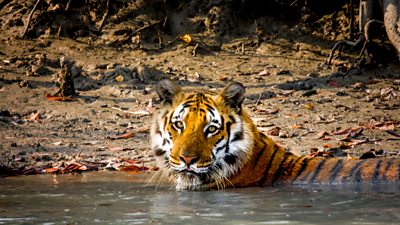
This species of tiger is found elsewhere in India, but in the Indian Sundarban they are known as the ‘swamp tiger’ and are notorious as man-eaters.
In the Sundarbans, the world's largest mangrove, cameraman Kalyan Varma and Producer Paul Williams spent 600 hours on a specially modified boat searching for the elusive and dangerous swamp tiger. One afternoon, at low tide, a large male suddenly appeared on the muddy shore. He patrolled his territory, scent-marked, and even walked into the water just a few metres in front off the boat. These tigers are infamous as man-eaters, so it was just as well that the boat had high sided secure barriers. After just 30 minutes the tiger vanished back into the mangroves.
This is the only place in the world where a big cat lives its entire life in tune with the tide, and where they are known to swim from island to island. Little is known about them, but recent camera trap surveys have revealed that there might be as many as 100 roaming these swamplands.
Producer Paul Williams says: "For four weeks the water was flat like a mirror, and would have allowed us to film smooth, steady shots, but when a Tiger finally appeared the water was unusually choppy. Kalyan [the cameraman] had to fight to try and keep the camera steady, while we held on tight to stop it from falling into the sea. To make matters worse the boat broke down, and we had to quickly swap to another to keep up with the tiger as it patrolled its shoreline.
"To film the time-lapse sequence the crew had to swim in the mangroves, and wade barefoot through thick mud. Our sandals were useless in such thick mud and I lost one pretty quickly, so we had to tread barefoot, carefully avoiding painful spikes from the mangrove roots. It was worrying when we saw snakes writhing in the mud. To complete the shot of the tides rising, we had to wait until the water was almost to the base of the camera before swimming out to retrieve our equipment - hoping that there were no tigers in the vicinity."
Camera operator Kalyan Varma says: "Filming tigers in Sunderbans was unlike any other shoot. Unlike all other tigers in the world, these are the most shy and less than a few hundred remain in this 10,000 sq km of mangroves. They have hardly ever been filmed, and attempting to do so from a boat that sways to the tides made the shoot particularly challenging. Searching for the moving stripes between the aerial roots for over 600 hours messes with your mind and imagination.
"It was a sobering fact that during the time we were searching for swamp tigers, four people were attacked and killed by them in the same area.
"After weeks of spending every daylight hour in a boat searching for the tiger it was difficult to keep motivated, always having to be on edge and ready to jump to action. Maybe there was a reason why these swamp tigers have eluded filming crews all these years. But patience eventually paid off and when the big male tiger showed up I knew everything was at stake, that I had to film whatever I could in those few moments, before he disappeared into the mangroves."
IUCN status: Endangered
- Filmed by Kalyan Varma
- Directed by Paul Williams
Black-Footed Cat - the world’s deadliest cat
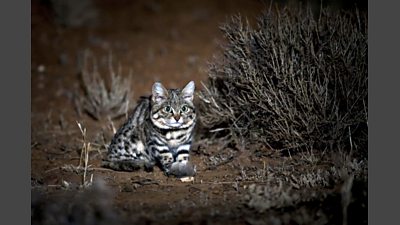
Africa’s deadliest cat is also the smallest. She waits for nightfall before heading out to hunt. Using specialist night cameras that rivals a cat’s own vision, the team joined researchers in South Africa's Karoo desert to track an individual that they have named Gyra.
Two hundred times smaller than a lion, Gyra would be almost impossible to find if it wasn’t for a radio collar that allowed the crew to follow her nocturnal pursuits. This black-footed cat has become accustomed to the scientists vehicle, but it still took hours just to get sight of her before she vanished again.
Black-footed cats walk as far as 20 miles a night in search of prey, the furthest recorded for a small cat, and anything that moves is a potential meal - from scorpions to gerbils or birds.
Over three weeks, the team built up a picture of her secretive nightlife, filming her hunting, time and time again - revealing how, with a 60 percent hit rate, black-footed cats are the most successful hunters in the entire cat family.
The reason for Gyra’s huge appetite is that she’s raising a kitten. Using remote cameras at the den site the team filmed the tender interaction between mother and excitable kitten.
Alex Sliwa, scientist, says: "This peek into the life of the black-footed cat embodies their character well. Despite their sweet exterior, due to their diminutive size, they hunt with deadly precision and tenacity. They are such charismatic little killers, particularly Gyra with her 'scary eye look'! She looks so innocent but then is such ruthless and efficient killer.
"This is a great example of collaboration, which was only possible through the perfect timing of the BBC film crew arriving in time to film the females caring for their kittens in the wild. This is no small feat, as black-footed cats are notoriously shy and mobile, and only our deep insight and long-term knowledge of them has made this possible."
Paul Williams, episode producer, says: "We had seen Gyra hunt various rodents by stealthily approach, like a domestic cat hunting in the garden, but we were very surprised the first time we saw Gyra hunt a bird. She slowly crept up behind some scrub, wiggled to get low to the ground and waited. The little spike-heeled lark continued to hop around right in front of her, seemingly not noticing the threat less than half a metre away. After a few minutes the bird got spooked and flew straight up, and much to our surprise, Gyra shot straight up after it - it took a moment to work out where she had landed."
Howard Bourne, camera operator, says: "Because the cameras we have been using are hugely sensitive, we were able to illuminate the Karoo desert landscape using tiny amounts of light and watch the black-footed cats go about their nightly behaviour undisturbed. The nocturnal world is a new frontier of wildlife filmmaking and these cameras unlock a whole new avenue of discovery."
IUCN status: Vulnerable
- Filmed by cameraman Howard Bourne
- Directed by Paul Williams
Serval
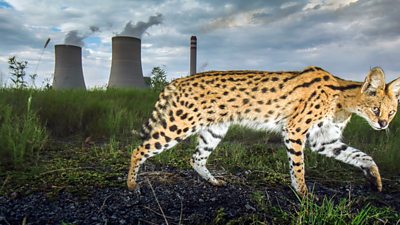
Equipped with a surveillance night vision camera and thermal scopes, the team spent several weeks filming inside the secure buffer zone that surrounds Africa's biggest industrial complex. It is home to zebra, wildebeest and ostrich. The lakes created to cool the machinery have led to an explosion of rodents - and with no big cats to worry about this wasteland has been overrun by the densest population of servals on the planet.
Using a specially modified filming vehicle the crew filmed nightly for three weeks, enduring powerful lightning storms and torrential downpours which left the ground saturated and the team stranded in the mud for hours. They were eventually rescued by a giant tractor sent out from the factories.
Paul Williams, episode producer, says: "The lightning was so intense that we could feel the hairs sticking up on our arms as it crashed around us. On one occasion we had to run and leave the cameras behind because it suddenly got too dangerous.
"Unlike the wilderness locations where we usually film this was a dystopian scene; noxious smells filled the air, clanging sounds of heavy industry echoed through the night. It felt more like the set of Blade Runner."
IUCN status: Least Concern
- Filmed by Howard Bourne
- Directed by Paul Williams
Desert Lion
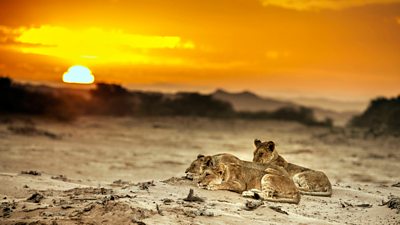
Camera operators Lianne and Will Steenkamp have spent years filming the lions of the Namib Desert in Namibia, working with scientist Dr Philip (Flip) Stander. Will and Lianne had been following one lioness raising her three cubs for three months. When she was killed in in a fight with a leopard they were able to capture the remarkable story of the young orphaned cubs surviving against all odds. These three desert lion cubs are, arguably, the youngest and most inexperienced pride in the Namib Desert.
The cubs were orphaned before their mother was able to teach them how to hunt. Fortunately, in the harsh desert, they have another way to survive. Here prey succumbs to hostile conditions, and a carcass lasts longer than it would on the plains. Lions are formidable hunters, but when times demand it they can survive by feeding on old rotting meat - unless danger comes and a bigger lion claims the meal.
Desert lions are specially adapted to a life on the dunes, with longer legs to walk over hot sand, and thicker coats to survive freezing desert nights. There are less than 200 desert lions, and they all live in the vast coastal desert of the Namib. They survive as small, dispersed prides, patrolling one of the largest territories of any cat. And with prey few and far between they will walk huge distances for a chance to hunt.
IUCN status: Vulnerable
- Filmed by Lianne and Will Steenkamp
Fishing Cat
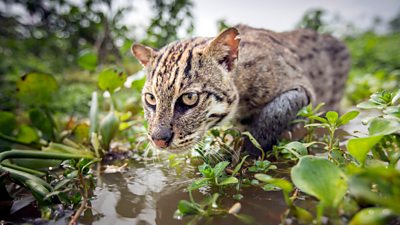
Fishing cats are adapted to hunt in water, with a short layer of watertight fur beneath an insulating outer layer. With partially webbed feet and long whiskers they can detect vibrations of fish moving beneath the surface. Every fishing cat must learn how to hunt, and for one young kitten encountering water for the first time, it’s an eye-opener.
The team heard of a unique opportunity in Bangladesh to film these unique cats. A conservation organisation in a remote part of the country had recently rescued an injured pregnant female, who was due to be released back into the wild. To help with their rehabilitation a large soft-release enclosure was established in their natural habitat, to allow the mother to fully recover and have the chance to teach her kittens to hunt.
Paul Williams, episode producer, says: "In order to keep a distance and allow the cats to behave naturally we used underwater remote cameras and dug a hole for the camera operator to sit in, to get low to the ground. This allowed us to film close-up shots of the fishing cat and her kittens as they learned to hunt for the first time in the monsoon wetlands.
"The mother stealthily tracked and pounced into the water to catch fish, while her kittens were more interested in playing with the aquatic plants.
"It was a huge privilege to see how quickly the fishing cats kittens took to the water. They seemed to have an innate ability to swim, and an excitement to play - every day they became braver and more active in the water."
IUCN status: Vulnerable
- Filmed by Sue Gibson
- Producer, Paul Williams