Episode One
They are the planet’s top predator and can enthral us like no other animal. Yet even among this remarkable family, some members stand out. Meet the world’s ultimate cats.
Published: 9 January 2018
In Ruaha, Tanzania, lions form huge 'super prides' in order to hunt giant prey. Among the cats lions are unusual, the only ones to live in groups. In numbers they find the strength and audacity to hunt even the most formidable quarry.
In Sri Lanka a tiny rusty spotted cat explores his forest home. Two hundred times smaller than a lion, the rusty spotted is the smallest of all cats, but just as curious.
The Canada lynx lives further north than any cat, relying on snowshoe hares to survive the bitterly cold winters. Until recently lynx were creatures of mystery, but now technology provides an insight into their secret lives.
Predators they may be, but cats are also tender, intelligent and emotional. Honey, an African leopard, has worn a radio collar for a decade that has allowed scientists to follow her life’s every twist and turn. Now, in the worst drought in decades, she’s battling to raise a cub.
In the Himalayas, perhaps the world’s most lonesome cat is searching for a mate. A male snow leopard may just get one chance to mate in his whole life.
Cats are naturally secretive, elusive and cryptic animals. Only now have the latest developments in filming technology, and a surge in cat research, enabled us to bring the cat superstars out of the shadows.
Combining fascinating behaviour with amazing stories, Big Cats reflects the true nature of cats - revealing how they still have the power to surprise.
Puma / Mountain Lion
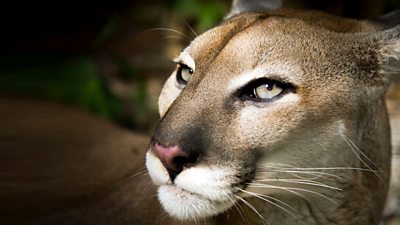
The Puma hunts penguins - and is filmed doing so for the very first time.
In a far-flung corner of Patagonia, Magellanic penguins come ashore to nest - and one of the world’s southernmost and adaptable cats survives thanks to its eye for an opportunity.
The crew, the first to attempt to film this predation, had little information to draw on and for weeks saw nothing more than tantalising glimpses of the cats.
During two shoots they battled sandstorms and a once-in-30-year flood event, before finally capturing the images of this extraordinary event for the very first time.
The moment, filmed using the latest low light technology, is also one of very few successful puma hunts ever caught on film; the director and the cameraman Santiago Cabral are two of only a tiny handful of people to have ever witnessed this behaviour.
The footage shows a puma approaching the penguin colony at dusk, before cornering and killing a penguin with a swipe and a bite to the neck.
- Directed by Nick Easton
- Filmed by Santiago Cabral, Sue Gibson, Bertie Gregory and Tom Walker
Canada Lynx - the world’s most northerly cat
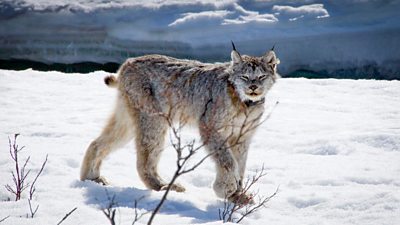
In the Yukon, Canada, the team pared the filming kit back to the bare basics and headed out on snowshoes to track down the elusive Canada lynx. The team worked closely with scientists, who were using GPS collars to study a population of lynx and their prey, but even with their technology it was a mammoth undertaking.
But, despite temperatures dropping to below -20 degrees and record-breaking snowfall, with huge physical effort the crew were eventually able to capture imitate portraits of the extraordinarily big-footed lynx and its unique relationship with its primary prey - snowshoe hares.
Sara Douglas, Director, says: “This was the toughest shoot either myself or cameraman Mark MacEwen had ever done. When I put on the 30kg pack full of camera gear and supplies (which was just the bare basics!), strapped on my snowshoes and took my first laboured steps through the thigh high snow I knew it was going to be a long month!
"We were working closely with a team of researchers who were studying the lynx and snowshoe hare in the area. These lynx were fitted with collars by scientists, so we were able track them through the forest - not that straightforward with our inexperienced, and therefore cumbersome snowshoe technique and dense woodland to trudge through! After a week we were starting to master it though, and had also had a few glimpses of the lynx we were following. He was starting to get used to us and trust us - a really promising start!
Two weeks into filming, we received a crushing blow. For the animal’s safety the collars are designed to fall off in the event that they get snagged on something - and our collar had fallen off. After seeing our chances of filming a lynx in action disappear, we decided to film the snowshoe hares and the beautiful scenery of the Yukon - useful footage for our sequence, but useless without capturing the Canada lynx in action!
"But we still had some luck in the tank. The research team collared another lynx as part of their studies, a big, confident male, who luckily for us was pretty relaxed around people. Fantastic news! However, we were dealt another blow... we were then scuppered by one of the biggest snowstorms the area had ever encountered – two foot of snow fell in two hours! Filming, or even finding, the lynx was now, very suddenly out of the question.
"Weeks later when the weather had improved, we didn’t have long left to catch up with Kronk. We drafted in the local expertise of Canadian cameraman Hugo Kitching and got straight back to work. A combination of A LOT of hard work, overcoming the crazy weather, countless cups of hot tea and advice courtesy of the research team, and sheer determination finally got us the sequence we had dreamt of since the start.
Despite the struggle, it was pleasure just to be in such a remote winter wonderland, especially hearing wolves calling in the distance. It’s amazing that any living thing was out and about in those woods when it was minus 30 degrees! And when you finally get a glimpse, it’s impossible not to love a lynx’s big feet and the way they seem to float across the top of the snow - a cat so perfectly adapted to its environment.”
- Directed by Sara Douglas
- Filmed by Mark MacEwen and Hugo Kitching
Rusty-spotted cat - the world’s smallest cat
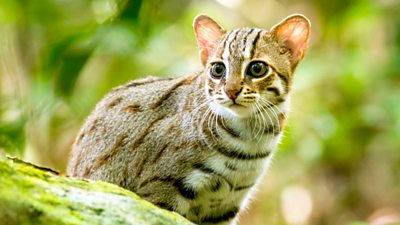
The most intimate images of this species ever filmed in the wild and an extraordinary insight into the baffling sensory world of a young cat in the wild.
Unsurprisingly, the world’s smallest cat is rarely seen, so the team paired up with conservationists in Sri Lanka to film a young male on the verge of independence in a remote rainforest reserve in Sri Lanka. Regular downpours, deep shade and a nimble cat all conspired to make this a huge challenge, but absolutely priceless images. Even armed with the knowledge that this was the smallest cat in the world… it would be a surprise just how small this little male was. His rainforest world is a baffling place, so his early explorations are full of wonder and surprise.
Ian Llewellyn, Camera operator, says: "Rusty spotted cats are a beautiful, yet elusive mammal. Filming them was incredibly challenging, both technically and logistically. As the smallest of the cat family rusty spotted cats are quick and unbelievably nimble; two factors that make them very hard to capture on film!
"Coupled with intermittent monsoon deluges, the deep shade of the rainforest canopy and lots of leeches, it made for a very interesting shoot. However with typical BBC NHU dogged determination we managed to film a sequence which I very much hope will shine at least some light on these incredible cats."
- Directed by producer Nick Easton
- Filmed by Ian Llewellyn
Cheetah - the world's fastest cat
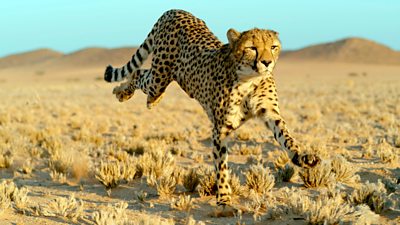
...and the fastest animal on land.
Here, the cheetahs are filmed on the run, using the closest tracking shots ever. The crew hacked a remote-controlled filming buggy, mounted it with a super slow motion camera to film alongside a sprinting cheetah. The close-up footage captures the intricacies of their movement in exquisite slow motion, like never before.
At 30 times slower than real time, it reveals that for a cheetah, speed is just the beginning. In fact, it’s their ability to rapidly change direction, braking and turning under immense forces, that gives them the edge.
Nick Easton, Director, says: "It was clear from the off that these cats loved a chase, and they relished the chance to chase something new. Predicting when and where they would run would prove to be more difficult. It took days of graft, but the plan did eventually come together. Of course, the cheetahs were more than a match for the buggy, which after just a few days as lure and camera man, looked like it had been roving on Mars for decades.
"Watching the shots back at the end of each day we knew these were special images that revealed a new side to a very special animal."
- Directed by producer Nick Easton
- Filmed by Rob Drewett, Andy Nancollis and Sue Gibson
Snow Leopard - the world's highest cat
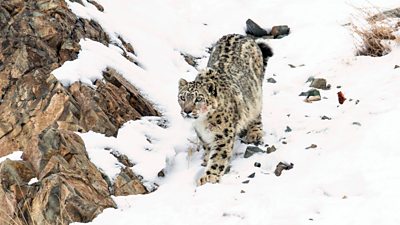
It took months of planning, days of travelling and weeks of trekking to capture just one shot of the elusive snow leopard. What followed was a monumental effort at over 4,000m to film an old male’s last-gasp search for a mate. His task would be nigh-impossible if it wasn’t for this cat’s knack for long distance romance.
The remote and very high location - the crew's base was the highest village in the world - took five days to drive to, and then the crew needed to acclimatise to the altitude.
Anna Place, director, says: "Everything about the snow leopard shoot was daunting. Getting to the location was terrifying, hiking day after day at such altitude was gruelling, and on top of that we were attempting to film a near-mythical cat, only seen by a handful of people!
"But just seeing the snow leopard for the first time - the cat turning to look directly at us - was heart-stopping and hugely emotional. It was the most incredible experience of my entire life."
Hector Skevington-Postles, camera operator, says: "After the initial shock of seeing a tiny rock-coloured, rock-shaped cat, almost a kilometer away down in the valley, the reality of actually being able to get a meaningful shot suddenly sunk in.
"Definitely a low point was having only a long-drop toilet, that also doubled as some sort of stable, at -15C. Not fun in the middle of the night on a diet of only curry.
"It was incredible, the first time seeing one of these cats. Compounded by the fact that I had spent a month in the same location on a previous shoot and seen nothing!"
- Directed by Anna Place
- Filmed by Hector Skevington-Postles
Leopard: Africa’s most elusive big cat
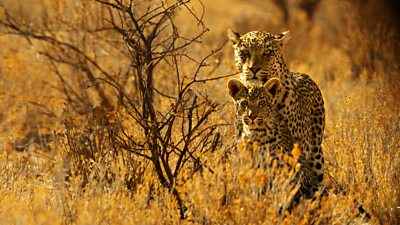
Leopards are remarkably elusive animals. Just seeing one is a challenge - following them is harder, and filming behaviour can seem impossible.
The subject of our film is Honey, a 10 year-old female leopard in Namibia who has been followed by researchers for her entire adult life. A radio collar allows researchers to track her down and over time, and with a careful approach she has become accustomed to vehicles and ignores them entirely. So you might think that filming this leopard would be easy… nope!
Cameraman Tom Walker says: "Spending over 150 hours with an individual leopard was an amazing experience, and for her to trust us enough to be so close to her young cub was a real privilege. The way that leopards can blend into their surroundings in an instant is an incredible thing to witness; they can go from a comatose state of sleep to a hunt in the blink of an eye and it definitely keeps you on your toes. The moment you started to doze, she would get up, disappear behind a bush - and seemingly vanish into thin air."
The film joins Honey during hard times, as the worst drought in decades grips her Kalahari home and she tries to raise a cub, whose chances of survival are less than 50:50. Mother leopards face a difficult choice every day. Childcare means making the choice between protection and provision - stay and protect your young cub, or leave to find food.
In the months that followed the shoot Honey successfully raised her young cub, who grew into a healthy adult. This is only the second cub, in 10 years, that Honey has managed to in raise to adulthood. But of course, she’ll be back to try again.
- Director: Sara Douglas
- Camera: Tom Walker