Sue Johnston is Ivy-Rae Regan
Sue Johnston takes on one of the boldest and most exciting characters she has ever played.
Published: 23 July 2018
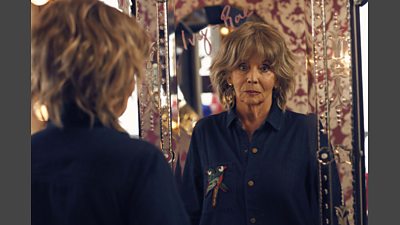
Whilst there is great drama on television at the moment, this drama stands alone and is completely different to anything else you might see
Sue Johnston takes on one of the boldest characters she has ever played.
"It was an adventure playing Ivy-Rae because she is completely different to the role I am usually cast as. Debbie Horsfield doesn’t bow down to age when it comes to Ivy-Rae; she goes dancing, she works and she runs around with men young enough to be her sons. She is brutally honest with those around her and if you don’t like it, that is tough. She doesn’t give a toss about what people think about her and there is a freedom in that. She also has this very upfront sex life, which you don’t see very often on television with women of my age. Most people are pretending it doesn’t happen but Ivy-Rae is very open about it. She is a dynamo."
Sue talks about the interesting relationship her character has with her on-screen husband, Chizzler, played by Struan Rodger:
"Her husband introduced swinging into their relationship and Ivy-Rae went along with it but it soon all went wrong. He is now in a wheelchair and so is no longer very active, but Ivy-Rae continues to be very active. She loves to dance and the men with whom she has these dalliances with are mostly her dance partners, who she is most likely just using for their fast cars and dance experience. She does have a fling with a Brazilian Northern soul dancer in the series. He is ‘Mr Smooth’. The actor who played him, Richard (Calkin), is a professional dancer and so could really dance which was great."
Sue tells us about the Northern Soul dancing she had to learn for the drama:
"It was much harder than I thought it would be, it is very energetic. We all worked with a choreographer and I totally loved doing all of that. I thought it must be what Strictly Come Dancing is like! It was fabulous. When we filmed the dance scenes, we did it in this wonderful ballroom, which was filled with professional Northern soul dancers all dressed in that style, including my character. As soon as the music started they were off - it was fantastic and the routines they have put together are incredible. There were men doing cartwheels and back flips and all sorts, it’s very physical. We are always full of admiration for other people’s talents and just watching these dancers work really blew my mind."
Other than dancing with attractive, young men, Sue tells us what is in store throughout the series for her character:
"Ivy-Rae gets heavily involved in the carryings-on of her daughters. She spots what is happening early on, she has an instinct for it, most likely because she has been there herself. You see her out and about on her Vespa scooter going around looking like the female Liam Gallagher, secretly spying on her kids. When she sees her daughters in pain, she wants to solve their problems for them. It brings out a side of her you don’t see very often, she becomes sympathetic and briefly supportive.
"I have always played very maternal women and Ivy-Rae is completely different. I found it very difficult in some ways that she is not maternal, she has these four daughters and yet she is sort of ambivalent towards them, she’s more interested in her own life than any of theirs. You would not think, if you came into the room when she was with her daughters, that she was their mother and not because she looks like their age, she doesn’t, but because they don’t treat her with much respect. She has obviously been a disappointing mother.
"They call her Razor because that is how she is, she’s sharp and tough. She is very straight with them and is very well aware of their shortcomings and is not frightened of telling them. Other than Heidi (Vicki Myers), who is the loveliest of all her daughters, they each have a slight edge of Ivy-Rae in them, of toughness, particularly, Leanne (Kelly Harrison). But it doesn’t mean she admires Leanne, she just understands her and where she is coming from."
Sue tells us how it feels to be in a female-lead drama with so many exciting and diverse roles for women:
"To be part of a drama that is over-weighted with women is fantastic. Other than Pride And Prejudice, you don’t often see a woman with four daughters on screen, but this drama centres around four very strong, interesting women and each of them get their moment. The women in this series are great characters, especially the youngest female character in the show, Disney (Isabella Gill), who desperately follows her grandma around looking for affection but gets none at all."
Whilst the drama boasts a number of exciting female roles, Sue also enjoyed working alongside her male cast members, James Murray and Robson Green.
"Anything with Robson in it is an absolute delight to film because he is so funny. When we did a big dance number I had to film a sequence with Robson and Jim and it was hilarious, I don’t know how we ever got through it because we couldn’t stop laughing. The dancing itself was great fun but Robson is specifically a joy to be on set with because he makes you laugh so much."
Sue tells us why she is excited for audiences to watch Age Before Beauty:
"Whilst there is great drama on television at the moment, this drama stands alone and is completely different to anything else you might see. The sets alone are extraordinary, so visually it is exciting and then on top of that there is all of the wonderful singing and dancing and it will be fun to see how people react to us all bursting into song. It is fun and dramatic and really does have a bit of everything in it. It is beautifully written and a very well put together production."
A Foreword by Debbie Horsfield
"In 2001 I worked with Laura Mackie and Sally Haynes on a series called Cutting It, which was set in the world of hairdressing. Fifteen years on, Laura, Sally and I were discussing what had changed in the world of makeovers and personal grooming, and we agreed that women - and increasingly, men - had become much more obsessed with looking youthful. The anti-ageing side of the beauty industry had exploded in those intervening years so we thought it would be interesting to explore the impact on three generations of one family by using it as the backdrop to our saga.
Age Before Beauty explores the expectations we have, and the 'rules' we create about what people are 'allowed' to do at any given age. It was inspired by a feature I read about what women were and weren’t 'allowed' to wear, according to their age and shape! [No bikinis after 35. No long hair over 40. No mini-skirts after 25. No leather trousers ever unless you’re 6ft tall and a size 8!] It made me wonder what other rules are there out there, which people feel they have to abide by? Especially in a world of selfies and social media where so many people are keen to pass judgement and so many people feel they have much to live up to.
So Age Before Beauty became less about specific anti-ageing beauty treatments and much more about characters deciding to confound age-related expectations - for better or worse - at whatever age they fancied! I say for better or worse because one of the things we explore is the midlife crisis. We ask the question: Is it automatically better to be young? Does age always envy youth? Is beauty always the thing to aim for? Or does youth and beauty ever have anything to learn from age and maturity?
We’re looking at three generations of one family and exploring how they deal with the demands of youth, age and everything in between. And how they confound expectations. So for instance, the worst-behaved generation is actually the oldest and the most sexualised and overdressed is actually a nine year-old!
Family has always played a large role in my work and I enjoy exploring the dynamics between siblings and different generations. In Age Before Beauty we have three generations, aged from nine to late 60s, and we’ve been fortunate enough to assemble an extraordinary cast. The drama is set in my home town of Manchester. Obviously I’m biased but I feel there are particular qualities about the city (its vibrant multiculturalism and ever-changing faces) and its inhabitants (their resilience, irreverence, inventiveness, humour) - which make for particularly entertaining drama.
It’s been fun to return to the world of contemporary Manchester after being immersed in 18th century Cornwall for the past few years, but in truth I’ve loved both worlds and would happily return to either and both!"