Professor Margaret MacMillan to go on tour recording BBC Radio 4’s Reith Lectures in June
Professor Margaret MacMillan will go on tour recording her Reith Lectures - entitled The Mark of Cain - this June, beginning in London and concluding in Canada.
Published: 19 April 2018
The Reith Lectures embody all that is best about the BBC - bringing the brightest ideas from the greatest minds to the largest audiences all around the world
The five lectures exploring the tangled history of war and society and our complicated feelings towards it and towards those who fight, will broadcast on Radio 4 and the World Service weekly from Tuesday 26 June at 9am.
Professor MacMillan’s first lecture will be recorded in London at the BBC’s Radio Theatre on Monday 4 June, she will then go on to the University of York [7 June], The Sursock Museum, Beirut [20 June], Stormont, Belfast [22 June] and will deliver her final lecture at The Canadian War Museum, Ottawa, Canada on Wednesday 27 June.
The lectures will be delivered to an audience at each venue. This year’s lectures will be presented by journalist and broadcaster, Anita Anand, after Sue Lawley announced last month that she would be stepping down as presenter and chair of the lectures after 17 years.
Anita Anand says: “It is a great honour to be stepping into Sue’s shoes. The Reith Lectures embody all that is best about the BBC - bringing the brightest ideas from the greatest minds to the largest audiences all around the world. I can’t wait to get started. I know I will learn a lot.“
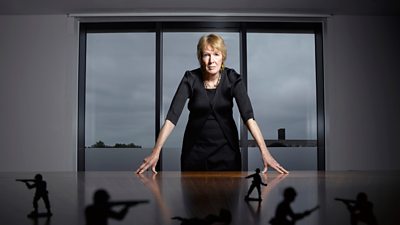
Across her five lectures Professor Margaret MacMillan will address the theme of war and humanity. She will ask why groups, whether nations or religions or gangs, get into wars and why individual men and women fight.
She will also explore the ways in which changes in society have affected the nature of war and how in turn wars have brought great change, for better and worse, to the societies that fight them. Economies, science, technology, medicine, have all been instrumental in war but have also been shaped by it. We might never have had penicillin or radar or rockets when we did without the impetus of war. Women, who have so often been the objects of violence in war, have seen their position in some societies change for the better as the need for their involvement has grown.
Finally she will examine how we think and feel about war. Writers, artists, film-makers, playwrights, composers, have taken war as their theme, whether to condemn, exalt or simply puzzle about it.
Gwyneth Williams, Controller of BBC Radio 4 says: “I can promise our audience a notable Reith 2018 series from the eminent historian Professor Margaret MacMillan as she considers the idea of war, a topic that has fascinated her since she was a young woman. I am delighted now to welcome Anita as our new presenter. I am confident that the Reiths will be in safe hands with Anita in the chair. She brings intelligence, wit and experience to this most significant part of Radio 4’s calendar and I look forward to working with her this year.”
Audiences can apply for tickets via BBC Shows and Tours, the details will be available on the Radio 4 website.
SW
Anita Anand
Anita Anand presents BBC Radio 4’s Any Answers - the live political discussion phone-in on Saturdays. She has also guest presented Beyond Westminster, the Westminster Hour, Woman’s Hour and Saturday Live. On Radio 5 Live, she has presented Drive, The Anita Anand show and Double Take. Anita’s television credits include Newsnight and the Daily Politics on BBC Two and The Sunday Politics and Heaven and Earth show on BBC One.
Her book Sophia – Princess, Suffragette Revolutionary was published in 2015 and Koh-I-Noor - the story of the world’s most infamous diamond, which she co-authored, was published last year. She has a book on empire and the impact of the Jallianwallah Bagh massacre coming out in 2019.
Reith Lectures
The Reith Lectures were inaugurated 70 years ago in 1948 by the BBC to mark the historic contribution made to public service broadcasting by Sir John (later Lord) Reith, the corporation's first director-general. John Reith maintained that broadcasting should be a public service which enriches the intellectual and cultural life of the nation. It is in this spirit that the BBC each year invites a leading figure to deliver a series of lectures on radio. The aim is to advance public understanding and debate about significant issues of contemporary interest.
The very first Reith lecturer was the philosopher, Bertrand Russell who spoke on Authority and the Individual. Among his successors were Arnold Toynbee (The World and the West, 1952), Robert Oppenheimer (Science and the Common Understanding, 1953) and J.K. Galbraith (The New Industrial State, 1966).
The Reith lectures have also been delivered by the Chief Rabbi, Dr Jonathan Sacks (The Persistence of Faith, 1990), Dr Steve Jones (The Language of the Genes, 1991), Michael Sandal (A New Citizenship, 2009), Martin Rees (Scientific Horizons, 2010) and Aung San Suu Kyi and Eliza Manningham-Buller (Securing Freedom, 2011). Most recently the Reith Lecturers have been Niall Ferguson (The Rule of Law and Its Enemies, 2012), Grayson Perry (Playing to the Gallery, 2013), Dr. Atul Gawande (The Future of Medicine, 2015), Stephen Hawking (Black Holes, 2016), Kwame Anthony Appiah (Mistaken Identities, 2016) and Hilary Mantel (Resurrection: The Art And Craft, 2017).
The Reith Archive is available at bbc.co.uk/radio4/reith and also includes the five-part series, Reith Revisited, broadcast earlier this year in which Sarah Montague and guests consider how some of the earliest BBC Reith Lectures look from the perspective of 2017. The ideas and individuals explored in the series included Michael Sandel, who examines Bertrand Russell’s inaugural 1948 Reith Lecture series on Authority And The Individual; Grayson Perry who revisits Nikolaus Pevsner’s The Englishness Of English Art; Brian Cox who explores the lectures on Science And The Common Understanding delivered by Robert Oppenheimer, the scientist known as the father of the atomic bomb; Professor Anand Menon on Robert Birley’s lectures on Britain In Europe; and Professor Angela Stent on George Kennan’s lectures on Russia, The Atom And The West.