BBC unveils Diversity Code of Practice
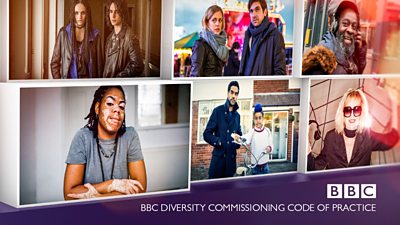
The BBC has today published its first Diversity Code of Practice, as part of its commitment to increase diversity on and off air to reflect and represent today’s UK.
Published: 28 March 2018
Every BBC commissioner and every producer has an important part to play in allowing us to continue to make progress in this area and reach our 2020 targets. It’s a priority everyone must share and take seriously.
The new Code of Practice puts diversity at the heart of the BBC’s commissioning processes across TV, Radio and our Online and Digital content. It standardises the approach to be taken across all output for the first time.
Building on existing guidance the Code sets out the BBC’s commitments on diversity within commissioning; it embeds them into the commissioning process and reporting frameworks, so action on diversity is agreed and progress checked.
These include:
- Continuing to ingrain diversity into everyday discussions around all of its commissions at the beginning of the creative process;
- agreeing the detail of what each production will do to increase diversity, on-air and off-air, before the commission gets the go ahead; and
- checking back, when productions deliver, on whether diversity agreements were met.
Additionally, the BBC is using the Code to insist that all productions follow its lead by banning all unpaid internships, in order to further open up the industry to people from all backgrounds. On larger productions at least one paid training and development placement on to a participant or alumni from an approved industry scheme must also be provided.
The BBC’s Head of Diversity, Inclusion and Succession, Tunde Ogungbesan, says: “Diversity is one of the BBC’s biggest priorities. Every BBC commissioner and every producer has an important part to play in allowing us to continue to make progress in this area and reach our 2020 targets. It’s a priority everyone must share and take seriously."
The BBC’s diversity and inclusion strategy published in 2016 set stretching targets for the make-up of our workforce and on air roles by 2020 and the corporation is making good progress towards meeting them.
The Diversity Code of Practice widens the scope of characteristics that the BBC and providers must report on to: age, disability, gender, gender reassignment, geographic portrayal, race, religion and belief, sexual orientation and socio-economic background.
The Code, approved by Ofcom, applies to commissioners, in-house production and external providers including BBC Studios. It builds on commissioning guidelines on diversity which were introduced for TV and Radio, in 2016 and 2017, which introduced early conversations about diversity as an essential element of the commissioning process.
The BBC will report on progress annually alongside its Annual Report, with the first report published in Summer 2019.
Purpose of this Code of Practice
On 13 October 2017 Ofcom issued an Operating Licence for the BBC containing regulatory conditions it considered appropriate for requiring the BBC to fulfil its Mission and promote the Public Purposes, including the fourth Public Purpose covering diversity. Ofcom included a specific regulatory condition for the BBC to establish and comply with a Code of Practice, approved by Ofcom, setting out the steps the BBC will take when commissioning content across all genres to ensure that it accurately represents, authentically portrays and reflects the diverse communities of the whole of the UK. This Code of Practice is the latest development in a suite of guidance that sets out the commitments we’ve made, the values we want to inspire in, and the support we will offer industry to deliver against our mission.
The Code covers all BBC commissioning whether that is of content produced by in-house teams who are part of the BBC Public Service, those working for the BBC’s commercial subsidiary (i.e. BBC Studios) or independent production companies. It applies to the commissioning of content across BBC Network and Non-Network TV, Radio and its Online and Digital content services in the UK. Where the Code refers to the ‘BBC’ it refers to BBC commissioners.
BBC Press Office
