BBC Radio 2 Breakfast Show’s 500 Words winners are revealed at Hampton Court Palace
The six winners of this year’s BBC Radio 2 Chris Evans’ Breakfast Show 500 Words competition were announced today in a special broadcast live from Hampton Court Palace Festival attended by The Duchess of Cornwall.
Published: 8 June 2018
The stories really are incredible and a joy to read - every single child that entered should feel massively proud of themselves.
Now in its eighth year, the competition received a record 134,790 entries from children aged between five and 13 from all over the UK, who composed an original work of fiction using no more than 500 words.
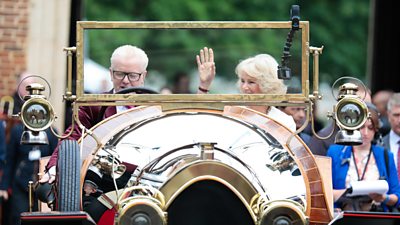
Honorary Judge, HRH The Duchess of Cornwall, arrived aboard Chitty Chitty Bang Bang and once all the winners were announced delivered a speech to the audience of over 3000 people at Hampton Court. The Bronze, Silver and Gold winning stories across the two age categories (5-9 years and 10-13 years) were revealed and read out on-air by celebrity narrators Dara O’Briain, Amanda Abbington, Jason Isaacs, Shobna Gulati, Jim Broadbent and David Walliams. Plus there was fantastic live music from John Newman, Alexandra Burke and Bastille. The Top 50 finalists, plus 3,000 of this year’s entrants and volunteer judges were in the audience to enjoy the show.
For this year’s prize, all six winners will have the opportunity to go for a ride in Chitty Chitty Bang Bang at Hampton Court Palace. They will be driven down to the river where they will board HM The Queen’s rowbarge, Gloriana, and be treated to Tea on the Thames which will include a beautiful book themed cake made by 2016’s Great British Bake Off winner, Candice Brown.
For a third year, HRH The Duchess of Cornwall joined the competition’s judging panel - award-winning and best-selling authors Malorie Blackman, Charlie Higson, Frank Cottrell-Boyce and Francesca Simon - as an Honorary Judge. Between them, they had the difficult task of choosing the six winners from the Top 50 stories which were shortlisted by 5,000 volunteer judges and The Reading Agency.
Chris Evans says: “Once again I’m absolutely astounded by the quality of the writing and the scope of these young authors’ imaginations. The stories really are incredible and a joy to read - every single child that entered should feel massively proud of themselves. Keep those pens poised for next year!”
Lewis Carnie, Head of BBC Radio 2, says: “500 Words is a huge annual highlight for the station and such a source of pride for BBC Radio 2. The competition goes from strength to strength and I’m thrilled that a record number of children were inspired to get creative and enter this year. Congratulations to the talented young winners, the Top 50 and all those who took part; and a huge thank you to everyone that has worked so hard behind the scenes, including the volunteer teachers and librarians who help to read through the 1000s of entries - without you, 500 Words would not be possible.”
HD2
The winners are:
Age 5-9 category
Gold
The Poo Fairy by Evan Boxall. Read by David Walliams.
Frank Cottrell Boyce says: “A brilliantly silly concept - the Poo Fairy - that was rigorously thought-through, full of great jokes but coming to a thoughtful, insightful conclusion. A really mature and accomplished piece of storytelling.”
Silver
The Little Messenger by Fionn McCann. Read by Jim Broadbent.
Charlie Higson says: “This touching story has the feel of the folk tale about it. It shows that kids aren't afraid to confront some quite serious topics.”
Bronze
Agent Ramsbottom and the Mysterious Fish and Chips by Francesca Wade. Read by Dara O’Briain.
Francesca Simon says: “What an incredibly wacky and wonderful world created!”
Age 10-13 category
Gold
Dancing on the Streets by Sadhbh Inman. Read by Shobna Gulati.
Frank Cottrell Boyce says: “We can’t begin to praise this story enough. It was elegant, moving, sad and sweet. The character of the undefeated little girl will stay with us for a long, long time.
Silver
A God Vacancy by Aoife Maddock. Read by Amanda Abbington.
Francesca Simon says: “Thought-provoking, playful and entertaining, and I thoroughly enjoyed the broader message too.”
Bronze
AI by Arthur Edmonds. Read by Jason Isaacs.
Malorie Blackman says: “Dark and intriguing, I was drawn in from the start!”
About 500 Words
The 500 Words competition was created by Chris Evans for his Radio 2 Breakfast Show - which has an audience of 9.12 million listeners per week - and first launched in 2011. Children aged 5-13 from around the UK are asked to compose an original work of fiction using no more than 500 words. The competition promotes literacy among children, encouraging them to explore their creativity through writing and reading. It provides them with a wealth of tips from published writers and other resources to support their learning.
Each and every one of this year’s entries was read by a fantastic team of 5,000 volunteer teachers and librarians from around the UK, before being whittled down to the Top 50 finalists by The Reading Agency. The 500 Words’ panel of judges then had the gruelling task of selecting three winners in each of the two age categories (5-9 and 10-13 years) from these groups of talented young writers.
Past guest narrators who have read out winning stories at the final have included Julie Walters, Tom Hiddleston, Jenny Agutter, David Suchet, Benedict Cumberbatch and Paloma Faith. Previous finals have been held at Hay Festival, St James’s Palace, Shakespeare’s Globe and the Tower of London.
Following the Oxford University Press (OUP) analysis of the entries for the 2018 500 Words competition, there was a wealth of fascinating insights into UK children’s use of language. OUP selected ‘plastic’ as the Children’s Word of the Year because of its significant increase in usage (a total rise of over 100% on 2017), the awareness and passion children demonstrated for environmental issues, and the creative solutions children invented in their stories. It demonstrated the huge impact the final episode of David Attenborough's Blue Planet II (screened on BBC One in December 2017) had on the nation’s children. The report also revealed that in 2018 the ocean, Emmeline Pankhurst, Donald Trump, Brexit, Korea, Grenfell Tower, unicorns, slime and computer game Fortnite as some of the people and subjects that influence British children’s creativity and use of language.